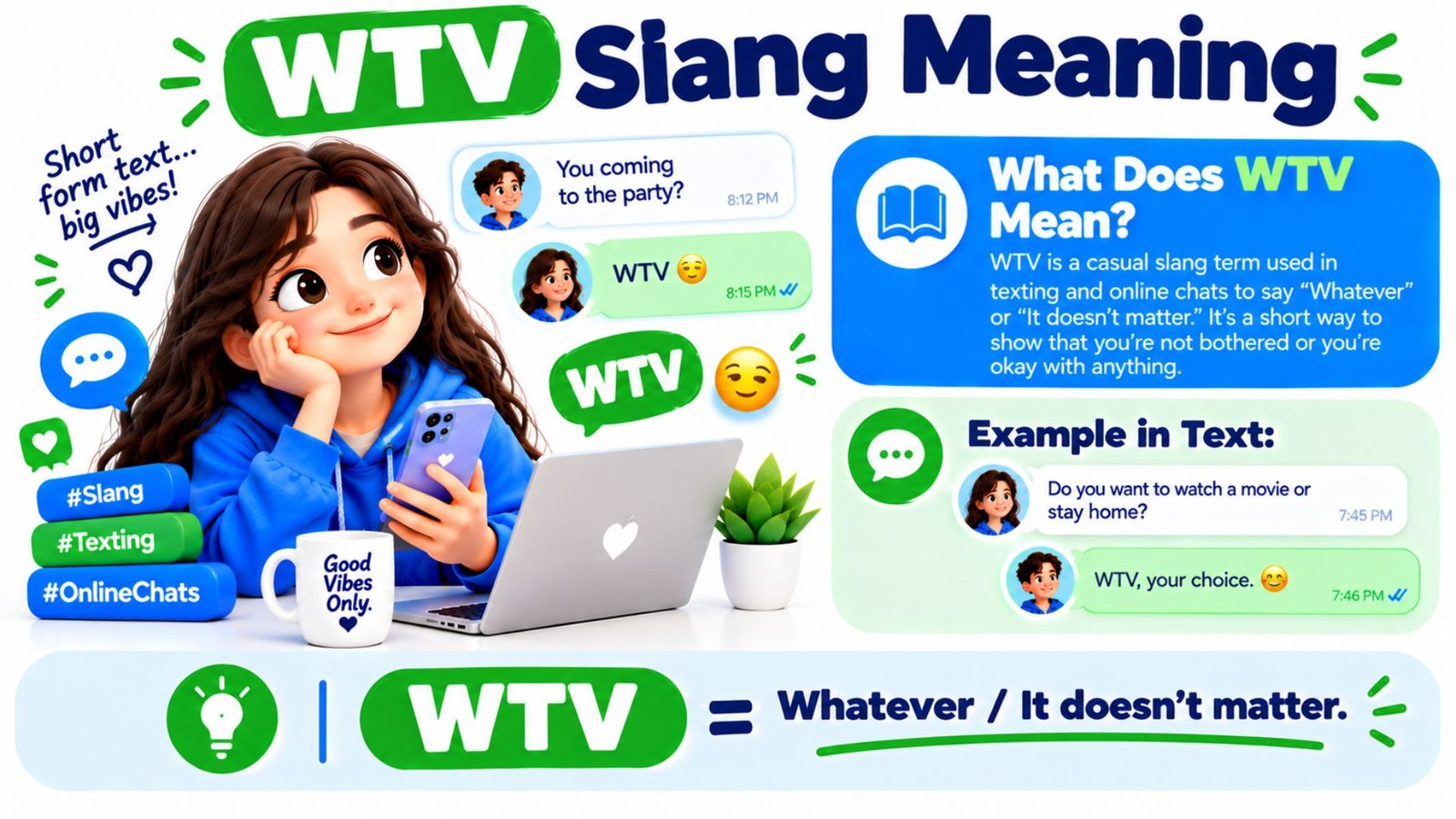
You’re scrolling through a group chat, and someone drops one lonely word: “wtv.” No emoji, no explanation. Is your friend relaxed or quietly annoyed? The wtv slang meaning looks simple, yet the tone can flip from friendly to cold in a single reply.
This guide breaks down the wtv slang meaning, the tone behind it, and how to reply. If you’ve ever asked what does wtv mean in slang, you’ll find clear answers, real chat examples, and simple tips for every platform. Whether you saw it in a DM, a TikTok comment, or a gaming lobby, you’ll know exactly what it says. Keep reading.
Quick Answer Box
WTV is short for “whatever.” In texts, chats, and comments, people use it to show they’re flexible, indifferent, or done with a topic. The meaning depends on tone: “wtv, you pick” sounds relaxed, while “wtv.” after an argument usually signals annoyance or a dismissive mood.
Meaning Summary Box
- Meaning: whatever
- Tone: neutral, dismissive, annoyed, sarcastic, or accepting
- Where it is used: texts, DMs, comments, gaming chats
- Positive or negative: neither by itself; the context decides
What Does WTV Mean in Slang?
You get one reply, just “wtv,” and suddenly you’re rereading the whole chat. Let’s settle the wtv slang meaning quickly, so you can finally stop overthinking one tiny little word.
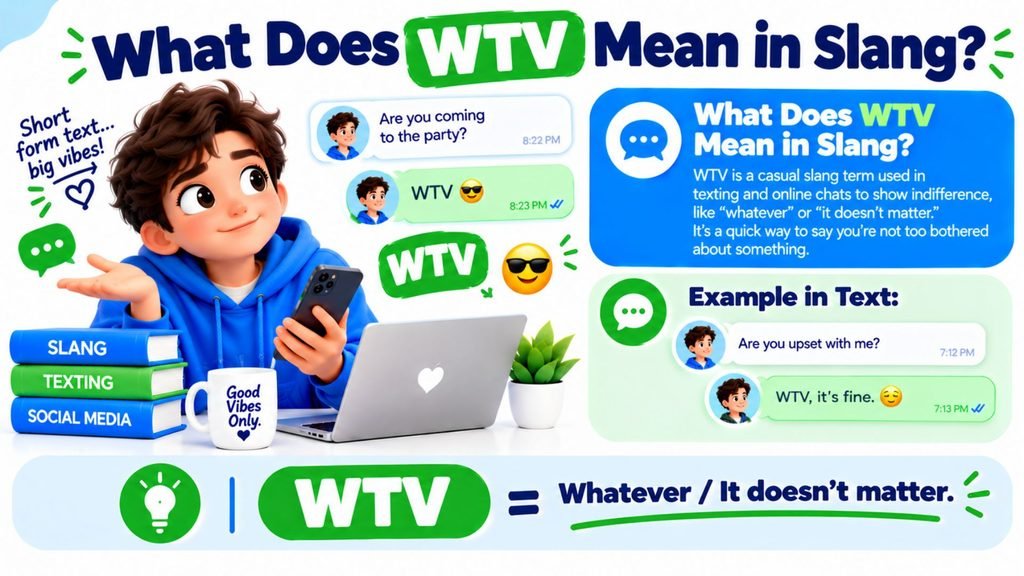
In slang, WTV means “whatever.” It is a fast, lowercase shortcut people use when they don’t mind the outcome, want to drop a topic, or feel a little annoyed. The word carries almost no feeling on its own. Tone, punctuation, emojis, and the earlier messages in the chat decide whether it sounds chill or cold.
- Whatever: the full form; WTV just removes the vowels.
- Indifference: signals “I don’t mind” or “I don’t care.”
- Flexibility: works as “anything is fine” when picking plans.
- Dismissal: can end an argument or shut down a topic.
- Tone: punctuation and emojis change the feeling a lot.
Example in chat:
Friend 1: Sushi or burgers tonight?
Friend 2: wtv, you pick.
wtv meaning slang
Short on time and just need the wtv meaning slang in one glance? Here’s a quick box you can screenshot, save, or send to that confusing friend in the chat.
| Detail | Answer |
|---|---|
| Term | WTV |
| Full form | Whatever |
| Core meaning | “I don’t mind,” “I don’t care,” or “let’s drop it” |
| Tone | Neutral to dismissive |
| Used in | Texts, DMs, comments, gaming chats |
| Formality | Informal only |
what does wtv mean from a girl
Wondering what does wtv mean from a girl, especially after a long chat or a small argument? Good news: the answer depends on tone and context, not on anyone’s gender.
WTV has no special meaning when a girl sends it. It still means “whatever,” so the same clues apply: how fast she replied, whether she used emojis, and what happened just before. A warm “wtv, I’m good with anything” is easygoing. A short “wtv.” after a disagreement usually means she’s frustrated or wants space.
Example in chat:
Friend 1: Should we go to your cousin’s party or stay in?
Friend 2: wtv, I’m good either way 😊
wtv meaning
Sometimes you only need the plain wtv meaning, no long history and no extra drama. Here it is in simple words, with the one small detail most people often miss.
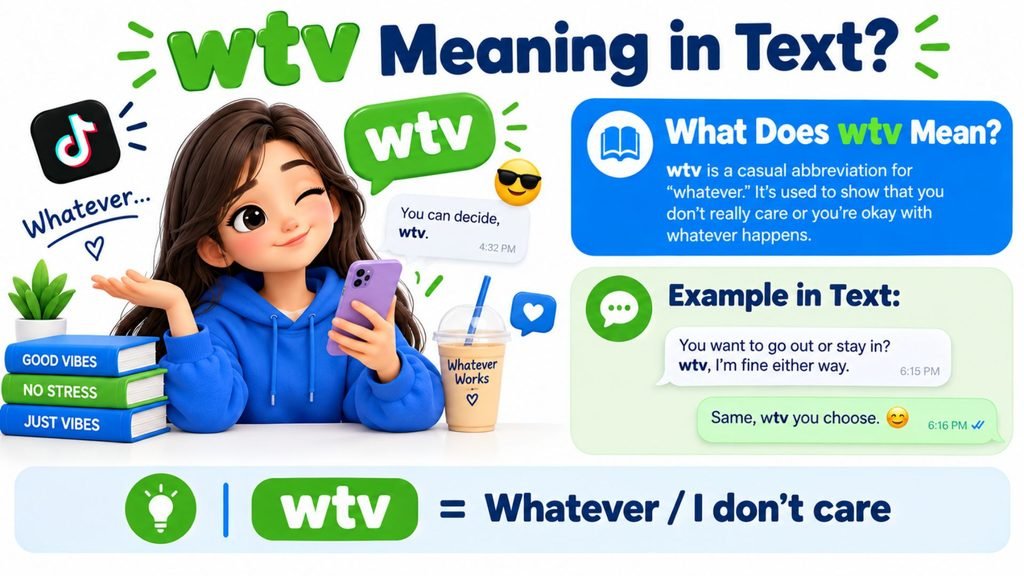
WTV means “whatever.” That is the whole literal meaning. The detail people miss is that WTV works like a tone marker. It tells you the sender is relaxed, indifferent, or done talking, but it never says which one. You have to read the message around it. Treat it as a clue, not a final answer.
wtv mean
Typing wtv mean into Google usually means you’re in the middle of a confusing chat right now. Let’s clear it up fast, with a tiny answer and one real example.
When people search “wtv mean,” the answer is “whatever.” A reply like “wtv, that’s fine” shows easy agreement with no strong feeling. A reply like “wtv.” with a period and no emoji may signal annoyance or a finished topic. When in doubt, a quick “Are you okay with that?” clears the air.
Key Takeaway: WTV always means “whatever.” The tone around it tells you what the sender actually feels.
Simple Definition
Let’s strip away all the jargon. If you want one clean sentence you can trust, this wtv slang meaning definition is short, simple, and easy to remember for almost anyone.
WTV is an informal abbreviation of the word “whatever,” used in texts, chats, and social media comments. So, what does wtv mean in slang in one line? It can mean “I don’t mind,” “anything works,” “it doesn’t matter,” or “I’m done talking about this.” It is casual internet slang, so keep it out of emails to a boss or teacher.
WTV Meaning in Texting: Tone Clues to Watch For
Texting strips out your voice, your face, and your timing. That’s why wtv meaning in texting depends so heavily on the small visible clues sitting right next to the word.
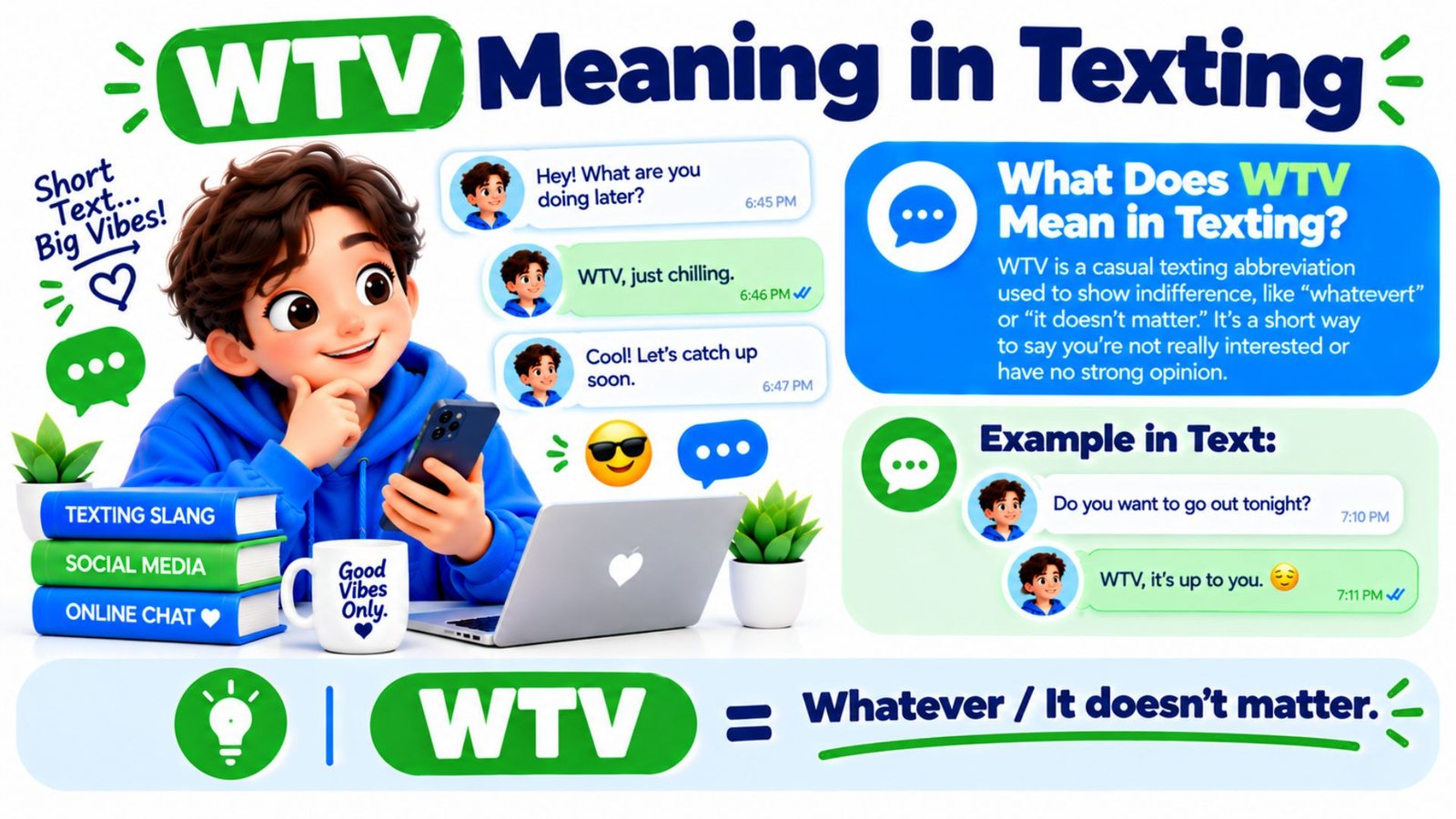
Watch four clues before you decide what WTV means: punctuation, emojis, reply speed, and the message before it. A period feels colder than no punctuation. A smiley softens the word. A long delay can add distance. Together, these signals tell you far more than the three letters alone ever will.
| What you see | What it often suggests |
|---|---|
| wtv, sounds good | Easygoing agreement |
| wtv. | Dismissive or finished with the topic |
| wtv 😊 | Relaxed and friendly |
| wtv 🙄 | Annoyed or eye-rolling |
| A long pause, then “wtv” | Hesitant, upset, or distracted |
Example in texting:
Friend 1: I can’t come tonight, sorry.
Friend 2: wtv 🙄
Why Is “WTV” So Popular?
Three letters, zero effort. No surprise the wtv slang meaning is everywhere online now, from rushed group chats to comment sections where nobody really wants to type a whole word.
WTV is popular because it is fast, flexible, and hard to argue with. People can agree, decline, or calm a debate without writing a full sentence. It also fits the casual style of texting culture, where short replies feel normal. Because tone stays vague, the sender keeps a little emotional distance, which some people prefer.
- Speed: three letters replace an eight-letter word.
- Flexibility: works for agreeing, declining, or ending debates.
- Low effort: fits quick replies typed on a phone.
- Vague tone: lets senders avoid naming their exact feelings.
- Shared culture: friends, gamers, and commenters all recognize it.
Origin and History of WTV
Every slang word has a starting point. The wtv slang meaning grew out of a simple habit: cutting letters to type faster. Here’s what we know, and what we don’t.
WTV comes from “whatever,” shortened by dropping vowels, a common texting habit from the early days of SMS, when message length was limited. No reliable source pins down a first use, so the exact date and inventor stay unclear. What is clear is that the abbreviation spread through texting, social media, and gaming chats as short replies became normal.
The Emotional Meaning Behind “WTV”
One word can hold five different moods. That’s the fun and the frustration of the wtv slang meaning, so let’s sort out each feeling with clear signs and real examples.
Emotion is the real story here. The same three letters can sound peaceful or prickly, depending on the situation. Below are five common moods behind WTV, each with a quick clue and a real example, so you can read the message like a pro.
Neutral or Chill
Neutral WTV means the sender is easygoing and has no strong preference. It usually comes with a decision request, like picking food or a time. Look for friendly wording nearby. Example: “Movie at 7 or 8?” “wtv, 8 works for me.” The word simply says, “I’m flexible.”
Dismissive or Uninterested
Dismissive WTV signals that the sender doesn’t want to discuss something. It often appears as a short, lowercase reply after a long message. Example: “I sent you three ideas for the trip.” “wtv.” The single word and the period shut the conversation down, so the topic feels unimportant to them.
Frustrated or Annoyed
Annoyed WTV shows up after disagreements, delays, or repeated complaints. The sender may be tired of arguing but doesn’t want to explain why. Watch for eye-roll emojis or short replies. Example: “You’re late again.” “wtv 🙄” Here, the emoji makes the frustration easy to spot.
Sarcastic or Passive-Aggressive
Sarcastic WTV says one thing and means another. Instead of saying “I’m upset,” the sender types “wtv” and hopes you notice. Extra phrases like “wtv you say” or “wtv, do whatever” often add the edge. Example: “I picked the restaurant.” “wtv, great choice, I guess.” The mixed message is the giveaway.
Accepting or Letting Go
Accepting WTV means the sender has decided to move on. It can feel peaceful, like shrugging off a small problem. Example: “Sorry, I forgot to call you back.” “it’s wtv, don’t worry about it.” Here, WTV works as a kind way to say the mistake is forgiven.
| Mood | Common clue | Sample reply |
|---|---|---|
| Neutral or chill | Friendly wording | “wtv, you pick” |
| Dismissive | Period, no emoji | “wtv.” |
| Annoyed | Eye-roll emoji | “wtv 🙄” |
| Sarcastic | Mixed message | “wtv, great choice, I guess” |
| Accepting | Reassuring words | “it’s wtv, don’t worry” |
How to Use WTV in a Sentence (Real Examples)
Knowing the wtv slang meaning is one thing. Using it naturally is another. Here are realistic examples for every setting, so you can use it without sounding rude or awkward.
Each example below shows a different setting, tone, and reply style. Notice how the words around WTV carry most of the feeling. A friendly phrase keeps it light, while a cold or short one makes it sharp. Pick the style that matches your relationship with the person.
Casual Texting
In everyday texts, WTV works best for low-stakes choices. Example: “Where should we meet?” “wtv, anywhere near the mall is fine.” Adding a reason or preference keeps the message warm, so your friend knows you’re flexible and not brushing them off.
Social Media Comments
In comments, WTV is often short and playful. Example: Someone comments, “This outfit is too much.” The poster replies, “wtv, I love it.” It shows confidence and a shrug at criticism. Keep it light in public threads, because tone is easier to misread when strangers are watching.
Gaming Chat
In gaming chats, players type fast, so WTV is a handy shortcut. Example: “Want to switch maps?” “wtv, I’m good with either.” It keeps the match moving. But during a heated round, a blunt “wtv” can sound like you’ve stopped caring, so add a quick “gg” or a friendly note.
Teen Conversations
Among teens and young adults, WTV is a common quick reply between friends. Example: “Are you coming to the game?” “wtv, maybe.” Here, it means the plan is open. Since it can also shrug off drama, check the emoji and timing before assuming it’s chill.
Relationship Conversations
Between partners, WTV carries more weight because feelings are closer to the surface. Example: “Do you want to talk about it?” “wtv.” That reply can sound like distance, not calm. When it shows up in a serious talk, ask a gentle follow-up instead of guessing.
WTV vs. Whatever: Is There a Difference?
Same idea, different vibe. Why does the typed version feel a bit cooler than the spoken one? The wtv slang meaning and “whatever” split apart in tone, setting, and attitude.
WTV and “whatever” mean the same thing, but they land differently. Spoken “whatever” can sound sharp because of the voice behind it, while typed WTV feels lighter, quicker, and more detached. That detachment cuts both ways: it can read as relaxed, or as a cold brush-off. Choose based on how close you are to the person.
| Term | Usual tone | Best setting |
|---|---|---|
| Whatever | Can sound sharp or sarcastic | Spoken conversations |
| WTV | Casual, detached, low-effort | Texts, chats, comments |
WTV vs. IDC: What’s the Difference?
Both abbreviations shrug, but one shrugs harder. Let’s quickly compare the wtv slang meaning with IDC, side by side, so you know which message is gentle and which one stings.
IDC means “I don’t care,” which says the feeling out loud. WTV means “whatever,” which hints at the feeling without naming it. That makes IDC feel blunt and WTV feel vaguer. Neither is gentle in an emotional talk, but WTV leaves more room for a friendly reading. Context still decides the final tone.
Example in chat:
Friend 1: Do you care which movie we watch?
Friend 2: wtv, I’m easy.
Common Variations and Related Slang
Slang never stays in one form. WTV has cousins, stretched spellings, and stand-ins that shift its mood. Here’s a quick little guide to the whole wtv slang meaning family tree.
Most variations change the spelling, the volume, or the attitude. A stretched word sounds louder. An added phrase makes the message softer or sharper. The lists below split the forms of WTV from the other slang people use to say something similar.
Variations
You’ll spot several forms: wtever, whatev, whateverrr, “wtv idc,” “wtv bro,” and “wtv lol.” The spellings are just style, but the add-ons matter. “wtv lol” softens the message, while “wtv idc” makes the indifference obvious. Example: “Want to leave early?” “wtv lol, sure.”
Similar Slang Expressions
Plenty of phrases do the same job. “IDC” and “IDGAF” show stronger indifference, “meh” is mild, and “fine” can hide annoyance. “Up to you,” “do you,” and “it is what it is” hand over the choice or accept the situation. Example: “Which one?” “Up to you.”
| Slang | Meaning | Tone |
|---|---|---|
| IDC | I don’t care | Blunt |
| IDGAF | A stronger, profane version of IDC | Very blunt |
| Meh | Mild indifference | Light |
| Fine | Passive agreement | Can hide annoyance |
| Up to you | No preference | Polite |
| It is what it is | Acceptance | Resigned |
Other Meanings of WTV You Might See
Not every WTV fits the wtv slang meaning. Depending on where you spot it, those three letters can point to a TV station or a file type. Context saves you.
Outside of chats, WTV can name several TV channels around the world, plus a Windows video file format for recorded TV shows. In a text or comment, though, “whatever” is almost always the answer. Some sites list extra meanings, like a TikTok phrase, but reliable confirmation is hard to find, so treat those claims with caution.
When NOT to Use WTV
One careless “wtv” can turn a small disagreement into a big chill. Knowing when not to use the wtv slang meaning can protect your friendships, your grades, and your job.
Because WTV sounds detached, it works badly when the other person needs care or clarity. The rule is simple: if the topic matters to them, don’t answer with a shrug. Use full words that show you’re listening, and save WTV for easy, low-stakes moments.
Avoid Using WTV In:
Skip WTV in serious talks, emotional discussions, apologies, arguments with partners, work emails, customer service, and school messages. In those moments it can feel cold or dismissive. Example: “I’m really upset about what happened.” “wtv.” That reply can feel like you don’t care, even if you do.
Better Alternatives to WTV (Depending on Situation)
Want the same easygoing energy without the cold edge? Swap the wtv slang meaning for a phrase that shows flexibility and care. Here are quick, simple options for common moments.
The best alternative depends on what you mean. If you truly don’t mind, say “I’m easy either way.” If you want the other person to choose, try “Up to you.” If you’re hurt but tired of arguing, be honest and say “I need a minute.” Clear words prevent guessing, and they protect the mood.
| Situation | Say this instead |
|---|---|
| You truly don’t mind | “I’m good either way.” |
| You want them to choose | “Up to you.” |
| You agree with a plan | “That works for me.” |
| You feel overwhelmed | “I need a minute.” |
| You’re letting a small thing go | “No worries, it’s fine.” |
When to Use WTV and When to Avoid It
Need a fast yes or no rule? This cheat sheet shows when the wtv slang meaning fits, when it’s risky, and when it’s best left out of the chat completely.
Green means go, yellow means think, and red means stop. Use WTV freely for low-stakes plans with close friends. Think twice when the other person seems upset or the topic is personal. Avoid it completely in professional messages and serious conversations, where a shrug can sound like disrespect.
| Situation | Verdict |
|---|---|
| Picking food or a movie with a friend | Green: go |
| Answering a casual group plan | Green: go |
| A friend seems quiet or upset | Yellow: think |
| Replying to a public comment | Yellow: think |
| Someone shares bad news | Red: stop |
| A tense talk with a partner | Red: stop |
| A work email or Slack message | Red: stop |
Is WTV Rude?
Short answer: sometimes. Long answer: it depends on who’s actually reading. Let’s quickly break down when the wtv slang meaning feels harmless and when it lands like a slammed door.
WTV isn’t rude by itself. It becomes rude when the other person wants engagement and gets a shrug. Among friends picking dinner, it’s harmless. In an emotional chat, it can feel invalidating. Timing, topic, and relationship all matter, so check the mood before you send it. A friendly emoji can also help.
Example in chat:
Friend 1: Why did you skip my birthday dinner?
Friend 2: wtv.
Key Takeaway: WTV is fine for easy choices and risky for feelings. When the topic matters, use full words.
How WTV Is Used Across Platforms
Same abbreviation, different room. The wtv slang meaning stays steady, but the vibe shifts from app to app, so here’s a quick look at how each platform changes the tone.
Platform culture shapes how people read short replies. Private chats feel personal, while public comments feel performative. The five examples below show where WTV usually sounds friendly, sarcastic, or heated, so you can adjust your reply before you hit send.
Text Messages
Text messages are where WTV is very common. Replies are quick, private, and often between people who know each other. Example: “I’ll be about ten minutes late.” “wtv, no rush.” With familiar friends it’s easygoing, but with someone stressed, a bare “wtv” can sound careless.
TikTok Comments
On TikTok, comments are public and fast, so WTV often reads as a playful or sarcastic shrug at a critic. Example: Someone writes, “This trend is cringe.” The creator replies, “wtv, I’m having fun.” Since strangers may read it, add an emoji if you want it to sound light.
Discord & Gaming Chats
In Discord and gaming chats, speed matters, so WTV helps players move on. Example: “You missed that shot.” “wtv, next round.” It can show a fresh start. In tense matches, though, teammates may hear blame or sulking, so a quick “my bad” keeps the team calm.
Instagram & Snapchat
On Instagram and Snapchat, WTV often appears in DMs between friends or crushes. Example: “Should I post this pic?” “wtv, post it 😄” With a smile, it’s playful. Without one, especially in a flirty chat, it might feel like the other person isn’t interested.
Twitter/X Replies
On X, replies can turn into debates fast, so WTV often shows up as a sarcastic exit line. Example: “Your take is wrong.” “wtv, we disagree.” It ends the back-and-forth without a fight. But in a heated thread, it can look like you’re dodging the point.
Psychological Meaning Behind Saying “Whatever” or “WTV”
Why do people say “whatever” when they clearly feel something? The wtv slang meaning often hides a mood, so let’s look at the feelings that can sit behind that shrug.
Saying “whatever” or WTV can be a way to step back from a conversation. Sometimes it shows real indifference. Other times it shows tiredness, stress, or a wish to avoid conflict. These are common readings, not a diagnosis, and no message can prove what someone feels. That is why a calm follow-up question works better than guessing.
- Emotional withdrawal: stepping back when a topic feels heavy.
- Conflict avoidance: ending a debate before it grows.
- Lack of interest: the topic simply doesn’t matter to them.
- Feeling overwhelmed: too tired to explain another opinion.
- Passive resistance: disagreeing without saying so directly.
Example in chat:
Friend 1: You seem off today.
Friend 2: wtv, I’m just tired.
WTV in Relationships & Friendships
Closer people usually read more into every single word. That’s exactly why the wtv slang meaning feels much heavier with partners and best friends than with a random commenter online.
Trust and history change how a shrug is read. A close person knows your habits, so they notice when your words suddenly get short. Below, you’ll see how WTV plays out in romantic relationships and in friendships, with a clear example for each.
In Romantic Relationships
In a relationship, WTV during an emotional talk can feel like shutting the door. It may come from tiredness, but your partner may hear “I don’t care.” Example: “Are we okay?” “wtv.” A better reply is “I’m tired, can we talk later?” It keeps the connection and the honesty.
In Friendships
Among friends, WTV is usually playful, but overuse can look uncaring. Example: “Tacos or sushi?” “wtv, surprise me.” That’s fine. But “Why did you ignore me?” “wtv.” will likely hurt. Match the word to the weight of the topic, and friendships stay smooth.
WTV in School and Teen Slang
Hallways, group chats, and class projects all have their own slang rules. Here’s how the wtv slang meaning fits into school life, and where it can get you in trouble.
Ask a student what does wtv mean in slang, and you’ll probably hear “whatever,” said with a shrug. Among teens and young adults, it’s a common quick reply in group chats, captions, and homework talk. It doesn’t belong in emails to teachers, school assignments, or messages to a principal. Formal messages need full words and a respectful tone.
Example in chat:
Friend 1: Should we meet before class or after?
Friend 2: wtv, before is fine.
Is WTV Appropriate in Professional Settings?
Would you type “wtv” to your boss? Probably not. Even if you know what does wtv mean in slang, at work it can sound careless before anyone really reads further.
In most workplaces, no. WTV can read as dismissive, unprofessional, or uncooperative in emails, Slack messages, meetings, and customer chats. Clear wording protects your image and avoids confusion. If you truly don’t mind, say so politely, like “Either option works for me” or “I’m flexible, let me know your preference.”
Common Misunderstandings About WTV
Slang attracts plenty of myths. Before you judge a message, let’s bust four popular beliefs about the wtv slang meaning that cause needless arguments, hurt feelings, and long awkward silences.
Each myth below has a simple reality check. In every case, the lesson is the same: WTV is a flexible word, and its meaning changes with the situation. Read the clues around it before you react, and you’ll avoid most misunderstandings.
Misconception 1: WTV always means anger
WTV does not always mean anger. Plenty of people type it to say “I’m fine with anything.” Example: “Which seat do you want?” “wtv, I’m good.” That is pure flexibility. Anger usually comes with other signs, like short replies, cold punctuation, or an eye-roll emoji.
Misconception 2: WTV is always rude
WTV isn’t always rude either. Between close friends, it’s often harmless and even funny. Example: “Should we watch the boring one?” “wtv, I brought snacks.” The rudeness depends on the topic and the mood. When feelings are involved, the same word can suddenly sting.
Misconception 3: WTV only teenagers use it
Teenagers use WTV a lot, but they aren’t the only ones. Adults use it in casual texts too, usually to settle small choices fast. Example: “Dinner at 7 or 7:30?” “wtv, 7:30.” Age matters less than the setting, so the same shortcut can appear in any friend group.
Misconception 4: WTV means “I don’t care about you”
WTV usually doesn’t mean “I don’t care about you.” It often means “I have no strong opinion” or “I’m stepping away from this topic.” Example: “Want to pick the playlist?” “wtv, you choose.” The person is trusting you with the choice. Only the full context shows if someone is truly pulling away.
WTV vs. Similar Slang Abbreviations
IDC, IDK, meh, fine, sure: they all look alike at a glance. Let’s separate them from the wtv slang meaning so you can pick the one that fits your mood.
WTV sits in the middle of the indifference family. It is softer than IDC, more emotional than IDK, and less polite than “up to you.” Other words like “ok” and “sure” can sound neutral, but “fine” often hides annoyance. Use the table to compare tone at a glance, then choose the word that matches your real feeling.
| Slang | Meaning | Emotional tone |
|---|---|---|
| WTV | Whatever | Detached, sometimes dismissive |
| IDC | I don’t care | Blunt |
| IDK | I don’t know | Neutral |
| Meh | Indifference | Light |
| OK | Acceptance | Neutral |
| Fine | Passive agreement | Can hide annoyance |
| Sure | Agreement | Neutral |
| Up to you | No preference | Polite |
How to Respond to Someone Who Says “WTV”
Got a “wtv” and no idea what to say back? Don’t panic. Reading the mood first makes your reply easy, and the wtv slang meaning gives you the right clues.
Your best reply depends on what kind of moment you’re in. A friendly chat needs a light answer, while a conflict needs care. Playful banter can stay playful. Pick from the three situations below and adjust the words to sound like you.
Friendly or Neutral Context
If the sender sounds relaxed, keep it light. Try “Got it,” “Perfect,” or “Easy plan.” Example: “wtv, you pick.” “Perfect, tacos it is.” A quick, upbeat answer confirms the plan and keeps the mood easy, without turning a tiny choice into a discussion.
Emotional or Conflict Situation
When WTV follows an argument, slow down. Ask, “Do you want space, or should we talk it through?” Example: “wtv.” “That sounded upset. Want to talk now or later?” Calm curiosity works better than answering one shrug with another, and it shows you care about the person, not just the point.
Playful Context
Among friends, you can joke back. Try “Bold of you,” “Okay, boss,” or “Noted.” Example: “wtv, I’m too tired to decide.” “Okay, boss, I’ll flip a coin.” Keep the humor kind, and drop it if the person seems truly upset, because a joke can sting in the wrong moment.
WTV in Different Cultures and Languages
Shrugging in words isn’t only an English habit. Many other languages have their own way to say “whatever,” and comparing them shows how universal the wtv slang meaning really feels.
WTV itself is English internet slang, but the feeling behind it shows up worldwide. Spanish speakers say “lo que sea,” French speakers say “comme tu veux,” and German speakers say “egal.” Each phrase can show acceptance, indifference, or a mild brush-off. Tone still depends on voice and context, so treat translations as close matches, not exact twins.
| Language | Phrase | Rough meaning |
|---|---|---|
| Spanish | Lo que sea | Whatever it is |
| French | Comme tu veux | As you like |
| German | Egal | It doesn’t matter |
| Portuguese | Tanto faz | It makes no difference |
Does WTV Always Mean You’re Mad?
Worrying that a short reply means anger is completely normal. Here’s a calm, direct answer about whether the wtv slang meaning always points to a bad mood or hidden anger.
No, WTV does not always mean you’re mad. It often means the person has no strong preference or feels relaxed. Anger is more likely when WTV appears after a disagreement, with a period, no emoji, and a slow reply. Check those clues together, and ask a gentle question if you’re still unsure.
Example in chat:
Friend 1: Are you upset about the plan change?
Friend 2: no lol, wtv works.
Why Do People Text WTV Instead of Whatever?
Eight letters or three? Plenty of people pick three. Let’s look at why the wtv slang meaning has replaced the full word in many chats, and what that says about texting.
People text WTV instead of “whatever” because it is faster, casual, and easy to type on a phone. It also fits the short-reply style of texting, where tone is carried by punctuation and emojis. The shorter form feels lighter and less confrontational than the spoken word, which is why some users choose it for small decisions.
Example in texting:
Friend 1: Why do you type wtv instead of whatever?
Friend 2: It’s faster lol.
Is WTV Positive or Negative?
Good vibe or bad vibe? People genuinely argue about this online. Here’s the honest answer on whether the wtv slang meaning is positive, negative, or a little bit of both.
So, what does wtv mean in slang, good or bad? It is a neutral shortcut that takes its mood from the situation. Relaxed plans make it easygoing, while emotional talks make it dismissive. To judge it, look at the topic, the relationship, and the words right around it.
| Situation | Tone | Positive or negative |
|---|---|---|
| Choosing food or a movie | Easygoing | Positive |
| Letting a small mistake go | Accepting | Positive |
| Ending a debate | Dismissive | Negative |
| Replying after someone is hurt | Cold | Negative |
| A sarcastic comeback | Passive-aggressive | Negative |
Key Takeaway: WTV is neutral. The situation, not the word, makes it kind or cold.
Why People Love Using WTV
Some words just feel good to type. Let’s look at why the wtv slang meaning keeps winning hearts in group chats, comment sections, and late-night texts, even when it confuses everyone.
People love WTV because it saves time, saves energy, and keeps things easy. It lets you agree without a speech and step back without a fight. It also sounds casual, so it fits modern chat habits. For many users, it works as emotional shorthand: a tiny word that carries a mood.
- Fast to type: three letters get the message across.
- Saves energy: no long explanation needed.
- Avoids arguments: lets people step back from a debate.
- Sounds casual: fits relaxed chats between friends.
- Shows a mood quickly: one word can carry a whole feeling.
Summary: What Does WTV Mean?
Let’s wrap it up in plain words. Here’s the whole wtv slang meaning in one short, simple recap you can save, share, or send to a friend who’s really confused.
In short, what does wtv mean in slang? WTV means “whatever.” It shows indifference, acceptance, dismissal, or emotional distance, depending on tone. People use it in texts, social media, gaming chats, and casual talks. It can sound rude in emotional moments, so use full words for serious topics, and skip it at work and school.
- Meaning: whatever.
- Tone: neutral, dismissive, annoyed, sarcastic, or accepting.
- Best use: low-stakes choices with friends.
- Avoid in: serious talks, work emails, and school messages.
- Smart move: check punctuation, emojis, and timing before you reply.
Frequently Asked Questions
What does WTV meaning in texting?
The wtv slang meaning in texting is “whatever.” People use it to show they’re flexible, indifferent, or done with a topic. Tone clues like punctuation and emojis show which one they mean.
Is WTV rude?
The wtv slang meaning isn’t rude by itself. It feels friendly for easy choices and cold in emotional talks. Check the topic and your relationship before you send it.
What does WTV mean on TikTok?
On TikTok, the wtv slang meaning is still “whatever,” usually a playful or sarcastic shrug in comments. Some sites list other TikTok meanings, but they’re hard to confirm. Always read the context first.
What does WTV mean from a girl or a guy?
The wtv slang meaning stays the same from a girl or a guy: “whatever.” Tone, timing, and the earlier chat decide if it’s relaxed or annoyed. Gender doesn’t change the meaning.
Is WTV the same as IDC?
Not exactly. The wtv slang meaning is “whatever,” which hints at indifference, while IDC says “I don’t care” outright. IDC usually feels blunter.
Can I use WTV in professional messages?
It’s best to avoid it. The wtv slang meaning is casual and can sound dismissive at work. Write something like “Either option works for me” instead.
Why do people say WTV instead of whatever?
The wtv slang meaning is popular because it’s faster to type and feels casual. It also fits short texting replies. The shorter form feels lighter than the spoken word.
Conclusion
So, what does wtv mean in slang? It means “whatever,” and the feeling behind it can change from easygoing to cold in one message. The wtv slang meaning depends on punctuation, emojis, timing, and the context of the conversation.
Use WTV for easy choices with friends, but choose clearer words when feelings are involved. It is also better to skip WTV at work and school.
Knowing the wtv slang meaning helps you understand chats without assuming the worst. If someone sends “wtv” and you’re unsure about the tone, ask a simple question instead of guessing.
Dictionary.com also lists WTV as a texting and chat abbreviation for “whatever.”

LearnerGrammar.com helps English learners improve grammar, vocabulary, writing, and communication skills with simple lessons and tips.