Have you ever received a message like “ion know” and wondered whether it was a typo? Internet slang can be confusing, especially when a familiar word suddenly has a different meaning.
Understanding what does ion mean texting helps you follow conversations on TikTok, Snapchat, Instagram, and other platforms. In casual American slang, ion usually means “I don’t.” This guide explains what ion mean in text, its origin, real chat examples, related slang, and when to use it naturally.
What Does “ion” Mean in Text?
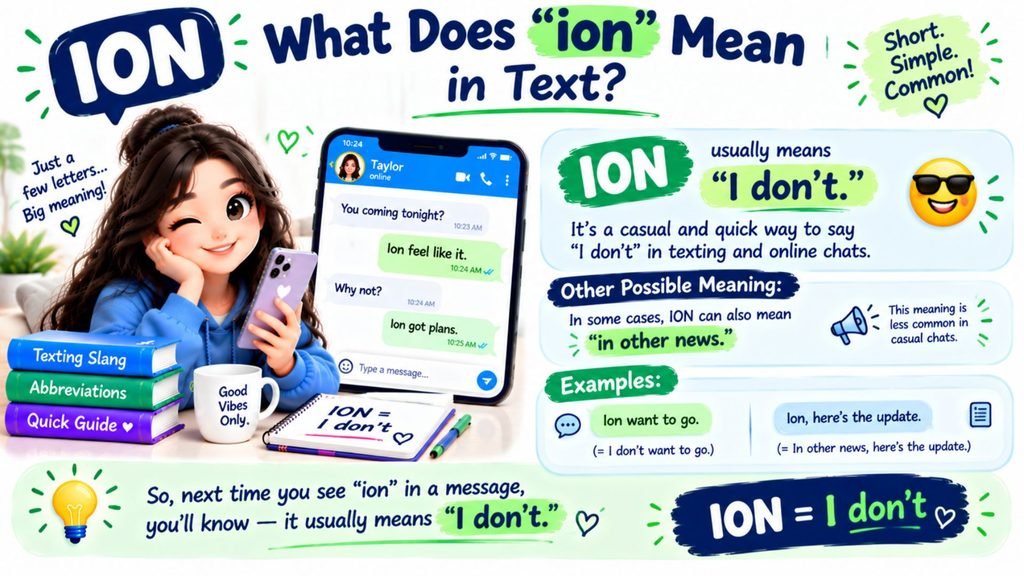
The word ion can confuse anyone who first sees it in a message. When asking what does ion mean texting, the most common answer is “I don’t,” an informal spelling used in casual digital conversations.
What Is “Ion” Meaning in Text?
In texting, ion represents how some people pronounce “I don’t” in relaxed speech. It is informal slang rather than standard English spelling.
Featured Snippet Definition: Ion is an informal texting slang term that usually means “I don’t.” It appears in casual conversations, social media comments, and direct messages.
For example:
- “ion know” means I don’t know.
- “ion care” means I don’t care.
- “ion want that” means I don’t want that.
- “ion think so” means I don’t think so.
- “ion get it” means I don’t get it.
Why Do People Use “Ion” in Digital Conversations?
People use ion because it reflects casual speech and makes messages feel relaxed. It can also signal familiarity with certain online communities and slang styles.
- Saves typing: It replaces the phrase “I don’t.”
- Sounds conversational: It resembles informal spoken English.
- Creates a casual tone: It fits relaxed conversations between friends.
- Reflects online culture: It appears in social media slang.
- Expresses personality: Some users prefer phonetic spellings over standard grammar.
Example in texting:
Friend 1: Are you going to the party tonight?
Friend 2: ion know yet, lemme check.
what does ion mean texting
If you have searched what does ion mean texting, context is the most useful clue. The expression usually means “I don’t,” but the rest of the sentence helps you understand the speaker’s exact message.
How Can You Identify the Meaning?
Look at the words following “ion.” They often reveal which phrase the person intends.
- Ion know: The person is unsure.
- Ion care: The person expresses indifference.
- Ion want: The person does not want something.
- Ion think: The person expresses doubt.
- Ion remember: The person cannot recall something.
| Text message | Standard English |
|---|---|
| ion know | I don’t know |
| ion care | I don’t care |
| ion want to go | I don’t want to go |
| ion think so | I don’t think so |
| ion remember | I don’t remember |
Example in texting:
Friend 1: Do you want pizza or burgers?
Friend 2: ion care, you choose.
what ion mean in text
The question what ion mean in text usually comes from someone who has encountered this spelling in a social media comment or private message. In most casual slang conversations, it means “I don’t,” but the surrounding sentence matters.
How Does Context Change the Meaning?
The same three letters can have different interpretations in different situations. In a casual message, “ion know” is slang; in a science discussion, an ion is a charged atom or molecule.
- Texting: Usually means “I don’t.”
- Chemistry: Refers to an electrically charged atom or molecule.
- Gaming chats: May appear in quick conversations between players.
- Social media: Often appears in comments and captions.
- Technical writing: Usually refers to the scientific term.
Example in chat:
Friend 1: What does “ion know” mean?
Friend 2: It means “I don’t know” in casual slang.
what does ion mean in slang
When people ask what does ion mean in slang, they are usually referring to informal American internet language. The term is associated with pronunciation patterns found in African American Vernacular English (AAVE) and has spread through online communities.
Is Ion a Slang Word or an Abbreviation?
Ion is better understood as a phonetic spelling of “I don’t” rather than a conventional initialism like “IDK.”
- Informal: It belongs mainly in casual communication.
- Phonetic: It reflects how a phrase may sound when spoken.
- Contextual: Its meaning depends on the surrounding words.
- Community-based: Usage varies between speakers and online groups.
- Nonstandard: It is not appropriate for every writing situation.
Example in texting:
Friend 1: You coming to study with us?
Friend 2: ion feel like going out today.
Understanding the Rise of “ion” in Texting
Online language changes as people adapt spoken expressions to fast digital conversations. If you are learning what does ion mean texting, understanding its cultural background explains why the spelling appears across social platforms.
How Did Ion Become Popular Online?
The spelling reflects informal speech associated with some American English varieties, including AAVE. Social media helped spread it beyond its original speech communities, although its use and meaning can vary.
- Social media: TikTok and Instagram help slang circulate.
- Text messaging: Short expressions fit quick conversations.
- Online communities: Friends and creators influence each other’s vocabulary.
- Memes and videos: Repeated exposure makes unfamiliar slang recognizable.
- Popular culture: Music and online creators can introduce expressions to wider audiences.
It is important not to assume that every person who uses “ion” belongs to a particular community. People adopt slang for different reasons, and language practices are not identical across generations or regions.
Example in chat:
Friend 1: I keep seeing “ion” in comments.
Friend 2: It’s a casual way some people write “I don’t.”
“ion” – Quick Meaning
The quickest way to understand what does ion mean texting is to replace “ion” with “I don’t” and reread the message. This simple trick works for many everyday examples, although context should always guide your interpretation.
Quick Examples of Ion
- Ion know: I don’t know.
- Ion mind: I don’t mind.
- Ion like it: I don’t like it.
- Ion remember: I don’t remember.
- Ion think so: I don’t think so.
| Slang phrase | Meaning | Possible tone |
|---|---|---|
| ion know | I don’t know | Uncertain |
| ion care | I don’t care | Casual or dismissive |
| ion mind | I don’t mind | Easygoing |
| ion think so | I don’t think so | Doubtful |
| ion want to | I don’t want to | Reluctant |
Example in texting:
Friend 1: Do you mind if we sit outside?
Friend 2: ion mind, that’s fine.
Origin & Background
The slang spelling “ion” reflects informal pronunciation rather than a formal abbreviation created by an organization. Its association with AAVE is relevant to understanding its history and the wider movement of language through American popular culture.
What Is the Linguistic Background of Ion?
In some speech patterns, “I don’t” can sound different from its careful, fully articulated form. Writing “ion” imitates that pronunciation.
- Spoken language: Informal speech often reduces sounds.
- AAVE: The spelling is associated with speech patterns used by some AAVE speakers.
- Digital writing: Texting makes phonetic spellings easy to share.
- Online exposure: Social media spreads expressions between communities.
- Language variation: Not every speaker uses or interprets the term identically.
The spelling should not be treated as evidence that a person is careless or does not understand standard English. Informal language follows its own social and conversational patterns.
Example in chat:
Friend 1: Is “ion” a proper English abbreviation?
Friend 2: It’s informal slang that represents how some people say “I don’t.”
Real-Life Conversations
Real examples make it easier to understand what does ion mean texting without memorizing a definition. Notice how the words after “ion” help explain whether someone is uncertain, uninterested, or declining an invitation.
Example 1: Making Plans
Maya: Are you coming to the basketball game?
Chris: ion know yet, I have homework.
Meaning: Chris has not decided.
Example 2: Talking About Food
Ava: Do you want sushi tonight?
Lena: ion really feel like sushi.
Meaning: Lena does not feel like eating sushi.
Example 3: Expressing Confusion
Jay: Did you understand the assignment?
Sam: ion get what the teacher meant.
Meaning: Sam does not understand the instructions.
Example 4: Declining an Invitation
Alex: Want to come shopping with us?
Jordan: ion think I can make it today.
Meaning: Jordan probably cannot attend.
Example 5: Discussing Social Media
Mia: Did you see that new video?
Zoe: ion check TikTok much these days.
Meaning: Zoe does not use TikTok often.
- Read the sentence: Look at the complete message.
- Check the relationship: Friends may use more slang.
- Notice the tone: The phrase may sound playful or blunt.
- Avoid assumptions: A short message does not reveal every emotion.
- Ask politely: Clarify if the meaning remains uncertain.
Example in texting:
Friend 1: Are you upset with me?
Friend 2: No, ion know what happened earlier.
Emotional & Psychological Meaning
Slang can affect how a message feels, not just what it literally says. When considering what does ion mean texting, remember that “ion” itself does not automatically signal anger, confidence, sadness, or indifference.
Can Ion Change the Tone of a Message?
Yes, informal spelling can make a message feel more conversational, but the emotional meaning depends on the words and relationship.
- Relaxed: It may sound natural between close friends.
- Dismissive: “ion care” can sound blunt in some situations.
- Uncertain: “ion know” can show hesitation.
- Playful: Emojis may make a message feel lighter.
- Serious: A sensitive conversation may require clearer wording.
For example, “ion care 😂” may be playful between friends, while “ion care” during an argument may feel dismissive. Neither interpretation is guaranteed without context.
Example in chat:
Friend 1: I thought you wanted to choose the movie.
Friend 2: ion care 😂 pick whichever one you like.
Usage in Different Contexts
The phrase “ion” is common in informal digital language, but it is not equally suitable in every situation. Knowing what does ion mean texting helps you understand casual conversations and choose language that fits your audience.
Where Is Ion Commonly Used?
- Social media: Comments, captions, and replies.
- Friend groups: Casual messages and everyday plans.
- Gaming chats: Quick exchanges between players.
- Private DMs: Informal conversations with familiar people.
- Professional settings: Usually replace it with standard English.
| Context | Is “ion” suitable? | Better approach |
|---|---|---|
| Chatting with friends | Usually | Use it naturally |
| TikTok comments | Often | Check the conversation |
| School assignment | No | Write “I don’t” |
| Job application | No | Use standard English |
| Serious disagreement | Usually avoid | State your meaning clearly |
Example in texting:
Friend 1: Are you joining the game later?
Friend 2: ion know yet, I’ll message you.
When NOT to Use It
Even if you understand what does ion mean texting, you should not use the slang everywhere. Standard English is clearer when accuracy, professionalism, or sensitivity matters.
Which Situations Call for Standard English?
- Professional emails: Write “I don’t have the information yet.”
- Academic writing: Follow standard grammar and spelling.
- Job interviews: Use clear, professional language.
- Sensitive conversations: Avoid wording that could sound dismissive.
- Unfamiliar audiences: Choose expressions everyone can understand.
For example, instead of writing “ion understand the instructions” to a manager, write “I don’t understand the instructions. Could you please clarify them?”
Example in chat:
Employee: I don’t have the report ready yet.
Manager: Thanks for letting me know. Please send it when it’s complete.
Common Misunderstandings
The meaning of “ion” can be confusing because the spelling already exists as a scientific word. To understand what does ion mean texting, check the complete sentence rather than relying on the letters alone.
What Mistakes Do People Make?
- Assuming chemistry: In a casual sentence, it may mean “I don’t.”
- Reading it as “I’m on”: That interpretation may not fit the sentence.
- Confusing it with “iron”: The words look similar but differ in meaning.
- Assuming anger: The slang does not automatically indicate frustration.
- Ignoring context: The surrounding words usually provide the strongest clue.
Example in texting:
Friend 1: The caption says “ion know.”
Friend 2: Here, it means “I don’t know,” not a chemistry term.
Comparison Table
Comparing “ion” with other texting expressions makes the meaning easier to remember. If you searched what ion mean in text, these related phrases show how informal language can shorten or reshape everyday expressions.
Ion vs. Other Texting Slang
| Term | Meaning | Typical use |
|---|---|---|
| ion | I don’t | Informal, phonetic slang |
| IDK | I don’t know | General texting |
| IDC | I don’t care | Expressing indifference |
| IMO | In my opinion | Sharing a viewpoint |
| IDRC | I don’t really care | Casual conversation |
| I don’t | Standard phrase | Formal and informal writing |
Key insight: “Ion” is different from an initialism such as IDK. It imitates pronunciation, while IDK uses the first letters of words.
Example in texting:
Friend 1: What does IDK mean?
Friend 2: It means “I don’t know.” “Ion know” can communicate the same idea informally.
Variations and Related Internet Slang
People often combine “ion” with other words to express complete thoughts. These phrases are not all separate abbreviations; most are informal combinations that become clear when “ion” is read as “I don’t.”
Common Ion Phrases
- Ion know: I don’t know.
- Ion care: I don’t care.
- Ion think so: I don’t think so.
- Ion even: I don’t even, often followed by an explanation.
- Ion want: I don’t want.
- Ion mind: I don’t mind.
- Ion get it: I don’t get it.
- Ion like it: I don’t like it.
- Ion feel like it: I don’t feel like it.
- Ion remember: I don’t remember.
These examples reflect informal usage, and their naturalness can vary between speakers. Some expressions need additional words to form a complete sentence.
Example in texting:
Friend 1: Do you want to go out tonight?
Friend 2: ion feel like it, maybe tomorrow.
How to Respond When Someone Uses It
Once you understand what does ion mean texting, responding becomes much easier. You usually do not need to mention the slang itself; reply to the message’s actual meaning.
Casual Replies
- If they don’t know: “No worries, let me know.”
- If they don’t care: “Okay, I’ll choose.”
- If they decline: “That’s fine, maybe next time.”
- If they’re confused: “I’ll explain it again.”
- If their meaning is unclear: “What do you mean?”
Example in chat:
Friend 1: ion know if I can come.
Friend 2: No worries, just let me know later.
Funny Replies
A playful response can work if you already have that kind of relationship.
- “Your keyboard is speaking a new language 😂”
- “Okay, mystery texter!”
- “Fair enough, you decide.”
- “The plans are officially undecided 😭”
- “Let me know when you know!”
Use humor carefully if the other person seems upset or the topic is serious.
Direct and Polite Replies
- Confirm plans: “Okay, tell me when you’ve decided.”
- Clarify a choice: “Would you prefer something else?”
- Offer help: “Want me to explain it?”
- Respect a refusal: “No problem, I understand.”
- Check the tone: “Are you saying you don’t want to?”
Example in texting:
Friend 1: ion want to go out tonight.
Friend 2: That’s okay. We can make plans another day.
Regional & Cultural Usage
Slang does not spread in exactly the same way everywhere. The meaning of “ion” is strongly associated with informal American online language, although people elsewhere may encounter it through social media and entertainment.
Do People Use Ion Around the World?
- United States: It is recognizable in some informal online communities.
- Other English-speaking regions: Usage varies by community.
- Asia: Exposure through American social media may increase recognition.
- Middle East: English-speaking online users may encounter it in digital content.
- Global platforms: Meanings can spread, but familiarity is not universal.
These are broad observations, not rules about every country or individual. It is better to judge usage from the actual conversation than to assume someone understands a term because of their age or location.
Example in chat:
Friend 1: Do people everywhere understand “ion”?
Friend 2: Not necessarily. It depends on their exposure to the slang.
Is It Safe for Kids?
“Ion” is generally a harmless slang expression when used to mean “I don’t.” However, parents and educators should consider the surrounding conversation rather than judging online communication by one word alone.
Should Parents Be Concerned About Ion?
- Meaning: The slang itself is not inherently explicit.
- Context: Read the full message before interpreting it.
- Communication: Ask children what unfamiliar slang means.
- Digital literacy: Teach them to recognize informal versus formal language.
- Online safety: Discuss privacy and respectful communication more broadly.
The term alone is not a reliable indicator of a child’s online safety or behavior. Conversations, platform settings, and the people they interact with matter much more.
Example in chat:
Parent: I saw “ion” in your message. What does it mean?
Teen: It means “I don’t.” It’s just texting slang.
Frequently Asked Questions
1. What does ion mean in texting?
What does ion mean texting? It usually means “I don’t.” People use it as informal, phonetic slang in casual conversations.
2. What does ion mean on Snapchat?
On Snapchat, what does ion mean texting usually has the same answer: “I don’t.” The rest of the message helps clarify the intended meaning.
3. Does ion mean “I don’t”?
Yes, what does ion mean texting is commonly answered as “I don’t.” This meaning is especially common in informal American internet slang.
4. Is ion the same as IDK?
What does ion mean texting differs slightly from IDK. Ion means “I don’t,” while IDK specifically means “I don’t know.”
5. Is ion proper English?
What does ion mean texting refers to informal slang, not standard spelling. Use “I don’t” in academic and professional writing.
6. Is ion rude?
What does ion mean texting does not automatically imply rudeness. The phrase following it and the conversational context determine the tone.
7. Why do people write ion instead of I don’t?
People use it to imitate casual pronunciation and fit informal online communication. What does ion mean texting is best understood through context.
Conclusion
Understanding what does ion mean texting helps you interpret a common form of informal internet slang. In most casual messages, ion means “I don’t,” as in “ion know,” “ion care,” or “ion want to go.” The phrase reflects pronunciation patterns associated with some American English communities and has spread through social media and online conversations.
If you have wondered what ion mean in text, look at the words around it before deciding what the sender means. Remember that slang can sound relaxed between friends but may seem unclear in professional or sensitive situations. Use standard English when clarity matters, and ask politely if a message is confusing. Once you recognize the pattern, understanding “ion” becomes much easier.

LearnerGrammar.com helps English learners improve grammar, vocabulary, writing, and communication skills with simple lessons and tips.