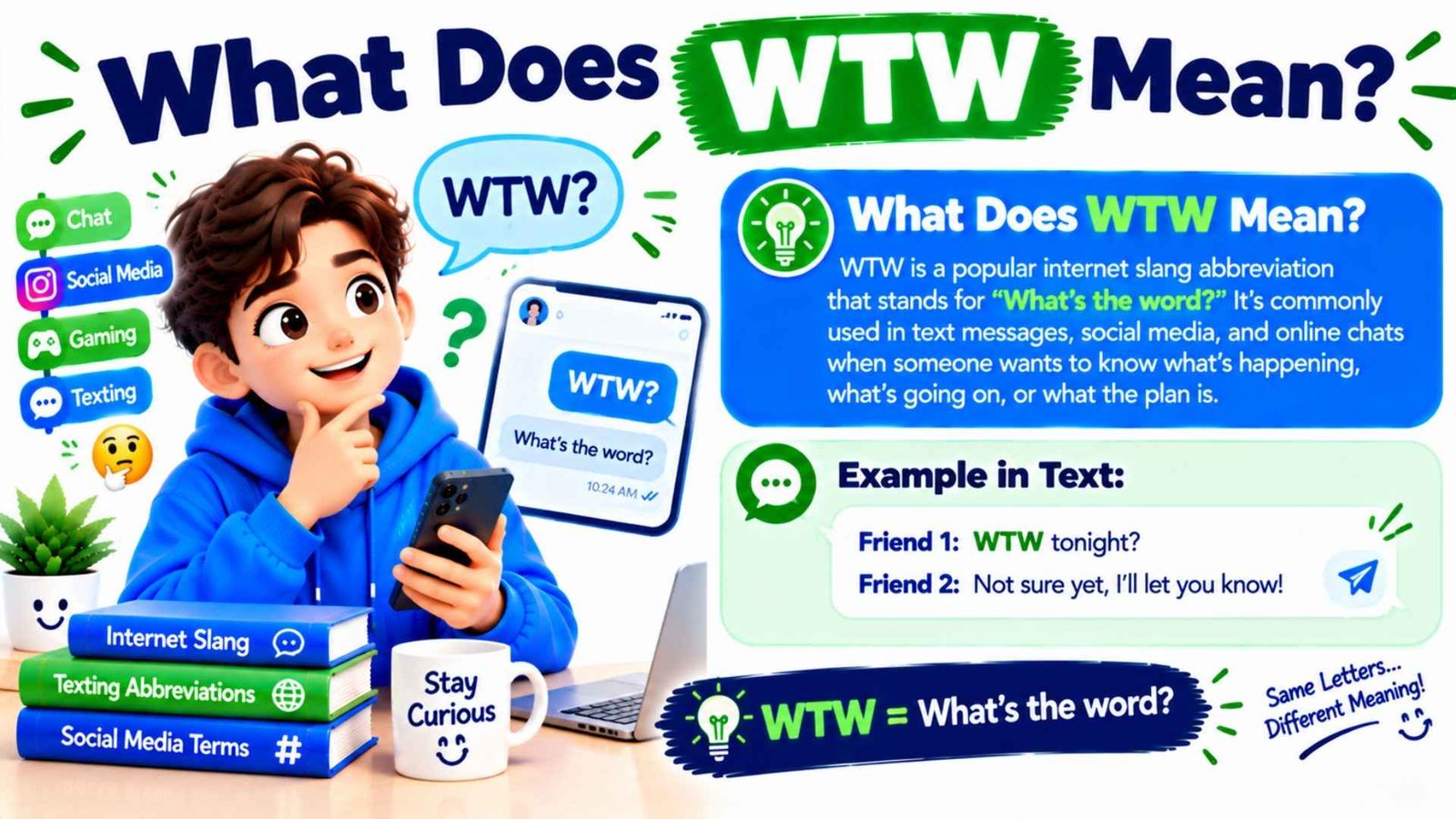
Have you ever received a message saying “WTW?” and wondered what the person actually wanted to know? These three letters can feel confusing when you see them without context. The most common what does WTW mean answer is “What’s the word?”—a casual way to ask what is happening or what plans someone has.
Understanding the WTW meaning makes it easier to follow conversations on Snapchat, Instagram, TikTok, and text messages. This guide explains its common uses, examples, possible alternative meanings, and natural replies so you can understand the message without overthinking it.
WTW Meaning in Text – Quick Meaning

The what does WTW mean question has a simple answer in most casual conversations: “What’s the word?” The WTW meaning usually relates to checking in, asking about plans, or starting a friendly conversation without sounding formal or demanding.
What Does WTW Stand For in Everyday Texting?
WTW is commonly used as an abbreviation for “What’s the word?” In everyday slang, this expression rarely asks for a literal word. Instead, it asks what is happening, what someone is doing, or whether anything interesting is planned.
For example, when a friend texts “WTW tonight?”, they are probably asking about your evening plans. If someone sends only “WTW?”, they may simply be checking in or opening a conversation.
Common interpretations include:
- What’s happening? Asking about current events or activities.
- What’s the plan? Checking whether something is arranged.
- What are you doing? Asking about someone’s current activity.
- What’s up? Starting a relaxed conversation.
- Are you free? Checking availability before suggesting plans.
| Text message | Likely meaning |
|---|---|
| WTW? | What’s happening? |
| WTW tonight? | What are the plans tonight? |
| WTW after class? | What are you doing after class? |
| Yo, WTW? | What’s up? |
| WTW this weekend? | What are your weekend plans? |
Example in texting:
Friend 1: WTW tonight?
Friend 2: Nothing planned yet. What are you thinking?
The key is to understand the abbreviation as a casual question rather than translate each letter separately.
Origin and Background of WTW
The WTW meaning comes from an informal expression that people use to ask about news, activities, or plans. Although the precise history of the abbreviation is difficult to establish, its use fits the wider habit of shortening everyday phrases in digital conversations.
How Did WTW Become a Texting Abbreviation?
“What’s the word?” is a conversational expression used to ask what is happening or whether there is any news. In online communication, people frequently shorten familiar phrases to make messages quicker and more casual.
WTW follows the same general pattern as other texting abbreviations. Its popularity in a conversation depends on the people using it, their online habits, and whether they already understand the expression.
- Shortening phrases: Initials make common expressions quicker to type.
- Casual communication: Friends often prefer relaxed language in private messages.
- Social media: DMs and group chats encourage brief conversational openings.
- Shared slang: People adopt abbreviations they see others using.
- Contextual meaning: The surrounding message helps explain the intended question.
| Abbreviation | Common expansion | Typical purpose |
|---|---|---|
| WTW | What’s the word? | Asking what’s happening or what the plans are |
| WYD | What are you doing? | Asking about someone’s activity |
| WYA | Where you at? | Asking someone’s location |
| HBU | How about you? | Returning a question |
| LMK | Let me know | Requesting an update |
These examples show how texting language compresses longer expressions into short forms. However, there is no need to assume that every person uses WTW in exactly the same way.
Real-Life Conversations Using WTW
Seeing WTW meaning in realistic conversations makes the abbreviation easier to understand than memorizing its full form alone. People usually use it as a quick question about activities, plans, or what is happening in a particular situation.
WhatsApp conversation
WhatsApp users may send WTW to friends, relatives, or group members when they want to start a conversation or arrange an activity.
Example in texting:
Friend 1: WTW this evening?
Friend 2: We might order pizza and watch a movie.
In this exchange, the sender wants to know whether anything is planned. The message is informal and does not require a detailed answer.
Instagram DM
On Instagram, WTW can appear in a direct message when someone wants to reconnect, ask about plans, or start chatting.
Example in chat:
Friend 1: Hey, WTW? 👀
Friend 2: Not much right now. What’s up?
The emoji may make the message feel playful or curious, but it does not automatically indicate flirting.
Text message
In an ordinary SMS conversation, WTW often works as a short way to ask about someone’s schedule.
Example in texting:
Friend 1: WTW after class?
Friend 2: I’m heading home. Want to grab coffee?
Here, the question creates an opportunity to suggest a plan. The recipient can answer directly or ask what the sender has in mind.
Why Does WTW Feel More Casual Than a Full Question?
Short messages often feel relaxed because they leave room for the other person to continue the conversation naturally. WTW is useful when both people understand the slang and are comfortable communicating informally.
- Quick opening: It starts a conversation without a long introduction.
- Flexible question: It can refer to plans, activities, or general updates.
- Friendly tone: It often suits conversations between people who know each other.
- Easy response: A short answer is usually enough.
- Context matters: The previous messages help clarify the intended question.
Emotional and Psychological Meaning of WTW
The WTW meaning can communicate curiosity, friendliness, or interest in making plans, but the abbreviation alone cannot reveal someone’s feelings. The relationship between the sender and recipient, the conversation history, and the message’s tone all help explain its intention.
What Does WTW Suggest About the Sender’s Intent?
Someone sending WTW may want to know whether you are available, find out what’s happening, or simply keep a conversation going. In some situations, it can be an indirect invitation to hang out.
However, it is important not to read too much into three letters. The message does not automatically mean the sender is romantically interested, upset, or expecting an immediate reply.
- Curiosity: The sender wants to know what is happening.
- Availability: They may be checking whether you have free time.
- Social connection: They may want to restart a conversation.
- Playfulness: An emoji may make the message feel more lighthearted.
- Possible invitation: A follow-up may reveal that they want to meet.
| Message | Possible impression | What it does not prove |
|---|---|---|
| WTW? | Casual check-in | Romantic interest |
| WTW tonight? | Asking about evening plans | A confirmed invitation |
| WTW 👀 | Playful curiosity | Flirting for certain |
| WTW bro? | Familiar, friendly tone | A specific emotional state |
| WTW?? | Possible urgency or excitement | Anger by itself |
Example in texting:
Friend 1: WTW tonight? 👀
Friend 2: Not sure yet. Are you planning something?
Friend 1: Maybe we can get dinner.
The follow-up reveals more about the sender’s intention than the abbreviation itself.
WTW Usage in Different Contexts
The WTW meaning can remain similar across platforms, but the situation changes how people interpret it. A message between close friends may sound natural, while the same abbreviation in a formal workplace email may appear unclear or unprofessional.
1. Social Media
WTW may appear in Instagram DMs, Snapchat chats, TikTok conversations, and other informal online spaces. Users can send it to ask what’s happening, check for plans, or begin a conversation.
- Instagram: Someone may use WTW to start a DM.
- Snapchat: A friend may ask about plans through chat.
- TikTok: The abbreviation may appear in informal comments or messages.
- Group chats: Members may use it to ask what everyone is doing.
- Private messages: The sender may expect a quick, casual reply.
Example in chat:
Friend 1: WTW this weekend?
Friend 2: Nothing yet. We could go shopping.
2. Friends and Relationships
Among friends, WTW can be a relaxed way to check whether someone is free. In dating conversations, it may open the door to making plans, but the meaning depends on the broader exchange.
- Close friends: Ask about activities or meetups.
- New acquaintances: Start a casual conversation.
- Dating conversations: Check availability without making a direct invitation.
- Long-distance friends: Ask what’s happening in the other person’s life.
- Group plans: Find out whether everyone has agreed on an activity.
Example in texting:
Friend 1: WTW after dinner?
Friend 2: I’m free. Did you want to go somewhere?
3. Work and Professional Settings
WTW is generally better suited to casual communication than formal professional messages. If the sender needs information about a meeting, deadline, or project, a complete question is usually clearer.
- Team chats: Use it only if the team communicates casually.
- Client messages: Prefer a clear, complete question.
- Meeting updates: Ask directly about the schedule.
- Project discussions: Specify the information you need.
- Formal emails: Avoid unexplained texting abbreviations.
Example in chat:
Colleague 1: What’s the plan for tomorrow’s meeting?
Colleague 2: We’ll review the project timeline at 10 a.m.
The full question makes the purpose clear and reduces the chance of misunderstanding.
4. Casual vs. Serious Tone
WTW naturally fits relaxed conversation. It may not be the best choice when discussing sensitive news, a serious disagreement, or an urgent responsibility.
- Casual situations: Ask friends what is happening.
- Planning: Find out whether anyone has suggestions.
- Sensitive topics: Use clear, considerate language.
- Urgent requests: Explain what information you need.
- Unfamiliar audiences: Avoid assuming everyone understands slang.
Example in texting:
Friend 1: WTW?
Friend 2: Not much. Is everything okay?
The second person can ask for clarification if the message arrives at an unexpected time.
Common Misunderstandings About WTW
People sometimes assume WTW meaning has one fixed interpretation in every message. In reality, abbreviations can be flexible, and the words surrounding them usually provide the strongest clues about what the sender intends.
WTW does not always mean exactly “What’s the word?”
“What’s the word?” is a common interpretation of WTW in casual texting. However, people often use the abbreviation more loosely to ask what is happening or what the plans are.
- Common meaning: What’s the word?
- Practical interpretation: What’s happening?
- Planning context: What’s the plan?
- General greeting: What’s up?
- Unclear context: Ask the sender what they mean.
It is not the same as WYD
WTW and WYD overlap in some conversations, but they do not always ask the same question. WYD generally asks about someone’s current activity, while WTW can be broader and relate to plans or what’s happening.
- WTW: What is happening or what are the plans?
- WYD: What are you doing?
- WYA: Where are you?
- HBU: How about you?
- LMK: Let me know.
| Message | Main focus | Example response |
|---|---|---|
| WTW tonight? | Plans | Nothing planned yet. |
| WYD right now? | Current activity | I’m watching a movie. |
| WYA? | Location | I’m at home. |
| HBU? | Returning a question | I’m good, thanks. |
| LMK when you’re free. | Future update | Sure, I’ll message you. |
WTW is not suitable for every conversation
Using WTW in the wrong situation can make a message seem too casual or unclear. A complete question is usually better when accuracy, respect, or professionalism matters.
- Avoid it in formal business emails.
- Replace it with a complete question for clients.
- Clarify your request when discussing important plans.
- Consider the recipient’s familiarity with texting slang.
- Choose direct language when the situation is serious.
WTW can have other meanings
Although “What’s the word?” is a common texting interpretation, the same letters can have other meanings in different communities or situations. For example, someone may use WTW as “What the what?” to express surprise or confusion.
Do not assume that an alternative meaning is intended unless the surrounding message supports it.
- What’s the word? A casual check-in.
- What the what? A possible expression of surprise.
- What to wear? A context-specific abbreviation about clothing.
- What to watch? A possible request for viewing suggestions.
- Industry-specific meanings: Specialized settings may use the same letters differently.
These alternative interpretations are context-dependent, not equally common in everyday texting.
What Does WTW Mean on Snapchat and Instagram?
People searching what does WTW mean may have seen it in a Snapchat message or Instagram DM. On either platform, it usually works as a casual question about what’s happening, what someone is doing, or whether there are plans.
How Can You Interpret WTW on Different Platforms?
The platform alone does not determine the meaning. The surrounding conversation, the sender’s usual communication style, and any additional words or emojis provide better clues.
- Snapchat: It may open a conversation or ask about plans.
- Instagram: It may appear in a DM or informal exchange.
- TikTok: It can appear in casual online conversations.
- WhatsApp: It may be used among friends or in group chats.
- SMS: It works as an informal text-message abbreviation.
Example in chat:
Friend 1: WTW on Snap?
Friend 2: Just relaxing. Why?
The sender’s follow-up would clarify whether they wanted to chat, make plans, or ask about something else.
Is WTW Flirty or Just Friendly?
WTW can be used in a flirty conversation, but it is not inherently romantic. Someone may simply be checking in or asking about your plans, so the surrounding conversation matters more than the abbreviation.
What Clues Help You Understand the Tone?
A single message cannot reliably reveal attraction. Look at the conversation as a whole rather than treating ordinary slang as proof of someone’s feelings.
- Conversation history: Consider how the person normally messages you.
- Follow-up questions: Notice whether they suggest spending time together.
- Personal interest: Look at the wider pattern of communication.
- Emojis: Treat them as clues, not definitive evidence.
- Direct communication: Ask what they have in mind if you’re unsure.
Example in texting:
Person 1: WTW tonight? 😊
Person 2: Nothing planned. Did you want to hang out?
Person 1: Yeah, let’s get dinner.
The invitation makes the intent clearer than the original abbreviation.
WTW Compared With Similar Texting Terms
Understanding similar abbreviations makes the WTW meaning easier to distinguish from other short expressions. Some ask about activities, others ask about location or plans, and a few simply help keep a conversation going.
How Is WTW Different From Other Texting Slang?
Although these terms can overlap in casual conversation, each has a typical use. Choose the expression that best matches the question you want to ask.
- WTW: Ask what is happening or what the plans are.
- WYD: Ask what someone is doing.
- WYA: Ask where someone is.
- HBU: Ask how the other person is doing or return a question.
- LMK: Ask someone to provide information later.
| Term | Common meaning | Best used for |
|---|---|---|
| WTW | What’s the word? | Checking in or asking about plans |
| WYD | What are you doing? | Asking about current activity |
| WYA | Where you at? | Asking about location |
| HBU | How about you? | Returning a question |
| LMK | Let me know | Requesting an update |
| What’s up? | General greeting or check-in | Starting a conversation |
| What’s the plan? | Asking about arrangements | Organizing an activity |
Key Insight
WTW is best understood as a flexible, informal question rather than a strict word-for-word translation. The surrounding message helps you decide whether the sender wants an update, is asking about your plans, or is simply starting a conversation.
Example in texting:
Friend 1: WTW this weekend?
Friend 2: Not sure yet. What about you?
The exchange is about possible plans, not a literal request for a word.
Variations and Types of WTW Usage
The wording around WTW often makes its meaning more specific. Learning common variations helps you interpret the WTW meaning more accurately and respond without guessing what the sender wants.
1. WTW?
A standalone “WTW?” is an open-ended question. It may be a simple greeting or a request for an update.
- Meaning: What’s happening?
- Purpose: Start a conversation.
- Tone: Casual.
- Typical recipient: A friend or acquaintance.
- Possible reply: Not much, you?
Example in texting:
Friend 1: WTW?
Friend 2: Just chilling. What’s up?
2. WTW tonight?
This version usually asks about evening plans. The sender may be checking whether you are available or inviting you to suggest an activity.
- Meaning: What are the plans tonight?
- Purpose: Discuss evening activities.
- Tone: Casual.
- Possible implication: The sender may want to meet.
- Possible reply: Nothing planned yet. You?
Example in texting:
Friend 1: WTW tonight?
Friend 2: I’m free after 7. What’s the plan?
3. WTW this weekend?
This variation focuses on upcoming weekend activities. It can help friends begin organizing plans before deciding on a specific place or time.
- Meaning: What are your weekend plans?
- Purpose: Check availability.
- Tone: Friendly.
- Context: Upcoming activities.
- Possible reply: Nothing set yet.
Example in texting:
Friend 1: WTW this weekend?
Friend 2: I might go to the mall. Want to come?
4. WTW after work?
This message asks what someone plans to do after finishing work. Depending on the conversation, it may be a check-in or an indirect suggestion to meet.
- Meaning: What are the plans after work?
- Purpose: Discuss availability.
- Tone: Informal.
- Context: Evening or after-work activities.
- Possible reply: I’m heading home unless something comes up.
Example in texting:
Friend 1: WTW after work?
Friend 2: I’m free around 6. Want to grab food?
5. WTW
Without a question mark, WTW may still function as a casual check-in. In informal messaging, punctuation is often inconsistent, so the surrounding conversation is especially useful.
- Meaning: Often what’s happening or what’s up.
- Purpose: Open a conversation.
- Tone: Usually relaxed.
- Context: A short DM or text.
- Possible reply: What’s up?
Example in chat:
Friend 1: Yo WTW
Friend 2: Not much. How about you?
6. WTW with you?
This version makes the question more personal. The sender is asking what is happening with you or what you have going on.
- Meaning: What’s going on with you?
- Purpose: Check in personally.
- Tone: Conversational.
- Context: Friends or familiar contacts.
- Possible reply: Everything’s good. What’s up with you?
Example in texting:
Friend 1: WTW with you lately?
Friend 2: Been busy with work, but all good.
7. WTW later?
Adding “later” shifts the question toward a future time. The sender may want to know whether you are available or interested in making plans.
- Meaning: What are the plans later?
- Purpose: Check future availability.
- Tone: Casual.
- Context: Later that day or evening.
- Possible reply: I’m free after dinner.
Example in texting:
Friend 1: WTW later?
Friend 2: Nothing much. Want to watch a movie?
8. WTW for tonight?
This version directly connects the question to tonight’s arrangements. It may be used when the sender wants to know whether a plan already exists.
- Meaning: What’s the plan for tonight?
- Purpose: Confirm or suggest arrangements.
- Tone: Informal.
- Context: Evening plans.
- Possible reply: We haven’t decided yet.
Example in texting:
Friend 1: WTW for tonight?
Friend 2: Maybe dinner around 8?
9. WTW bro?
Adding “bro” makes the message sound familiar and friendly in many conversations. It does not change the basic question by itself.
- Meaning: What’s happening, bro?
- Purpose: Check in with a friend.
- Tone: Casual and familiar.
- Context: Informal friendships.
- Possible reply: All good, bro. You?
Example in texting:
Friend 1: WTW bro?
Friend 2: Nothing much. Just got home.
10. WTW?
When WTW appears at the beginning of a conversation without extra details, its exact meaning remains open-ended. The safest approach is to read the previous messages or ask a follow-up question.
- Meaning: Usually what’s up or what’s happening.
- Purpose: Start a conversation.
- Tone: Depends on the sender.
- Context: Important when no details are provided.
- Possible reply: What did you have in mind?
Example in chat:
Friend 1: WTW?
Friend 2: Not much. Are you asking about plans?
How to Respond When Someone Uses WTW
The best response depends on what you are doing and whether you want to continue the conversation. You do not need a clever answer every time; a simple, honest reply usually works well.
Casual replies
Casual replies are useful when a friend is checking in or asking about your plans.
- “Not much, you?” Return the question.
- “Nothing planned yet.” Explain that you’re available.
- “Just relaxing.” Share what you’re doing.
- “I’m free later.” Show that you may be available.
- “What did you have in mind?” Invite the sender to suggest something.
Example in texting:
Friend 1: WTW?
Friend 2: Not much, you?
Funny replies
A playful response can keep the conversation light if you already share that kind of humor.
- “The word is pizza.” Make a lighthearted joke.
- “The word is chaos.” Add playful exaggeration.
- “Absolutely nothing.” Joke about having no plans.
- “You tell me.” Turn the question around.
- “Waiting for your big plan.” Encourage the sender to suggest something.
Example in chat:
Friend 1: WTW tonight?
Friend 2: The word is snacks and absolutely no responsibilities 😂
Mature or confident replies
If you want to make plans clearly, give a specific answer and ask what the other person has in mind.
- “I’m free after 7.” Give a clear time.
- “Nothing set yet. What’s your plan?” Encourage a direct suggestion.
- “I can meet after work.” State your availability.
- “I have plans today, but another time works.” Set a polite boundary.
- “Let’s decide on a time and place.” Move the conversation forward.
Example in texting:
Friend 1: WTW tonight?
Friend 2: I’m free after 7. Did you have somewhere in mind?
Private or respectful replies
You do not have to share your plans if you are uncomfortable. If the message is unclear, asking for clarification is perfectly reasonable.
- “What do you mean by WTW?” Ask for clarification.
- “Nothing much, why?” Invite an explanation.
- “I’d rather keep my plans private.” Set a boundary.
- “I’m busy today, but thanks for asking.” Decline politely.
- “Could you explain what you mean?” Avoid guessing.
Example in chat:
Friend 1: WTW?
Friend 2: Do you mean what I’m doing or what the plans are?
Regional and Cultural Usage
WTW is used in informal English-language digital conversations, but not everyone recognizes the abbreviation. Its familiarity depends on the online communities a person follows, their language habits, and the context in which they encounter it.
Western Culture
In American and other English-speaking online communities, WTW may appear in casual conversations about activities, updates, or social plans. Its exact meaning still depends on the message.
- Friend groups: It may be used as a casual check-in.
- Social messaging: It can open a conversation.
- Weekend planning: It may ask about upcoming activities.
- Informal tone: It usually suits relaxed communication.
- Individual differences: Not every English speaker uses the abbreviation.
Example in texting:
Friend 1: WTW this weekend?
Friend 2: Probably watching the game. You?
Asian Culture
People in many Asian countries use English abbreviations alongside local languages in online conversations. However, understanding WTW depends on individual familiarity with English slang rather than nationality alone.
- Multilingual chats: English slang may appear alongside local languages.
- Online friendships: Abbreviations can make messages shorter.
- Different language backgrounds: Some users may not recognize WTW.
- Contextual clues: Extra words can clarify the intended meaning.
- Clear communication: Spell out the phrase when necessary.
Example in chat:
Friend 1: WTW after class?
Friend 2: Are you asking about our plans?
Middle Eastern Culture
English abbreviations also appear in multilingual online communities across the Middle East. Still, WTW is informal slang, and familiarity with it varies between individuals and social groups.
- Mixed-language conversations: English shorthand may appear alongside Arabic or other languages.
- Casual DMs: Friends may use short expressions.
- Different preferences: Some people prefer complete sentences.
- Local context: Interpret the message based on the conversation.
- Clarification: Ask what the sender means if necessary.
Example in texting:
Friend 1: WTW tonight?
Friend 2: Do you mean what’s happening tonight?
Global Internet Usage
Social platforms allow slang to travel between countries, communities, and age groups. Even so, an abbreviation can be familiar to one group and unfamiliar to another.
- Social media: Users encounter abbreviations across platforms.
- Online communities: Shared slang develops within groups.
- Language differences: Some readers may need clarification.
- Changing usage: Meanings can shift with context.
- Clear replies: Use complete wording when the audience may not understand the slang.
Example in chat:
Friend 1: WTW?
Friend 2: Do you mean what’s going on?
Frequently Asked Questions About WTW
1. What does WTW mean in text?
WTW meaning in text is usually “What’s the word?” It asks what’s happening or what plans someone has.
2. What does WTW mean on Snapchat?
The WTW meaning on Snapchat is generally “What’s the word?” It is a casual way to ask what’s happening.
3. What does WTW mean on Instagram?
The WTW meaning on Instagram is usually “What’s the word?” People use it to start DMs or ask about plans.
4. Is WTW the same as WYD?
No, the WTW meaning usually concerns what’s happening or planned. WYD specifically asks what someone is doing.
5. What does WTW mean from a guy?
The WTW meaning from a guy is usually the same casual question. It does not automatically indicate romantic interest.
6. What does WTW mean from a girl?
The WTW meaning from a girl is generally “What’s the word?” Context helps clarify whether she is checking in or making plans.
7. How should I respond to WTW?
To answer a WTW meaning message, try “Not much, you?” or “What did you have in mind?” Choose a reply that fits your situation.
Conclusion
Understanding what does WTW mean is easier when you focus on the conversation rather than the letters alone. In most casual text messages, WTW stands for “What’s the word?” and asks what’s happening, what someone is doing, or what plans are being discussed.
The WTW meaning can vary slightly with context, and it may sometimes be used for other expressions. Messages such as “WTW tonight?” usually point toward making plans, while a standalone “WTW?” may simply be a friendly check-in. It is similar to WYD, but the two abbreviations are not always interchangeable.
If someone sends you WTW, you can reply naturally with “Not much, you?”, “I’m free later,” or “What did you have in mind?” When the meaning is unclear, ask a simple follow-up question. Clear communication matters more than knowing every piece of texting slang.

LearnerGrammar.com helps English learners improve grammar, vocabulary, writing, and communication skills with simple lessons and tips.