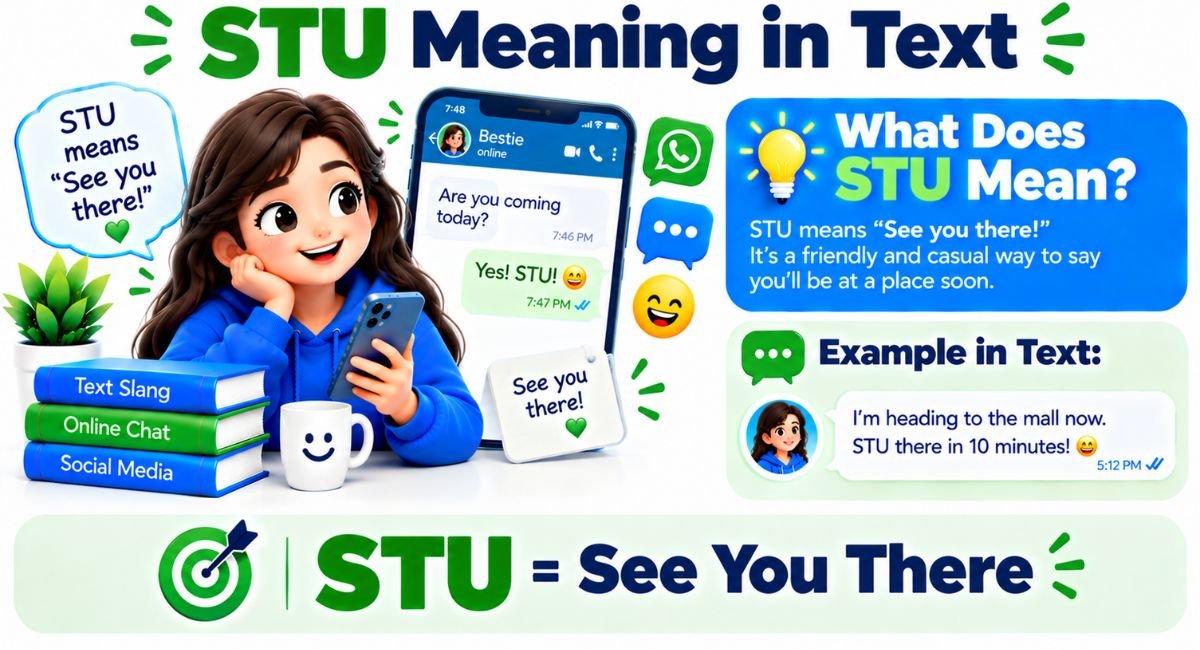
If you have seen STU meaning in text during a chat and wondered what those three letters mean, you are not alone. Short slang terms can be confusing because their meaning often depends on the conversation, tone, and people involved. Knowing what does STU mean in text can help you understand a message without guessing what the sender intended.
This guide explains the meaning, usage, tone, examples, and possible misunderstandings surrounding STU. You will also learn where this abbreviation appears, when it may sound rude, and how context changes its meaning. Keep reading to get a clear answer without unnecessary confusion.
What Does STU Mean in Text?
STU meaning in text can depend on context, while what does STU mean in text usually points readers toward its slang interpretation in casual online conversations and messages. Slang erms can change meaning depending on context, audience, and online communication style.
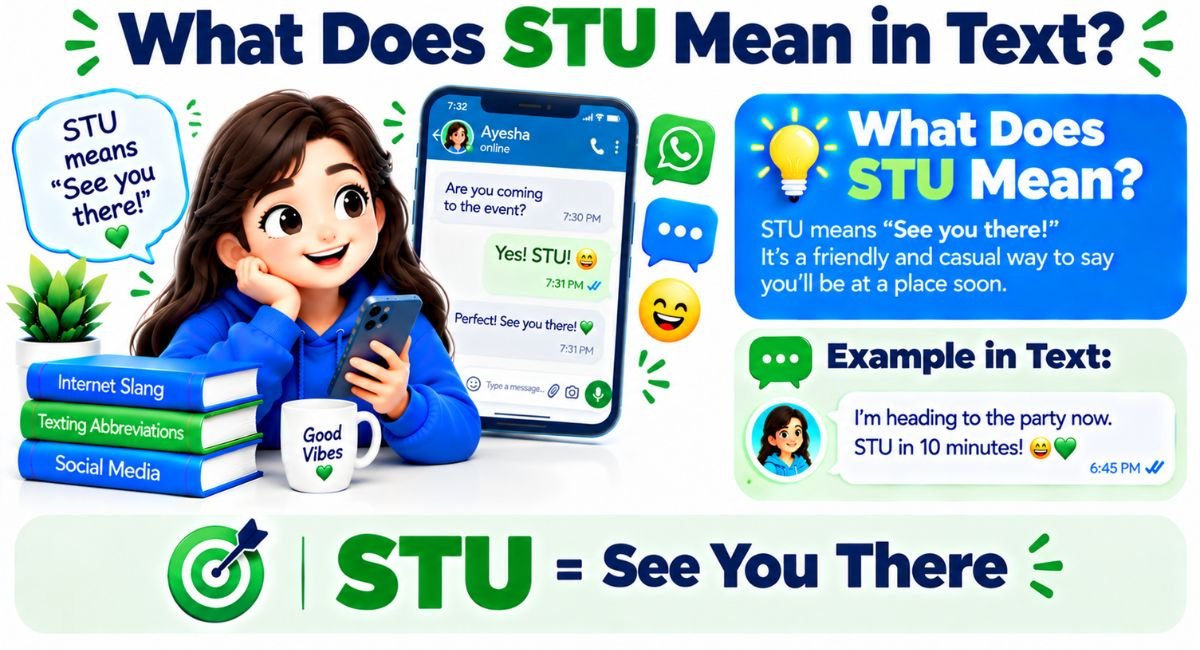
What Does STU Usually Mean?
STU is commonly used as a short form in casual digital communication, but its exact meaning should always be checked against surrounding words.
- Check context before interpreting STU.
- Read nearby words for clues.
- Consider tone and the relationship.
- Avoid assumptions from the abbreviation alone.
- Look for slang cues in the conversation.
Example in texting:
Friend 1: “STU, you actually did that?”
Friend 2: “I know 😭 I couldn’t believe it either.”
STU Meaning
The STU meaning is not always fixed across every conversation. Unlike abbreviations with one widely accepted definition, STU may represent different words or phrases depending on the platform and context.
Why Context Matters With STU
When someone writes STU, the surrounding message often gives the strongest clue about what they intended.
- Review context before replying.
- Notice punctuation and emojis.
- Check previous messages for meaning.
- Consider the platform being used.
- Ask politely when meaning remains unclear.
| Context | What to Check | Why It Matters |
|---|---|---|
| Texting | Nearby words | Reveals conversational intent |
| Social media | Caption or comments | Slang can vary by community |
| Gaming | Chat terminology | Communities use specialized shorthand |
| School | Student-related context | STU may have a different meaning |
| Work | Industry terminology | Acronyms can have technical meanings |
Example in chat:
Friend 1: “What did STU mean there?”
Friend 2: “I think they were using it as slang.”
STU Meaning in Text
The STU meaning in text is best understood through the complete message rather than the three letters alone. If you are asking what does STU mean in text, context should be your first clue.
How Can You Understand STU Correctly?
A short abbreviation can create confusion when several meanings are possible.
- Read the whole sentence first.
- Identify the conversation topic.
- Look at the sender’s tone.
- Check whether STU appears repeatedly.
- Ask for clarification if necessary.
STU can function differently across communities, which makes a simple dictionary-style answer less reliable than contextual interpretation.
Example in texting:
Friend 1: “STU 😭 that was so unexpected.”
Friend 2: “Wait, what are you talking about?”
what does stu mean
If you searched what does stu mean, you probably encountered the abbreviation without enough context to understand it. That is common with internet slang because people often shorten words and phrases during fast conversations.
What Should You Check First?
The easiest way to interpret an unfamiliar abbreviation is to examine how it is being used.
- Read the previous message.
- Check the conversation topic.
- Notice emotional language.
- Look for repeated usage.
- Compare similar slang nearby.
Example in chat:
Friend 1: “I saw STU in the comments.”
Friend 2: “What was the comment about?”
what is a stu
The question what is a stu can have different answers because STU is used as an abbreviation in more than one setting. In casual conversations, slang may be intended, while educational, organizational, or professional contexts can give the letters another meaning.
Why Is STU Difficult to Define?
Three-letter abbreviations are especially dependent on context.
- Slang meanings vary between communities.
- Technical meanings depend on the field.
- Names can create another interpretation.
- School contexts may use STU differently.
- Online communities create informal shorthand.
Example in texting:
Friend 1: “What does STU stand for here?”
Friend 2: “Not sure. The rest of the message should explain it.”
STU Def
STU def is a common search variation used by people looking for a quick definition. However, a useful definition should explain not only the letters but also how people use them in actual conversations.
A Quick Definition
STU should be interpreted according to the message, platform, and surrounding context rather than automatically assigning one meaning.
- STU is an abbreviation.
- Meaning depends on context.
- Tone affects interpretation.
- Platform can influence usage.
- Technical contexts differ.
Example in chat:
Friend 1: “Can you give me the STU def?”
Friend 2: “Sure, but send me the full sentence first.”
Simple Meaning
The simple way to understand STU meaning in text is to avoid treating every abbreviation as having one universal definition. People use short forms differently across texting, social media, gaming, school, and professional communication.
The Easiest Rule
When you see STU, look at the words around it before deciding what it means.
- Context comes first.
- Tone provides clues.
- Platform matters.
- Relationship matters.
- Full sentences reduce confusion.
Example in texting:
Friend 1: “I don’t understand STU here.”
Friend 2: “Send me the whole conversation.”
Where Is STU Used?
STU meaning in text can appear in casual digital communication, while what does STU mean in text becomes easier to answer when you know the platform and conversation type.Other texting abbreviations, such as BYI Meaning in Text, can also appear in casual online conversations.
Common Places You May See STU
Different online environments develop their own abbreviation habits.
- Text messages use quick shorthand.
- Social media comments favor short expressions.
- Group chats create community-specific slang.
- Gaming chats use rapid abbreviations.
- Online forums may develop niche meanings.
| Platform or Setting | Possible Context | What Helps Interpretation |
|---|---|---|
| Text messages | Casual conversation | Previous messages |
| Snapchat | Informal communication | Caption and replies |
| TikTok | Comments and videos | Creator or comment context |
| DMs and comments | Conversation topic | |
| Private/group chats | Message history | |
| Gaming | Fast communication | Game-specific language |
Example in chat:
Friend 1: “Where did you see STU?”
Friend 2: “In a TikTok comment, so I wasn’t sure what it meant.”
Why Do People Use STU?
People use abbreviations because typing shorter messages can make online conversations faster, more casual, and easier to scan. However, STU meaning in text still depends heavily on the context where it appears.
Why Short Forms Feel Natural Online
Digital conversations encourage speed and informal communication.
- Save typing time during quick chats.
- Match casual tone with friends.
- Fit short comments on social platforms.
- Create shared slang within communities.
- Add personality to messages.
Example in texting:
Friend 1: “Why do you always use abbreviations?”
Friend 2: “STU and other short forms just make texting faster.”
1. It’s Shorter
Short abbreviations can reduce typing effort, especially when people are chatting quickly. This makes shorthand attractive in fast-moving conversations where users prefer quick responses over complete formal wording.
- Reduce typing during fast conversations.
- Keep messages compact.
- Speed up replies.
- Fit casual chats.
- Create conversational rhythm.
Example in texting:
Friend 1: “Why shorten everything?”
Friend 2: “Because quick messages are easier when we’re chatting fast.”
2. It Softens the Swear Word
Some slang abbreviations are created to shorten stronger expressions or make them feel less direct. However, STU should not automatically be interpreted as a softened swear word without enough contextual evidence.
- Check the surrounding words.
- Notice emotional tone.
- Avoid assuming profanity.
- Consider the sender’s style.
- Read the entire exchange.
Example in chat:
Friend 1: “Was STU supposed to be rude?”
Friend 2: “Maybe, but I’d need the full conversation.”
3. It Can Be Playful
Internet slang often adds personality to ordinary conversations. An abbreviation may feel humorous, dramatic, sarcastic, or playful depending on the people communicating.
- Play with tone among friends.
- Use emojis for extra emotion.
- Match the group’s style.
- Keep jokes understandable.
- Avoid confusing new readers.
Example in texting:
Friend 1: “STU 😭 why would you do that?”
Friend 2: “Because it seemed funny at the time.”
4. Internet Culture Loves Abbreviations
Online communication has created countless abbreviations, from everyday texting shorthand to niche community expressions. People often prefer compact language that works naturally with rapid digital conversations.
- Shorten common phrases.
- Create community language.
- Make replies faster.
- Express emotion quickly.
- Adapt language online.
Example in chat:
Friend 1: “Everyone in this group uses abbreviations.”
Friend 2: “That’s basically normal internet language now.”
Examples of STU in Real Life
Examples make STU meaning in text easier to understand because the same abbreviation can feel different depending on emotion, relationship, and situation.
How Can STU Change With Tone?
The surrounding message can make an abbreviation seem playful, confused, annoyed, or surprised.
- Playful messages may include emojis.
- Annoyed messages often sound shorter.
- Shocked reactions may use punctuation.
- Arguments can make slang sound harsher.
- Friendly chats usually feel more relaxed.
Example in chat:
Friend 1: “STU, seriously?”
Friend 2: “Okay, okay. I get it 😂”
Example 1: Playful Use
A playful message can make slang feel less serious, especially when friends already understand each other’s communication style.
- Use humor when appropriate.
- Add emojis for clarity.
- Match the relationship.
- Avoid confusing strangers.
- Keep the tone light.
Example in texting:
Friend 1: “STU 😂 you really posted that?”
Friend 2: “Yep. I had to!”
Example 2: Annoyed Use
In an annoyed conversation, short abbreviations can make a message feel sharper. Context and punctuation can strongly affect how the recipient interprets the message.
- Keep criticism clear.
- Avoid unnecessary hostility.
- Read before sending.
- Consider the recipient.
- Clarify serious concerns.
Example in texting:
Friend 1: “STU, you forgot again.”
Friend 2: “Oh, you’re right. My mistake.”
Example 3: Shocked Reaction
Short slang can appear in surprised reactions because users often type quickly when something unexpected happens.
- React naturally.
- Use punctuation carefully.
- Add context when needed.
- Avoid ambiguous replies.
- Match the situation.
Example in chat:
Friend 1: “STU 😭 Did you actually win?”
Friend 2: “Yes! I still can’t believe it.”
Example 4: Argument Context
During an argument, unfamiliar slang can make communication harder. A direct explanation is usually better when the conversation involves an important disagreement.
- Avoid vague shorthand.
- Explain your point.
- Control emotional language.
- Use clear wording.
- Ask before assuming intent.
Example in texting:
Friend 1: “STU, that’s not what happened.”
Friend 2: “Then tell me what actually happened.”
STU vs Similar Terms
Comparing STU with other abbreviations can prevent confusion because short internet expressions often look similar while carrying completely different meanings.
How Should You Compare Slang?
Look at meaning, tone, and context rather than comparing letters alone.
| Term | General Type | Best Clue |
|---|---|---|
| STU | Context-dependent abbreviation | Surrounding message |
| TBH | Texting abbreviation | Honesty or opinion |
| NGL | Texting abbreviation | Frank admission |
| FR | Internet slang | Agreement or emphasis |
| OMG | Reaction abbreviation | Surprise or emotion |
| ISTG | Strong emphasis | Context and emotional tone |
- Compare meaning, not spelling.
- Check tone before replying.
- Read surrounding text.
- Notice platform usage.
- Avoid treating slang as universal.
Example in chat:
Friend 1: “Is STU the same as TBH?”
Friend 2: “Not necessarily. They can serve different purposes.”
When Should You Use STU?
Use STU meaning in text only when the recipient is likely to understand the abbreviation. Casual slang works best when both people share similar communication habits.
Who Is Most Likely to Understand It?
Familiarity matters more than trying to sound trendy.
- Use slang with friends who understand it.
- Match the existing tone.
- Avoid unclear shorthand.
- Explain unfamiliar abbreviations.
- Use standard wording when clarity matters.
Example in texting:
Friend 1: “Can I use STU in this group?”
Friend 2: “If everyone understands it, sure.”
Common Misunderstandings About STU
Many searches for what does STU mean in text happen because readers assume the abbreviation has one fixed definition. That assumption can lead to incorrect interpretations .Like STU, ARL Meaning in Text can also be confusing when you see it without enough context.
1. Is STU a Name?
STU can appear as a name or nickname in some contexts. Therefore, not every appearance of STU should automatically be interpreted as internet slang.
- Check capitalization.
- Look at the sentence.
- Consider personal names.
- Review previous messages.
- Ask when uncertain.
Example in chat:
Friend 1: “Is STU talking about a person?”
Friend 2: “Maybe. The previous message mentions someone named Stu.”
2. Does STU Mean “Student”?
In some settings, STU can be used as an abbreviation connected with student-related wording. However, context is essential because the same letters can represent different terms.
- Check school context.
- Look for academic words.
- Avoid automatic assumptions.
- Consider local shorthand.
- Read the complete sentence.
Example in texting:
Friend 1: “Does STU mean student here?”
Friend 2: “It could, because we’re discussing the class.”
3. Is It Always Rude?
STU should not automatically be labeled rude. Tone, context, relationship, and the intended meaning determine how a recipient may interpret it.
- Check emotional tone.
- Consider the relationship.
- Look at surrounding language.
- Avoid judging quickly.
- Clarify unclear messages.
Example in chat:
Friend 1: “Was that STU message rude?”
Friend 2: “It depends on what they meant by it.”
Pro Tips for Using STU Correctly
Understanding STU meaning in text is only part of communicating clearly. Good slang usage also requires knowing your audience and recognizing when a shorter expression could create confusion. Understanding terms such as DUMP ACCOUNT Meaning in Text also becomes easier when you consider how and where the phrase is used.
Know Your Audience
Not everyone follows internet slang, so the same abbreviation can be clear to one person and confusing to another.
- Know the recipient.
- Match their vocabulary.
- Avoid forced slang.
- Explain unusual terms.
- Prioritize understanding.
Example in texting:
Friend 1: “Should I explain STU?”
Friend 2: “Yes, if they haven’t seen the term before.”
Read the Room
A casual abbreviation may work perfectly in a friendly conversation but feel inappropriate in a serious or formal discussion.
- Match the mood.
- Respect serious topics.
- Use formal wording when needed.
- Watch emotional reactions.
- Choose clarity over trends.
Example in chat:
Friend 1: “Should I use STU in this work message?”
Friend 2: “I’d use clearer wording instead.”
Avoid Overusing It
Repeated slang can make messages difficult to understand and may reduce the impact of the expression.
- Keep slang occasional.
- Avoid repeated abbreviations.
- Write clearly.
- Mix shorthand naturally.
- Let context guide you.
Example in texting:
Friend 1: “Why is every sentence STU something?”
Friend 2: “Fair point. I might be overdoing it.”
Add Context If Needed
When an abbreviation has several possible interpretations, a few extra words can prevent unnecessary confusion.
- Give enough context.
- Clarify unusual slang.
- Avoid ambiguous replies.
- Explain niche meanings.
- Consider new readers.
Example in chat:
Friend 1: “What does STU mean here?”
Friend 2: “I mean it in the slang sense, not as a name.”
The Emotional Side of STU
The emotional effect of STU meaning in text depends heavily on how it appears. The same abbreviation can feel funny, frustrated, surprised, or confusing when placed in different messages.
How Does Tone Change Meaning?
Digital communication removes many facial expressions and vocal cues, so punctuation and surrounding words become important.
- Emojis can soften reactions.
- Punctuation can increase intensity.
- Capitalization may add emphasis.
- Short replies can feel blunt.
- Extra context reduces uncertainty.
Example in texting:
Friend 1: “STU 😭 I can’t believe you.”
Friend 2: “I knew you’d react like that 😂”
Is STU Popular in 2026?
Whether STU meaning in text is popular depends on the community, platform, and specific meaning. Three-letter abbreviations continue to appear across online communication, but not every abbreviation has the same level of widespread recognition.
Why Can Slang Popularity Change?
Internet language changes quickly as platforms and online communities evolve.
- Trends change across platforms.
- Communities create slang.
- Older terms fade.
- New abbreviations appear.
- Context shapes popularity.
Example in chat:
Friend 1: “Is STU still popular?”
Friend 2: “I see different abbreviations everywhere, so it depends on the group.”
Should Parents or Professionals Worry About It?
Parents and professionals generally do not need to judge an abbreviation based only on its appearance. The important issue is understanding what the sender means and whether the surrounding conversation is appropriate.
What Should Adults Look For?
Context provides much more useful information than focusing on one unfamiliar abbreviation.
- Read the full conversation.
- Check the surrounding language.
- Ask calmly about unfamiliar terms.
- Consider the platform.
- Focus on behavior and context.
Example in chat:
Parent: “What does STU mean in this message?”
Teen: “It depends on what the person was talking about.”
What Does STU Really Mean in Texting?
If you are asking what does STU mean in text, the safest answer is that its interpretation depends on context, platform, and surrounding words rather than assuming one universal definition.
How Can You Find the Intended Meaning?
A contextual approach gives you a more reliable interpretation.
- Read the complete message.
- Check previous replies.
- Identify the conversation topic.
- Look for emotional clues.
- Ask the sender directly.
Example in texting:
Friend 1: “I still don’t know what STU means.”
Friend 2: “Send me the full sentence and we’ll figure it out.”
Why Do People Use STU Online?
People use short expressions online because digital conversations often favor speed, informality, and shared language. The exact reason someone uses STU depends on their communication style and the context of the conversation.
What Makes Abbreviations Useful?
Short forms can make casual communication feel quicker and more conversational.
- Save time while typing.
- Keep replies short.
- Match informal language.
- Create shared expressions.
- Add personality.
Example in chat:
Friend 1: “Why is online slang everywhere?”
Friend 2: “Short words make fast conversations easier.”
When Should You Avoid Using STU in Messages?
Avoid using an unclear abbreviation when the recipient may misunderstand your message. Clear wording is especially important in professional, academic, serious, or unfamiliar conversations.
When Is Standard Language Better?
The goal of communication should always be understanding.
- Use formal wording at work.
- Avoid unexplained slang with strangers.
- Clarify serious messages.
- Choose direct language during conflict.
- Prioritize the recipient’s understanding.
Example in texting:
Friend 1: “Should I put STU in my application email?”
Friend 2: “No, use the full wording instead.”
Frequently Asked Questions
What does STU mean in text?
STU meaning in text depends on context, so read the surrounding message carefully.
What does STU mean in texting?
STU meaning in text can vary between casual conversations, communities, and online platforms.
What does STU def mean?
STU meaning in text is often searched as “STU def” for a quick definition.
Does STU always have one meaning?
STU meaning in text is context-dependent and may represent different terms.
Is STU rude?
STU meaning in text does not automatically indicate rudeness; tone determines interpretation.
Can STU mean student?
STU meaning in text can relate to student contexts, but surrounding words matter.
Should I use STU professionally?
STU meaning in text may be unclear professionally, so standard wording is usually clearer.
Conclusion
Understanding STU meaning in text is less about memorizing three letters and more about reading the situation around them. Online abbreviations can change meaning depending on the platform, community, relationship, and tone of a conversation.
If you searched STU meaning in text because someone used it in a message, start by checking the surrounding words before assuming what they meant. The same applies when someone asks what does STU mean in text without providing the original conversation. Context is often the missing piece.
Ultimately, STU meaning in text should be interpreted carefully rather than automatically labeled as slang, a name, or a student abbreviation. When clarity matters, asking the sender for context is always a simple and practical solution.

LearnerGrammar.com helps English learners improve grammar, vocabulary, writing, and communication skills with simple lessons and tips.