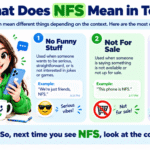
NFS mean in text is a phrase people search when they receive a confusing message, see an unfamiliar caption, or notice three letters in a social media comment. You might assume NFS has one simple meaning, but the truth is more interesting. Depending on the conversation, NFS can mean No Funny Stuff, Not For Sale, or Need for Speed. Choosing the wrong meaning can lead to an awkward reply, especially when the conversation is serious or someone is discussing an item for sale.
If you’re asking what does NFS mean in text, the easiest way to understand it is to look at the surrounding words and situation. This guide explains the common meanings, social media usage, realistic examples, and simple replies so you can understand NFS with confidence.
NFS Text Meaning – Quick Meaning
The nfs mean in text question has more than one possible answer, which is why the context matters. NFS may express seriousness, mark an item as unavailable for purchase, or refer to a racing video game.
What Are the Main Meanings of NFS?
- No Funny Stuff: Signals that someone wants a conversation taken seriously.
- Not For Sale: Indicates that an item is not available to buy.
- Need for Speed: Refers to the racing video game franchise.
- Context: Helps you distinguish between these meanings.
- Clarification: Asking the sender can prevent confusion.
| NFS meaning | Common context | Example |
|---|---|---|
| No Funny Stuff | Casual conversation | “I’m serious, NFS.” |
| Not For Sale | Marketplace or collection | “This pair is NFS.” |
| Need for Speed | Gaming | “Anyone playing NFS?” |
Example in texting:
Friend 1: Are you joking about what happened?
Friend 2: No, NFS. I’m being serious.
NFS meaning text
Seeing someone write “NFS?” can feel confusing when you do not know which meaning they intend. In a casual conversation, they might be asking about No Funny Stuff, but in a selling or gaming conversation, the same letters may mean something different.
- Read the message: Check the words surrounding NFS.
- Identify the topic: Determine whether the conversation involves feelings, products, or games.
- Check punctuation: A question mark may indicate a request for clarification.
- Avoid assumptions: Do not decide the meaning from the abbreviation alone.
- Ask directly: A simple question can clear things up.
Example in chat:
Friend 1: NFS?
Friend 2: I mean no funny stuff. I’m being serious.
what dose nfs mean in text
If you’re searching what dose nfs mean in text, you probably want to understand an abbreviation you saw in a message. The grammatically correct search phrase is “what does NFS mean in text?” Its meaning depends on the situation, but No Funny Stuff is one interpretation used in casual slang.
- No Funny Stuff: May signal seriousness.
- Not For Sale: Often appears beside an item.
- Need for Speed: May appear in gaming conversations.
- Tone: Can help explain the sender’s intention.
- Context: Is the most useful clue.
Example in texting:
Friend 1: What does NFS mean here?
Friend 2: In this chat, I mean no funny stuff.
NFS mean in text
The phrase nfs mean in text usually points to a slang definition, but there is no guarantee that every sender uses NFS the same way. A message about emotions may suggest one meaning, while a photo of shoes with an NFS caption may indicate another.
- Look for the subject: Feelings, products, and games provide different clues.
- Check the sentence: The full message matters.
- Consider the platform: Marketplace posts differ from private chats.
- Notice the tone: A serious message may suggest No Funny Stuff.
- Confirm when unsure: Ask the person who wrote it.
Example in chat:
Friend 1: These sneakers look amazing. Are you selling them?
Friend 2: No, they’re NFS.
NFS meaning text slang
In slang, NFS can be used to add emphasis or show that someone is serious. However, nfs meaning text slang is not limited to one definition. The abbreviation also appears in buying and selling communities, where Not For Sale is a straightforward label.
- Casual slang: May mean No Funny Stuff.
- Marketplace language: May mean Not For Sale.
- Gaming discussions: May refer to Need for Speed.
- Informal tone: Is common in short online messages.
- Different meanings: Make context essential.
Example in texting:
Friend 1: You’re really not joking?
Friend 2: NFS, I’m telling the truth.
1. No Funny Stuff
When someone uses NFS during a serious conversation, they may mean No Funny Stuff. This interpretation tells the other person not to joke around, mislead them, or treat the topic lightly. The exact tone still depends on the words and relationship.
How Is No Funny Stuff Used?
- Serious requests: Shows that the speaker means what they say.
- Honest conversations: Emphasizes sincerity.
- Friendly challenges: Can signal that someone wants a genuine answer.
- Boundaries: May communicate that a topic should not become a joke.
- Casual messages: Fits informal conversations better than formal writing.
Example in texting:
Friend 1: Are you actually telling me the truth?
Friend 2: Yes, NFS. I’m being completely serious.
2. Not For Sale
In a marketplace or collector conversation, NFS commonly stands for Not For Sale. People may use it when posting a photo of an item they own but do not want to sell. This is particularly useful when sharing collections, clothing, sneakers, artwork, or other possessions.
How Can You Recognize This Meaning?
- Product photos: The letters may appear beside an item.
- Sneaker collections: A pair may be shown without being offered for purchase.
- Collector posts: Someone may display a prized possession.
- Marketplace listings: NFS can clarify that an item is unavailable.
- Buying questions: The sender may be answering whether the item can be purchased.
Example in chat:
Friend 1: How much are you selling these shoes for?
Friend 2: I’m not selling them. They’re NFS.
3. Need For Speed
In gaming conversations, NFS may refer to Need for Speed, a well-known racing video game franchise. This meaning is more likely when people are discussing games, racing, cars, gameplay, or playing together online.
When Does NFS Refer to the Game?
- Gaming chats: Friends may discuss playing NFS.
- Racing games: The abbreviation may refer to the franchise.
- Game recommendations: Someone may ask whether you enjoy NFS.
- Gameplay discussions: The context may mention cars or races.
- Game titles: Check whether the conversation is about entertainment.
Example in chat:
Friend 1: What game should we play tonight?
Friend 2: Need for Speed. NFS is fun when we race together.
4. Quick Examples
Realistic examples can make nfs mean in text easier to understand. Instead of memorizing one definition, look at the topic of each message and use it to identify the likely meaning.
How Do People Use NFS in Messages?
- Serious conversation: “I’m telling you the truth, NFS.”
- Marketplace post: “My personal collection, NFS.”
- Gaming chat: “Anyone want to play NFS?”
- Relationship conversation: “I really mean it, NFS.”
- Product question: “Sorry, that item is NFS.”
| Message | Likely meaning |
|---|---|
| “NFS, I’m serious” | No Funny Stuff |
| “This jacket is NFS” | Not For Sale |
| “Let’s play NFS” | Need for Speed |
| “No jokes, NFS” | No Funny Stuff |
Example in chat:
Friend 1: Can I buy the jacket in your picture?
Friend 2: Sorry, it’s NFS. I’m keeping it.
Origin & Background
NFS does not have one single meaning or origin across every online community. Abbreviations often develop independently in texting, gaming, and marketplace settings. The letters can represent different phrases because each community has its own communication habits.
The expression Not For Sale is a natural label for products and collections. Need for Speed is associated with the game franchise, while No Funny Stuff appears as an informal phrase in some texting contexts. Without reliable historical evidence, it is better not to assign a precise date or claim that one meaning came first.
Why Do People Use NFS?
- Speed: Short forms make messages quicker to type.
- Convenience: Three letters can replace a longer phrase.
- Shared language: Communities develop abbreviations familiar to their members.
- Limited space: Short captions can be easier to read.
- Context: The same abbreviation can serve different purposes.
Example in texting:
Friend 1: Why do you write NFS instead of the whole phrase?
Friend 2: It’s shorter, and people in this chat understand it.
Real-Life Conversations
The best way to understand nfs mean in text is to see how the abbreviation works in different situations. A message between friends may use NFS to emphasize sincerity, while a product post may use it to indicate that an item is not available for purchase.
On WhatsApp, NFS may appear in a private message or group conversation. If someone is discussing a personal issue, they may use it to signal seriousness. If the conversation is about a product or game, another interpretation may fit better.
- Personal chats: May emphasize sincerity.
- Group messages: Can be understood through shared context.
- Buying conversations: May indicate an item is not for sale.
- Gaming groups: May refer to Need for Speed.
- Unclear messages: May require a quick follow-up question.
Example in chat:
Person A: You’re really serious about this?
Person B: Yes, NFS. I’m not joking.
Instagram DMs
On Instagram, NFS may appear in direct messages, captions, or comments. The meaning depends on whether someone is sharing an emotional thought, displaying a personal possession, or discussing a game.
- Direct messages: May use NFS as informal slang.
- Collection photos: May indicate that an item is not for sale.
- Comments: The topic can help clarify the abbreviation.
- Gaming content: May refer to Need for Speed.
- Private conversations: Should be interpreted with care.
Example in chat:
Person A: Are those sneakers available?
Person B: No, they’re NFS. Just sharing my collection.
TikTok Comments
TikTok comments often use short expressions because users respond quickly to videos. NFS may be used as slang in a comment, but a video about collectibles or gaming can point toward a different meaning.
- Emotional videos: May invite a serious response.
- Gaming videos: May reference Need for Speed.
- Collection videos: May use Not For Sale.
- Comment threads: Read the full discussion.
- Unfamiliar slang: Check whether other users explain it.
Example in chat:
Person A: This story is actually serious.
Person B: NFS, I wasn’t expecting that ending either.
Text Messages
In ordinary SMS messages, NFS may be used between people who are familiar with the abbreviation. However, if the recipient does not know the term, writing the complete phrase is clearer.
- Friends: May understand informal slang.
- Serious discussions: No Funny Stuff may fit the context.
- Product questions: Not For Sale may be intended.
- Gaming plans: Need for Speed may be the topic.
- Clear communication: Spell out the phrase when needed.
Example in chat:
Person A: Are you joking about what happened?
Person B: No, NFS. I’m being serious.
Emotional & Psychological Meaning
When NFS is used to mean No Funny Stuff, it may signal that a person wants to be taken seriously. However, the abbreviation alone cannot prove that someone feels hurt, angry, vulnerable, or emotionally close to you. Those interpretations depend on the wider conversation.
What Feelings Might NFS Communicate?
- Sincerity: The speaker may want to emphasize honesty.
- Frustration: The sender may be tired of jokes about a serious topic.
- Vulnerability: They may be sharing something personal.
- Trust: They may want their words to be believed.
- Uncertainty: Ask for clarification instead of interpreting emotions from three letters.
Example in texting:
Person A: Do you really miss me?
Person B: Yes, NFS. I mean it.
Usage in Different Contexts
The interpretation of NFS changes with the topic, audience, and tone. Understanding nfs mean in text requires checking what the conversation is about before deciding whether the sender means No Funny Stuff, Not For Sale, or Need for Speed.
On social media, NFS can appear in captions, comments, stories, and direct messages. It may emphasize a serious statement or label a personal item that is not being sold.
Social Media
- Captions: Check the photo or video.
- Comments: Read the conversation around the abbreviation.
- Stories: Consider whether the content is personal or product-related.
- Gaming posts: Look for references to racing games.
- Marketplace content: Check whether an item is being offered for sale.
Example in chat:
Person A: Is the bag in your photo available?
Person B: No, it’s NFS.
Friends & Relationships
Between friends or partners, NFS may mean No Funny Stuff when someone wants an honest response. Still, it should not be treated as a guaranteed sign of love, anger, jealousy, or any other emotion.
- Honest questions: May emphasize that a response should be genuine.
- Personal boundaries: Can discourage joking about a serious topic.
- Sensitive discussions: Clear words may be better than slang.
- Relationship messages: Read the full sentence before interpreting tone.
- Clarification: Ask what the person means if unsure.
Example in chat:
Person A: Do you really want to work things out?
Person B: Yes, NFS. I’m serious about talking.
Work / Professional Settings
NFS can be confusing in a professional environment because colleagues may interpret it differently. For workplace communication, it is usually better to write the full phrase instead of relying on informal slang.
- Emails: Use complete sentences.
- Business listings: Clearly label items that are not for sale.
- Team chats: Explain unfamiliar abbreviations.
- Client communication: Avoid ambiguous slang.
- Technical discussions: Check the terminology used by your team.
Example in chat:
Colleague A: Is the sample item available for purchase?
Colleague B: No, the sample is not for sale.
Casual vs Serious Tone
NFS can appear in a casual message while communicating a serious point. The letters themselves do not determine the tone; the surrounding words, punctuation, and relationship between the speakers all contribute.
- Casual use: May appear among friends.
- Serious use: Can emphasize that a statement is genuine.
- Playful use: May be used jokingly, depending on the group.
- Marketplace use: Usually describes whether an item is available.
- Clear wording: Helps avoid tone confusion.
Example in chat:
Person A: You’re joking again, right?
Person B: NFS, I’m actually serious this time.
When NOT to Use It
Although NFS can be convenient in informal conversations, it is not suitable for every situation. When clarity is important, the complete phrase is safer than an abbreviation with multiple possible meanings.
Avoid using NFS in:
- Formal Emails: Write complete, professional sentences.
- Academic Writing: Use standard language instead of texting slang.
- Sensitive Conversations: Explain your meaning clearly and respectfully.
- Cross-Cultural Conversations: Do not assume everyone recognizes the abbreviation.
- Business Transactions: State explicitly whether an item is for sale.
Example in chat:
Colleague A: What does NFS mean in this email?
Colleague B: I’ll write it out clearly so there’s no confusion.
Formal Emails
Using NFS in a formal email may make the message unclear. A full phrase helps the recipient understand your intention without needing to interpret slang.
- Use clear language: Avoid unexplained abbreviations.
- State your purpose: Explain whether you are serious or discussing availability.
- Consider the reader: They may not know internet slang.
- Be professional: Keep workplace communication direct.
- Proofread: Check that the intended meaning is obvious.
Example in chat:
Employee A: Can I use NFS in this client email?
Employee B: Better to write the full phrase.
Academic Writing
Academic work usually requires precise language. NFS may be appropriate when discussing a specific abbreviation, but it should not replace a clear explanation in an essay or assignment.
- Define terms: Explain abbreviations when they are relevant.
- Use formal wording: Avoid casual slang in academic arguments.
- Follow guidelines: Apply your instructor’s formatting rules.
- Avoid ambiguity: Make the meaning explicit.
- Check context: Use NFS only when appropriate to the subject.
Example in chat:
Student A: Should I write NFS in my essay?
Student B: Only if you define it and the topic requires it.
Sensitive Conversations
When someone is upset or sharing a difficult experience, an abbreviation may sound dismissive or unclear. It is often kinder to respond using direct, thoughtful language.
- Show empathy: Acknowledge what the person shared.
- Use clear words: Explain what you mean.
- Avoid assumptions: Do not guess someone’s emotional state from NFS.
- Listen carefully: Respond to the actual concern.
- Respect boundaries: Let the person decide what they want to share.
Example in chat:
Person A: I need you to take this seriously.
Person B: I understand, and I’m listening.
Cross-Cultural Conversations
People from different language backgrounds may not recognize the same slang. NFS can be particularly confusing when a conversation includes people who use English differently or belong to different online communities.
- Avoid assumptions: Not everyone knows the abbreviation.
- Explain politely: Spell out the intended phrase.
- Use simple English: Prefer wording most readers understand.
- Check understanding: Ask whether the message is clear.
- Respect differences: Slang familiarity varies between individuals.
Example in chat:
Person A: What does NFS mean?
Person B: Here, I mean “Not For Sale.”
Business Transactions
When buying or selling something, ambiguity can cause practical problems. If you mean that an item is unavailable, write Not For Sale rather than expecting every buyer to understand NFS.
- State availability: Clearly say whether an item can be purchased.
- Avoid confusion: Do not rely on unexplained initials.
- Answer questions: Clarify whether an item is available.
- Use accurate listings: Make product status obvious.
- Confirm details: Ensure both parties understand the transaction.
Example in chat:
Buyer: Is this watch available?
Seller: No, it is not for sale.
Common Misunderstandings
The biggest mistake people make with NFS is assuming it always means one thing. The intended definition depends on the topic, and a message that makes sense in one community may be confusing in another.
1. Assuming Only One Meaning
NFS does not have a single universal meaning across every platform. No Funny Stuff, Not For Sale, and Need for Speed may each fit different situations.
- Check the subject: Identify what the conversation is about.
- Look for clues: Nearby words can help.
- Avoid automatic assumptions: Do not use one definition everywhere.
- Ask questions: Clarify when the message is unclear.
- Learn common uses: Familiarity makes interpretation easier.
Example in chat:
Person A: NFS means No Funny Stuff, right?
Person B: Sometimes, but it can also mean Not For Sale.
2. Tone Confusion
When NFS means No Funny Stuff, it can sound firm or serious. That does not automatically mean the sender is angry. Tone depends on the complete message and relationship.
- Read the sentence: Do not judge by NFS alone.
- Check punctuation: Exclamation marks can affect how a message feels.
- Consider the relationship: Friends may communicate differently from strangers.
- Avoid overthinking: A short abbreviation does not reveal every emotion.
- Ask respectfully: Clarify if the tone genuinely concerns you.
Example in chat:
Person A: You sound angry. What happened?
Person B: I’m not angry; I just mean no funny stuff.
3. Marketplace Confusion
A person showing a product with NFS may be saying it is Not For Sale, not asking others to take the conversation seriously. This distinction matters when commenting on collections or personal belongings.
- Look at the image: A product photo can provide context.
- Check the caption: Sellers may explain the item’s status.
- Ask about availability: Do not assume it is being sold.
- Respect the answer: Accept that an item may not be available.
- Use explicit wording: “Not for sale” is clearer.
Example in chat:
Person A: I want to buy that pair.
Person B: Sorry, NFS. I’m keeping it.
4. Overusing It
Using slang in every message can make communication harder, particularly when the recipient does not know the abbreviation. NFS is most useful when its intended meaning is clear.
- Keep it natural: Do not force abbreviations into every sentence.
- Know your audience: Consider whether the recipient understands slang.
- Prefer clarity: Use full words when the topic is important.
- Avoid repetition: One clear explanation is usually enough.
- Adapt your style: Match the situation and audience.
Example in chat:
Person A: What do you mean by NFS?
Person B: Sorry, I mean I’m serious. I’ll explain clearly.
Comparison Table
Comparing NFS with other abbreviations can help you understand how people communicate seriousness, agreement, humor, or availability online. The key is to recognize that these expressions do different jobs and are not always interchangeable.
How Does NFS Compare With Similar Slang?
- FR: Commonly means “For Real.”
- ONG: Commonly expands to “On God,” emphasizing sincerity.
- JK: Means “Just Kidding.”
- SRS: Can be shorthand for “serious.”
- FS: Often means “For Sure” in informal chats.
| Expression | Common meaning | Typical use |
|---|---|---|
| NFS | No Funny Stuff / Not For Sale | Serious chats or item listings |
| FR | For Real | Emphasizing sincerity |
| ONG | On God | Strong emphasis or sincerity |
| JK | Just Kidding | Clarifying a joke |
| SRS | Serious | Indicating seriousness |
| FS | For Sure | Agreement or confirmation |
Example in chat:
Person A: Are you being serious?
Person B: FR, I’m not joking.
Key Insight
NFS is useful precisely because context helps identify its meaning. The same letters can describe a serious statement, a personal item that is not for sale, or a video game.
- Read carefully: Look at the entire message.
- Identify the setting: A marketplace differs from a gaming chat.
- Check the tone: Emotional wording can suggest the intended meaning.
- Avoid assumptions: Several meanings may be possible.
- Clarify: Ask when you cannot tell.
Example in chat:
Person A: You wrote NFS on your picture. What does that mean?
Person B: It means the item isn’t for sale.
Variations / Types
People may combine NFS with other words to add emphasis or make a message sound more conversational. Some combinations are understandable variations rather than established slang terms, so their meanings should be judged from context.
1. NFS bro
“NFS bro” may be used when someone wants a friend to take a statement seriously. The exact meaning depends on the conversation.
- Audience: Usually a friend or familiar contact.
- Tone: Informal.
- Purpose: May emphasize sincerity.
- Context: Read the sentence around it.
- Alternative: “Bro, I’m serious.”
Example in chat:
Friend 1: You’re making that up.
Friend 2: NFS bro, I’m telling the truth.
2. NFS though
“NFS though” may add emphasis to a previous statement, especially when NFS means No Funny Stuff. It is not a fixed phrase with one universal interpretation.
- Emphasis: Reinforces the statement.
- Tone: Casual.
- Context: The previous message matters.
- Clarity: Explain the phrase if needed.
- Alternative: “Seriously, though.”
Example in chat:
Friend 1: That was the best concert ever.
Friend 2: NFS though, it really was amazing.
3. NFS fr
Adding “fr,” commonly meaning “for real,” can intensify the idea of sincerity. The combination may be redundant, so its exact meaning depends on how the sender uses slang.
- NFS: May mean No Funny Stuff.
- FR: Commonly means For Real.
- Tone: Informal and emphatic.
- Audience: Best suited to people familiar with the terms.
- Clarity: Use a full phrase when the meaning is uncertain.
Example in chat:
Friend 1: You really enjoyed that movie?
Friend 2: NFS fr, it was so good.
4. NFS rn
“Rn” commonly means “right now.” When combined with NFS, it may refer to being serious at that moment, but the interpretation depends on the sentence.
- Rn: Means right now in common texting usage.
- Context: Helps identify the meaning of NFS.
- Tone: Usually casual.
- Timing: Adds a sense of immediacy.
- Alternative: Write “right now” for clarity.
Example in chat:
Friend 1: Are you serious about this?
Friend 2: NFS rn, I’m being honest.
5. NFS this hurt
This wording may be used in an emotional post, but it is not a standard expression with a single established meaning. The complete sentence matters more than the abbreviation alone.
- Emotion: The message may describe hurt feelings.
- Context: Read the entire post.
- Tone: Could be serious or expressive.
- Avoid assumptions: NFS alone does not reveal the person’s feelings.
- Response: Be considerate if someone shares a painful experience.
Example in chat:
Friend 1: That comment really hurt me.
Friend 2: I’m sorry. Do you want to talk about it?
6. NFS I miss you
When NFS appears beside “I miss you,” the sender may be emphasizing sincerity if they mean No Funny Stuff. However, the phrase is context-dependent and should not be treated as a fixed abbreviation.
- Meaning: May emphasize that the statement is genuine.
- Tone: Personal and informal.
- Context: The relationship matters.
- Response: Answer honestly.
- Clarity: Ask what they mean if uncertain.
Example in chat:
Person 1: Do you really miss me?
Person 2: Yes, NFS. I miss talking to you.
7. NFS pair
In a sneaker or collectible context, “NFS pair” generally indicates that the pair is Not For Sale. It is a descriptive label rather than a separate texting definition.
- Pair: Often refers to shoes or another matching set.
- NFS: Indicates the item is unavailable for purchase.
- Context: Product photos may clarify the meaning.
- Buying: Ask about availability before making an offer.
- Clarity: Spell out “Not For Sale” when needed.
Example in chat:
Buyer: Are you selling these sneakers?
Owner: No, they’re my personal NFS pair.
8. NFS collection
An NFS collection is a collection of items that the owner is not offering for sale. This use is most understandable in a collecting or resale context.
- Collection: May include shoes, toys, cards, or other items.
- NFS: Means Not For Sale in this context.
- Purpose: Shows the items without inviting purchase.
- Context: Check the caption or listing.
- Alternative: “Personal collection, not for sale.”
Example in chat:
Friend 1: Can I buy one of your collectibles?
Friend 2: Sorry, the whole collection is NFS.
9. NFS pls
“NFS pls” may be used informally to request that someone avoid joking or to emphasize a preference. Its meaning is not universal, so the rest of the message is important.
- Pls: Common shorthand for please.
- Tone: May sound casual or firm.
- Context: Read what comes before it.
- Clarity: A full sentence may be more effective.
- Respect: Respond to the actual request.
Example in chat:
Friend 1: I’m going to tell everyone your secret.
Friend 2: NFS pls, I’m serious about keeping it private.
10. NFS mode
“NFS mode” is not a universally established phrase. In an informal message, someone might use it to describe being serious, but other communities may interpret the letters differently.
- Informal use: May describe a serious mood.
- Context: The surrounding sentence is essential.
- Gaming: NFS could refer to Need for Speed.
- Avoid assumptions: Do not treat it as a fixed slang term.
- Clear alternative: Say “I’m being serious” if that is your intention.
Example in chat:
Friend 1: Are you joking or being serious?
Friend 2: Serious mode today. No jokes, please.
How to Respond When Someone Uses It
The best response to NFS depends on the meaning the sender intends. If it means No Funny Stuff, acknowledge the seriousness. If it means Not For Sale, respect the owner’s decision. If it refers to Need for Speed, respond to the gaming topic.
Casual Replies
- “Got you.” — A simple acknowledgment.
- “Okay, I understand.” — Shows that the message is clear.
- “Fair enough.” — Accepts the other person’s point.
- “No worries.” — Keeps the tone friendly.
- “Thanks for explaining.” — Works when someone clarifies the abbreviation.
Example in chat:
Friend 1: NFS, I’m being serious.
Friend 2: Got you. I’m listening.
Funny Replies
Humor can work when the conversation is light, but avoid joking if the other person is discussing something sensitive.
- “Serious mode activated.” — Playful acknowledgment.
- “Okay, no jokes then.” — Light and direct.
- “Message received, captain.” — Friendly humor.
- “I’ll behave.” — Casual response between friends.
- “Understood, straight talk only.” — A playful but clear reply.
Example in chat:
Friend 1: NFS, no funny business.
Friend 2: Okay, serious mode activated!
Mature Replies
A mature response acknowledges what the sender means without making assumptions or escalating the conversation.
- “I understand what you’re saying.”
- “Thanks for being clear with me.”
- “I’ll take that seriously.”
- “I appreciate the clarification.”
- “Let’s talk about it honestly.”
Example in chat:
Person 1: NFS, I need an honest answer.
Person 2: I understand. I’ll be honest with you.
Respectful Replies
If someone is setting a boundary or discussing a serious issue, choose a response that respects their wishes.
- “I hear you.” — Shows that you are listening.
- “I respect that.” — Acknowledges a boundary.
- “Thanks for explaining.” — Appreciates their clarification.
- “I won’t joke about it.” — Responds to a serious request.
- “Let me know if you want to talk.” — Offers support without pressure.
Example in chat:
Person 1: NFS, this is important to me.
Person 2: I understand, and I’ll take it seriously.
Regional & Cultural Usage
NFS may be understood differently by people who participate in different online communities. However, it would be misleading to assign one meaning to an entire country or culture without reliable evidence. Individual familiarity, language, and platform habits can matter more than geography.
Western Culture
English-language online communities may use NFS in casual slang, gaming, or marketplace posts. The exact interpretation still depends on the topic.
- Texting: May mean No Funny Stuff.
- Resale communities: May mean Not For Sale.
- Gaming: May refer to Need for Speed.
- Age groups: Familiarity varies between individuals.
- Clarity: Check the surrounding message.
Example in chat:
Person 1: Is your jacket for sale?
Person 2: No, NFS.
Asian Culture
People who use English-language social media in Asian countries may encounter NFS through gaming, messaging, or online marketplaces. That does not mean everyone in the region uses or understands the same abbreviation.
- Online communities: Usage can vary by group.
- Language: Users may prefer different expressions.
- Gaming: NFS may refer to Need for Speed.
- Marketplace posts: Not For Sale may fit the context.
- Clarification: Asking is better than assuming.
Example in chat:
Person 1: What does NFS mean on this post?
Person 2: Here, it means the item isn’t for sale.
Middle Eastern Culture
English abbreviations may appear in multilingual online conversations, but usage differs between individuals and communities. NFS should be interpreted from the message rather than assumptions about the sender’s background.
- Private chats: Informal slang may appear.
- Gaming groups: The game-related meaning may fit.
- Selling posts: The item may be marked Not For Sale.
- Language differences: Not everyone will recognize the abbreviation.
- Best practice: Explain the intended meaning when necessary.
Example in chat:
Person 1: Is that item available to buy?
Person 2: No, it is not for sale.
Global Internet Usage
The internet allows abbreviations to spread across countries and platforms. However, a term’s popularity in one community does not prove that it has the same meaning everywhere.
- Social media: Slang can travel between communities.
- Gaming: Shared interests can make abbreviations familiar.
- Marketplaces: Product labels may be widely understood in context.
- Local usage: Meanings may vary between groups.
- Context: Remains the most reliable clue.
Example in chat:
Person 1: I’ve never seen NFS before. What does it mean?
Person 2: It depends on the context. Here, it means No Funny Stuff.
Generational Differences
Age can influence which abbreviations people recognize, but there is no single slang vocabulary shared by everyone in a generation. Personal interests and online habits also matter.
- Gen Z: Some users may recognize casual internet slang.
- Millennials: Familiarity depends on their online communities.
- Older users: Some may prefer full phrases.
- Gaming fans: May recognize the game-related meaning.
- Clear communication: Helps across age groups.
Example in chat:
Person 1: Do you know what NFS means?
Person 2: I’ve seen it in gaming, but what does it mean here?
Gen Z
Some younger internet users may use NFS as casual slang, but it is not safe to assume every Gen Z user knows the same definition.
- Short messages: Abbreviations can save typing.
- Social media: Context shapes interpretation.
- Friend groups: Slang may be shared within a group.
- Gaming: NFS may mean Need for Speed.
- Clarification: Is normal when a term is unfamiliar.
Example in chat:
Friend 1: NFS, I’m serious.
Friend 2: Okay, I get what you mean.
Millennials
Millennials may recognize some forms of internet slang, while others may be more familiar with traditional abbreviations. Recognition varies with personal experience and platform use.
- Texting habits: People develop different preferences.
- Gaming: Familiarity can depend on gaming interests.
- Marketplace posts: NFS may label an item.
- Work messages: Full phrases are often clearer.
- Context: Helps readers of every age.
Example in chat:
Person 1: The listing says NFS.
Person 2: In that context, it probably means Not For Sale.
Is It Safe for Kids?
NFS is not inherently harmful, but its meaning depends on the context. When it is used as No Funny Stuff, it may emphasize seriousness; when used in a marketplace or gaming discussion, it may refer to an item or game.
What Should Parents and Kids Know About NFS?
- Understand context: The letters alone do not tell the whole story.
- Ask questions: Children can ask a trusted adult about unfamiliar slang.
- Respect boundaries: Take serious messages seriously.
- Check buying contexts: Not For Sale is a product label, not an invitation to purchase.
- Encourage communication: Discuss confusing messages without embarrassment.
Example in chat:
Child: Someone wrote NFS in a message. What does it mean?
Parent: It can mean different things. Let’s look at the conversation together.
Frequently Asked Questions
What does NFS mean in text?
NFS can mean No Funny Stuff when someone wants to be taken seriously. It can also mean Not For Sale or Need for Speed.
What does NFS mean on Instagram?
NFS may mean No Funny Stuff in a casual conversation. On a product post, it may mean Not For Sale.
What does NFS mean in selling?
NFS means Not For Sale when a seller or collector labels an item. It indicates that the item is not being offered for purchase.
Is NFS rude?
NFS is not automatically rude when used in a message. The tone depends on the wording, situation, and relationship between the people.
Do girls and guys both use NFS?
NFS is not gender-specific slang and can be used by anyone. Whether people use it depends on their communication habits and online communities.
Is NFS popular with Gen Z?
Some younger users may recognize NFS from social media or gaming. However, its familiarity and intended meaning vary between groups.
Can I use NFS in work messages?
It’s usually clearer to avoid unexplained NFS in professional messages. Write the complete phrase to make your meaning obvious.
Conclusion
Understanding nfs mean in text starts with recognizing that the abbreviation can have several meanings. In casual conversations, NFS may mean No Funny Stuff, signaling that someone wants to be taken seriously. In selling and collecting communities, it often means Not For Sale, while gaming conversations may use it for Need for Speed.
If you are asking what does NFS mean in text, remember that context is more useful than guessing from the letters alone. Read the complete message, consider the subject, and ask for clarification when needed. You can use NFS with people who understand the abbreviation, but full phrases are often better in formal or sensitive situations. The next time you see NFS in a message, pause for a moment and check the context before replying.

LearnerGrammar.com helps English learners improve grammar, vocabulary, writing, and communication skills with simple lessons and tips.