Have you ever received a message ending with 🌚 and wondered what the person was really trying to say? Maybe their words seemed normal, but that little moon face made the entire message feel suspicious, funny, or even slightly flirty.
Understanding the 🌚 emoji meaning in text can help you catch these subtle hints. Different moon emojis communicate different moods, from peaceful goodnight wishes to playful teasing. We’ll explain the meanings, compare the most popular moon symbols, and show how people use them in real conversations. You’ll also learn about the phase of the moon right now emoji, including the difference between lunar-phase symbols and moon-face emojis. Let’s make those confusing messages easier to understand.
Moon Emoji Meaning in Text – Quick Meaning

The 🌚 emoji meaning in text can be surprisingly different from what you expect. One small symbol can make a simple message sound playful, suspicious, or suggestive.
The 🌚 emoji is called the New Moon Face. In online conversations, people often use it to express mischief, awkward humor, suspicion, or playful teasing. Sometimes it suggests a hidden meaning, but it doesn’t automatically mean flirting or anything sexual.
Other moon emojis have different associations. The 🌙 crescent moon often represents nighttime, sleep, peace, or affection. The 🌝 full moon face can communicate silliness, irony, or an exaggerated smile.
Quick Meaning Box
- 🌚 New Moon Face: Mischief, teasing, suspicion, or suggestive humor.
- 🌙 Crescent Moon: Nighttime, sleep, peacefulness, or a warm goodnight.
- 🌝 Full Moon Face: Playfulness, awkward humor, or exaggerated cheerfulness.
- 🌑 New Moon: Darkness, lunar cycles, mystery, or a fresh beginning.
- 🌕 Full Moon: The full moon, nighttime scenery, or lunar themes.
- 🌒 and 🌘: Lunar phases that may also suggest change or transitions in creative contexts.
Key takeaway: Read the message and the relationship before deciding what a moon emoji means.
What Does a Moon Emoji Mean When Someone Texts You?
A moon emoji can be literal or emotional. Someone might send 🌕 because the moon looks beautiful tonight, while 🌚 after a teasing question can suggest they know more than they’re saying.
Consider these examples:
Example in texting:
Friend 1: “You were smiling at him all day 😂”
Friend 2: “What are you talking about? 🌚”
Here, the moon face makes the reply sound playfully suspicious.
Now compare this:
Friend 1: “I’m going to sleep. Goodnight!”
Friend 2: “Sleep well 🌙”
The crescent moon creates a peaceful, friendly tone.
Emoji meaning in text
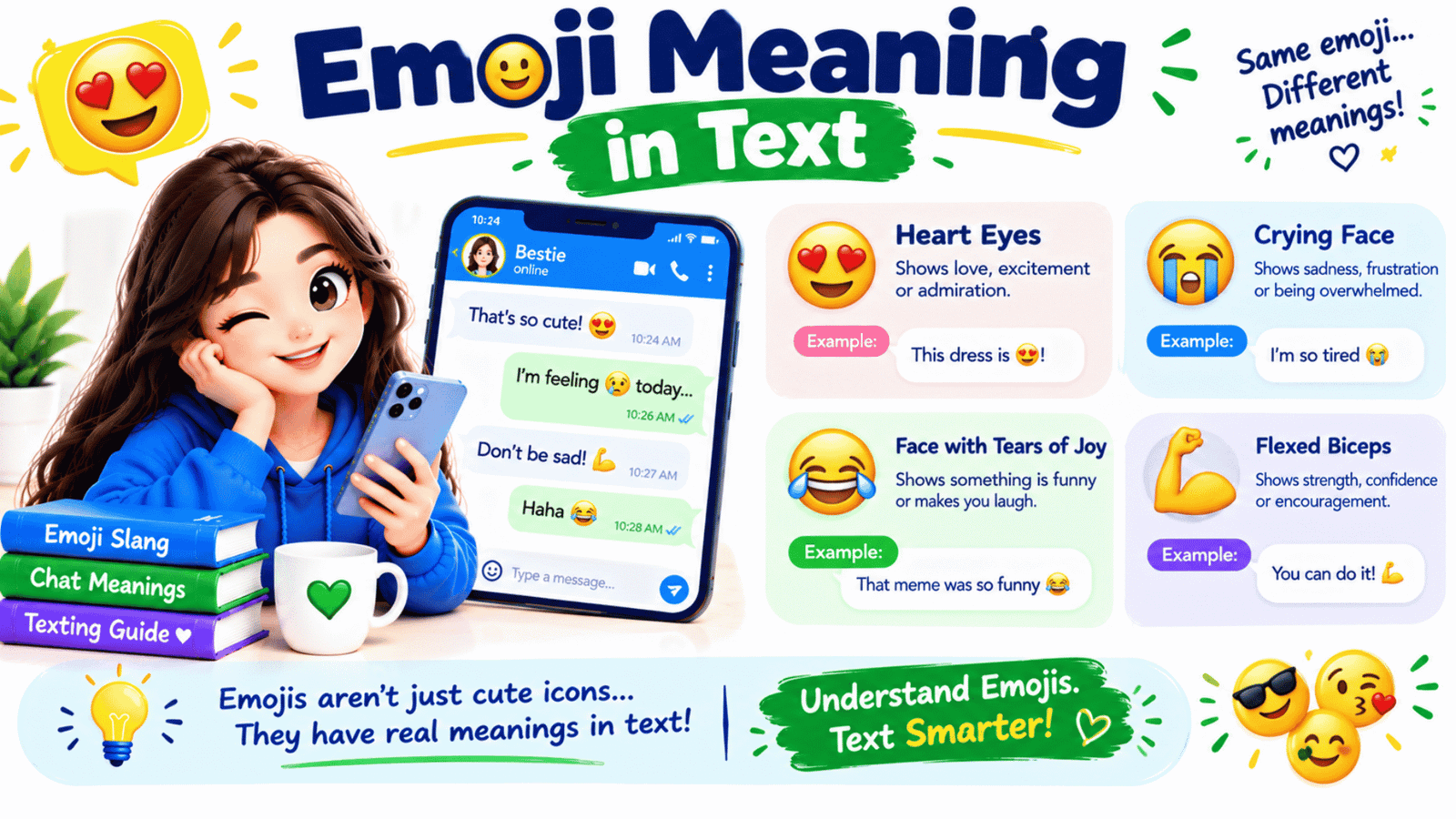
Emojis help people express feelings that plain text sometimes fails to communicate. The 🌚 emoji meaning in text depends on the surrounding words, the sender’s personality, and the kind of conversation you’re having.
A moon emoji might add humor to a joke, warmth to a goodnight message, or mystery to an aesthetic social media caption. Unlike an abbreviation with a clear full form, emoji meanings are often flexible.
How Do Moon Emojis Change a Message?
- Tone: 🌚 can make a statement sound teasing.
- Affection: 🌙 can soften a goodnight message.
- Humor: 🌝 can add an awkward or exaggerated expression.
- Atmosphere: 🌕 can suggest a beautiful night.
- Symbolism: 🌑 can represent darkness or a new cycle.
- Aesthetics: Moon symbols can complement dreamy captions and nighttime photographs.
Example in chat:
Friend 1: “Nothing happened between us.”
Friend 2: “Sure, sure 🌚”
The second message suggests playful disbelief rather than necessarily expressing genuine suspicion.
Remember, these are common interpretations, not universal rules. Some people use emojis simply because they like how they look.
Phase of the moon right now emoji
Searching for the phase of the moon right now emoji is slightly different from asking what 🌚 means in a message. One question concerns the moon’s current astronomical phase; the other concerns the meaning of a symbol in digital communication.
Moon-phase emojis include 🌑, 🌒, 🌓, 🌔, 🌕, 🌖, 🌗, and 🌘. They represent different stages of the lunar cycle. The 🌚 emoji, meanwhile, depicts a face associated with the new moon and is often used as a reaction in chats.
Which Emoji Represents Each Moon Phase?
| Moon emoji | Astronomical phase | Common symbolic association |
|---|---|---|
| 🌑 | New Moon | Darkness, beginnings |
| 🌒 | Waxing Crescent | Early growth |
| 🌓 | First Quarter | Progress, halfway point |
| 🌔 | Waxing Gibbous | Approaching fullness |
| 🌕 | Full Moon | Completion, nighttime |
| 🌖 | Waning Gibbous | Reflection, transition |
| 🌗 | Last Quarter | Change, turning point |
| 🌘 | Waning Crescent | Endings, rest |
| 🌚 | New Moon Face | Teasing, mischief |
| 🌝 | Full Moon Face | Playfulness, awkward humor |
These symbolic associations are interpretations rather than official meanings for every conversation.
How Can You Find the Current Moon Phase?
If you want the actual lunar phase today, check a reliable astronomical calendar rather than guessing from an emoji. The current phase depends on the date and time, and the moon may appear different depending on your location.
The phrase phase of the moon right now emoji can refer to a symbol someone wants to use in a caption, but the symbol itself doesn’t verify the current phase.
- Check the date: Lunar phases change throughout the month.
- Use a reliable calendar: Look for an astronomical source.
- Consider your location: Local viewing conditions affect visibility.
- Choose the matching symbol: Use a lunar-phase emoji for an astronomical reference.
- Separate fact from symbolism: A moon emoji in a message may be purely decorative.
Key takeaway: 🌚 is a moon-face emoji, while 🌑 through 🌘 represent the main lunar phases.
Every phase of the moon emoji
Every phase of the moon has its own visual appearance. People sometimes use these symbols in captions, journaling, astrology-related content, or messages about personal growth.
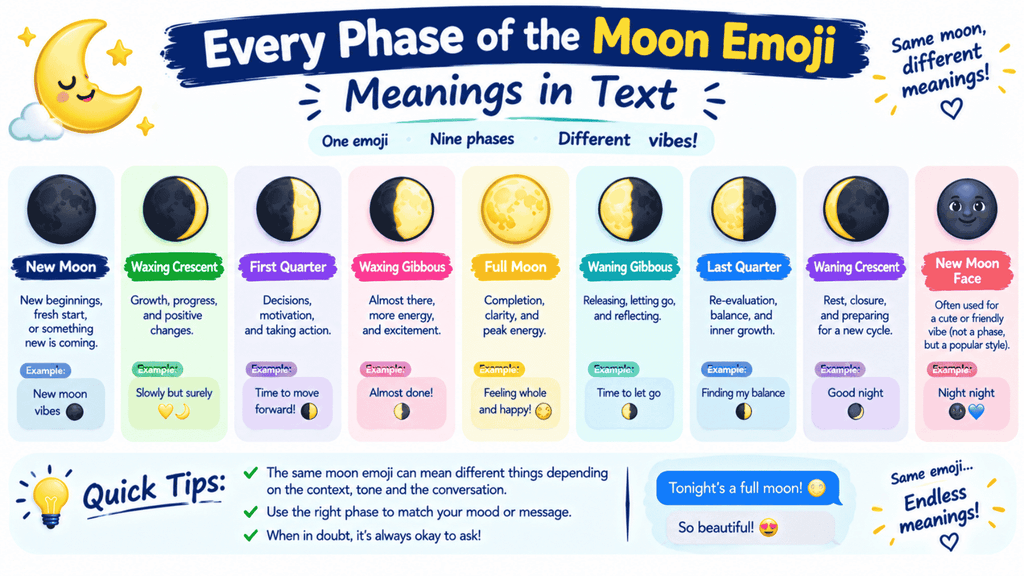
However, the moon-phase emojis don’t have universally accepted slang meanings. Their symbolic interpretations depend on the person and the context.
What Are the Eight Main Moon-Phase Emojis?
| Emoji | Phase | Simple explanation |
|---|---|---|
| 🌑 | New Moon | The moon’s illuminated side is generally facing away from Earth. |
| 🌒 | Waxing Crescent | A small visible portion is growing. |
| 🌓 | First Quarter | About half of the visible disk is illuminated. |
| 🌔 | Waxing Gibbous | More than half is illuminated, approaching full. |
| 🌕 | Full Moon | The visible disk appears fully illuminated. |
| 🌖 | Waning Gibbous | The illuminated portion is decreasing after the full moon. |
| 🌗 | Last Quarter | About half of the visible disk is illuminated again. |
| 🌘 | Waning Crescent | A thin illuminated portion remains before the new moon. |
The precise appearance of the moon depends on its position relative to Earth and the Sun. The emojis are simplified illustrations, not live astronomical displays.
How People Use Moon Phases Symbolically
- 🌑 New beginnings: A fresh start or a new chapter.
- 🌒 Early progress: Working toward a goal.
- 🌓 Balance: Reaching a midpoint.
- 🌔 Growth: Moving closer to a goal.
- 🌕 Completion: Celebrating an achievement.
- 🌖 Reflection: Thinking about changes.
- 🌗 Transition: Moving from one stage to another.
- 🌘 Rest: Preparing to begin again.
Example in texting:
Friend 1: “Starting my new chapter today 🌑”
Friend 2: “Here’s to a fresh start! 🌒”
These meanings are creative interpretations. They shouldn’t be confused with standardized astronomical definitions.
Origin & Background of Moon Emojis
The moon has carried cultural and emotional meaning for centuries. It’s associated with nighttime, changing seasons, romance, dreams, and mystery, which makes it a natural symbol for digital conversations.
Moon emojis brought these familiar associations into text messages. Over time, social media users also gave certain designs additional meanings through jokes, reactions, and repeated online use.
Why the Moon Became Emotionally Powerful
The moon appears in poetry, stories, art, celebrations, and everyday observations of nature. Its changing appearance makes it a useful symbol for time, change, beauty, and mystery.
In digital conversations, these associations give moon emojis more expressive possibilities.
- Nighttime: The crescent moon often accompanies bedtime messages.
- Romance: Moon imagery can create a gentle, affectionate mood.
- Mystery: Dark imagery can suggest something hidden.
- Change: Lunar cycles can symbolize transitions.
- Nature: Moon emojis complement photographs of the night sky.
Social Media Changed the Meaning
Social media helped moon emojis develop recognizable reaction styles. The 🌚 face, for example, is often used when someone wants to appear suspicious, amused, or knowingly mischievous.
The 🌝 face can look cheerful, awkward, or intentionally strange. Its effect depends on the message and the sender’s humor. Different platforms also have their own popular slang terms and texting habits.
Example in chat:
Friend 1: “I definitely didn’t read your messages.”
Friend 2: “Interesting excuse 🌚”
The emoji adds a playful hint of disbelief without requiring another sentence.
Real-Life Conversations With Moon Emojis
Moon emojis become easier to understand when you see them in realistic conversations. The same symbol can express affection in one chat and sarcasm in another.
The examples below show how people might use moon emojis in everyday messaging. They are illustrative examples, not claims that everyone uses the symbols identically.
WhatsApp Conversation
Example in chat:
Friend 1: “I’m exhausted. Going to bed now.”
Friend 2: “Goodnight! Sleep well 🌙”
Here, the crescent moon reinforces the message’s nighttime meaning.
Another example:
Friend 1: “I might have a little surprise for you.”
Friend 2: “What kind of surprise? 🌚”
In this case, the moon face adds curiosity and playful suspicion.
Instagram DM
Example in chat:
Friend 1: “You liked all his pictures?”
Friend 2: “I was just scrolling 😂”
Friend 1: “Righttt 🌚”
The moon face suggests the sender isn’t entirely convinced.
TikTok Comments
Example in chat:
Person 1: “He said they’re only friends 🌚”
Person 2: “The comments know something 😂”
The emoji helps establish a joking or teasing tone. It doesn’t prove anything about the people in the video.
Text Message
Example in chat:
Friend 1: “Look outside. The moon is beautiful tonight.”
Friend 2: “You’re right 🌕”
Here, the full moon emoji refers to the actual moon rather than hidden meaning.
Key takeaway: A moon emoji’s meaning becomes clearer when you read the entire exchange.
Emotional & Psychological Meaning of Moon Emojis
Text messages don’t include facial expressions, eye contact, or voice tone. Emojis help fill that gap by giving readers extra clues about how a message might sound.
The 🌚 emoji meaning in text often involves the attitude behind the words rather than their literal meaning. A teasing face can make an ordinary statement feel playful, although readers may interpret it differently.
Why People Use Moon Emojis
People use emojis to make conversations feel more expressive. Moon symbols can communicate nighttime, affection, humor, mystery, or a particular aesthetic without adding a long explanation.
- Expressing mood: Add a feeling to a short message.
- Softening words: Make a goodnight message feel warmer.
- Creating humor: Use 🌚 for a cheeky reaction.
- Showing personality: Choose symbols that match your style.
- Building atmosphere: Complement nighttime or dreamy posts.
- Adding ambiguity: Suggest a playful hint without explaining everything.
Example in texting:
Friend 1: “I’m totally not jealous.”
Friend 2: “Of course you’re not 🌚”
The emoji adds a teasing tone. It doesn’t establish that either person genuinely feels jealous.
Moon Emoji Meaning in Different Contexts
The same moon symbol can communicate different things across social media, friendships, romantic conversations, and professional settings. The surrounding words are often more informative than the emoji alone.
Understanding context is especially useful when you’re trying to decide whether a message is friendly, sarcastic, affectionate, or suggestive.
Social Media
Moon emojis frequently appear in nighttime photographs, aesthetic captions, music posts, and humorous reactions.
- 🌙: A peaceful nighttime atmosphere.
- 🌚: A teasing reaction or suspicious joke.
- 🌝: An exaggerated or awkward expression.
- 🌕: A visible full moon or nature-themed caption.
- 🌑: A dark aesthetic or new beginning.
Example: “Late-night thoughts 🌙✨”
This caption creates a dreamy mood without implying anything romantic.
Friends and Relationships
Between friends, 🌚 can suggest that someone noticed a suspicious detail or wants to tease another person. In a romantic conversation, it may also accompany flirting.
However, the emoji alone cannot confirm romantic interest.
Example in chat:
Person 1: “I stayed up talking to you again.”
Person 2: “Someone enjoys my company 🌚”
This sounds playful, but the actual intention depends on their relationship.
Work and Professional Settings
Moon emojis can be appropriate in casual workplace chats about night shifts, astronomy, or evening schedules. A simple 🌙 may help convey that someone is signing off for the night.
A teasing 🌚 can be less suitable in a formal email or serious workplace discussion because its meaning may be unclear.
Casual vs. Serious Tone
Moon emojis work best when the tone matches the conversation.
| Situation | Suitable approach |
|---|---|
| Saying goodnight | 🌙 |
| Joking with a friend | 🌚 |
| Posting a full-moon photo | 🌕 |
| Discussing astronomy | Use the relevant phase symbol |
| Handling a serious disagreement | Explain your meaning in words |
| Messaging someone unfamiliar | Avoid ambiguous teasing until you know their style |
Key takeaway: Use moon emojis to support your message, not to replace important explanations.
When NOT to Use Moon Emojis
Moon emojis are generally harmless, but the wrong symbol can make a sensitive message sound dismissive, sarcastic, or suggestive. Think about the other person’s feelings before using a playful reaction.
When Should You Avoid 🌚?
- Serious conversations: It may sound like you’re making fun of someone.
- Sensitive disclosures: A teasing face may seem dismissive.
- Professional messages: Its meaning may be unclear.
- Unfamiliar relationships: The other person may misread your intention.
- Important clarification: Use direct words instead of ambiguous hints.
For example, if a friend tells you they’re upset about a personal problem, replying only with 🌚 could appear insensitive. A supportive sentence is a better choice.
Moon imagery also appears in religious and cultural settings. The crescent moon is commonly associated with Ramadan and Eid celebrations in many Muslim communities. Use such symbols respectfully.
Common Misunderstandings About Moon Emojis
Moon emojis don’t have one fixed emotional meaning. People sometimes assume that a particular symbol always means flirting, sadness, or goodnight, but the surrounding conversation can change its interpretation.
“Every Moon Emoji Means Goodnight”
Not every moon emoji means goodnight. 🌙 commonly appears in bedtime messages, while 🌚 is often used as a teasing or humorous reaction.
Example: “Oh, really? 🌚” sounds different from “Goodnight 🌙.”
“ Always Means Something Sexual”
The 🌚 emoji can sometimes create a suggestive tone, especially after a flirty message. However, it also communicates sarcasm, suspicion, mischief, or ordinary humor.
Don’t assume an inappropriate meaning without considering the full conversation.
“ Means Someone Likes You”
Receiving 🌙 or 🌚 doesn’t automatically mean someone has romantic feelings for you. The person might be friendly, joking, or simply choosing an emoji that fits the message.
Look at their overall behavior rather than relying on one symbol.
“ Always Means Depression”
A dark moon symbol can appear in moody artwork or posts about difficult feelings. However, 🌑 also represents an astronomical phase and can symbolize a new beginning.
An emoji alone isn’t enough to determine someone’s emotional state.
“ Means Something Supernatural”
The full moon appears in folklore, fiction, and supernatural stories. In everyday texting, though, 🌕 may simply refer to the night sky, astronomy, or a beautiful view.
Key takeaway: Emoji meanings are interpretations, not reliable evidence of someone’s feelings or intentions.
Moon Emoji Comparison Table
Comparing moon emojis makes their differences easier to understand. Some focus on facial expressions, while others represent the moon’s astronomical phases.
| Emoji | Common interpretation | Typical tone | Example |
|---|---|---|---|
| 🌙 | Nighttime, sleep, affection | Peaceful | “Goodnight 🌙” |
| 🌚 | Mischief, teasing, suspicion | Cheeky | “Oh, really? 🌚” |
| 🌝 | Humor, awkwardness, irony | Playful | “I’m totally fine 🌝” |
| 🌑 | New moon, darkness, beginnings | Mysterious | “A fresh start 🌑” |
| 🌕 | Full moon, nighttime, nature | Calm or appreciative | “Look at that moon 🌕” |
| 🌒 | Waxing crescent | Hopeful or reflective | “Slow progress 🌒” |
| 🌓 | First quarter | Balanced | “Halfway there 🌓” |
| 🌔 | Waxing gibbous | Anticipatory | “Almost finished 🌔” |
| 🌖 | Waning gibbous | Reflective | “Things are changing 🌖” |
| 🌘 | Waning crescent | Quiet or reflective | “Time to reset 🌘” |
Key Insight
The biggest distinction is between the facial moon emojis and the phase symbols. 🌚 and 🌝 are often used to express an attitude, while 🌑, 🌒, 🌓, 🌔, 🌕, 🌖, 🌗, and 🌘 depict lunar phases.
These interpretations are common conventions, not strict rules.
10 Moon Emoji Variations and Their Meanings
Moon emojis may look similar, but their designs can create different impressions. Learning the differences helps you choose the right symbol for a message, caption, or reaction.
1. Crescent Moon
Emoji: 🌙
The crescent moon commonly represents nighttime, sleep, peace, or a gentle mood. It’s popular in goodnight messages and aesthetic captions.
Example: “Hope you sleep well tonight 🌙”
2. New Moon Face
Emoji: 🌚
The new moon face often conveys mischief, teasing, suspicion, or suggestive humor. Its expression can make a message feel as though the sender has noticed something interesting.
Example: “You two were together again? 🌚”
3. Full Moon Face
Emoji: 🌝
The full moon face features a smiling expression that people sometimes use for silliness, irony, or awkward humor.
Example: “That was definitely not embarrassing 🌝”
The contrast between the words and the smile can make the message funny.
4. New Moon
Emoji: 🌑
The new moon represents a lunar phase when the moon’s illuminated side generally faces away from Earth. In creative writing, it may symbolize darkness, mystery, or a new cycle.
Example: “Starting over this month 🌑”
5. Full Moon
Emoji: 🌕
The full moon appears fully illuminated from Earth’s perspective. People often use it in astronomy discussions, nature photography, and nighttime captions.
Example: “The sky looks amazing tonight 🌕”
6. Waxing Crescent
Emoji: 🌒
The waxing crescent appears after the new moon as the illuminated portion grows. In symbolic captions, it can represent early progress or a developing idea.
Example: “One small step forward 🌒”
7. First Quarter Moon
Emoji: 🌓
The first quarter is a lunar phase when about half of the moon’s visible disk is illuminated. Some people use it as a metaphor for reaching the midpoint of a journey.
Example: “Halfway through my goal 🌓”
8. Waxing Gibbous
Emoji: 🌔
The waxing gibbous phase occurs when more than half of the visible disk is illuminated, before the full moon. Symbolically, it can suggest growth or progress.
Example: “Getting closer every day 🌔”
9. Waning Gibbous
Emoji: 🌖
The waning gibbous follows the full moon as the illuminated portion begins to decrease. In creative contexts, it may represent reflection or transition.
Example: “Learning from the past 🌖”
10. Waning Crescent
Emoji: 🌘
The waning crescent is the final main phase before the new moon. It may be used symbolically for rest, endings, or preparing for a fresh start.
Example: “Closing one chapter, beginning another 🌘”
These symbolic meanings are optional interpretations, not universal texting definitions.
How to Respond When Someone Uses a Moon Emoji
Your response should match the conversation. A peaceful 🌙 may call for a warm goodnight, while a suspicious-looking 🌚 might invite a joke or a question.
If you aren’t sure what the sender means, asking directly is usually the simplest solution.
Casual Replies
Use these responses for friendly or ordinary conversations:
- “Goodnight! 🌙”
- “Sleep well!”
- “Beautiful night 🌕”
- “Haha, what does that mean? 😂”
- “Love the moon aesthetic 🌙”
Funny Replies
If someone sends 🌚 after teasing you, you can respond with humor:
- “Why are you looking at me like that? 😂”
- “Don’t start with that moon! 🌚”
- “I know what you’re implying 😭”
- “Explain yourself!”
- “That emoji makes everything suspicious.”
Mature Replies
When the message is ambiguous, a clear question prevents misunderstandings.
- “What do you mean by that emoji?”
- “Are you joking, or are you serious?”
- “I’m not sure how to interpret that.”
- “Can you explain what you mean?”
- “I don’t want to assume the wrong thing.”
Respectful Replies
If the moon emoji appears during a sensitive conversation, respond to the person’s actual words rather than focusing on the symbol.
For example, if someone says they’re having a difficult night and sends 🌙, you could ask whether they’re okay. If you’re unsure whether 🌚 is sarcastic, ask what they mean instead of immediately assuming bad intentions.
Key takeaway: Match the sender’s tone, but choose clear words when the conversation matters.
Regional & Cultural Usage of Moon Emojis
Moon imagery appears in many cultures, traditions, and forms of art. However, people don’t all interpret it in the same way, and broad cultural differences shouldn’t be treated as strict rules.
Western Culture
In many Western online settings, 🌙 appears in bedtime messages, nighttime photography, dreamy aesthetics, and astrology-related posts.
The 🌚 and 🌝 faces also appear in jokes and reaction messages.
Asian Culture
Moon symbolism has important roles in several Asian cultural traditions. For example, the Mid-Autumn Festival in Chinese communities is associated with the full moon, family gatherings, and reunion.
A moon emoji may reference these ideas in a suitable context, but its meaning depends on the individual and the occasion.
Middle Eastern Culture
The crescent moon has strong cultural recognition in many Muslim communities. It frequently appears in Ramadan and Eid greetings, decorations, and social media posts.
In these settings, 🌙 may carry a religious or celebratory association rather than simply meaning bedtime.
Global Internet Usage
Online communication allows emojis to spread across languages and communities. The 🌚 face can function as a playful reaction even when people speak different languages.
Still, a shared symbol doesn’t guarantee a shared interpretation. Local customs and personal habits can affect its meaning.
Gen Z vs. Millennials
Some younger users frequently use 🌚 for irony, teasing, and humorous reactions. Other users prefer 🌙 for nighttime messages or aesthetic captions.
These are general observations, not reliable rules for identifying someone’s age or intention.
Example in chat:
Friend 1: “You really thought nobody noticed? 🌚”
Friend 2: “I knew you’d say something 😂”
Here, the emoji works as a playful reaction regardless of the sender’s age.
Is the Moon Emoji Safe for Kids?
Moon emojis are ordinary symbols that can be used in family messages, school projects, astronomy discussions, and social media captions. Their presence alone doesn’t indicate inappropriate content.
However, children may encounter different interpretations of 🌚 in online conversations. It’s helpful to explain that symbols can have playful or suggestive meanings depending on context.
What Should Parents Know?
- Explain context: The same emoji can mean different things.
- Encourage questions: Children should feel comfortable asking about confusing messages.
- Discuss online behavior: Explain why some jokes may be misunderstood.
- Promote respectful communication: Encourage clear words during serious conversations.
- Avoid assumptions: An emoji alone doesn’t prove someone’s intentions.
For example, 🌙 in a bedtime message is generally straightforward. A 🌚 reaction might simply be a joke, but the surrounding conversation determines how it should be understood.
Parents don’t need to treat ordinary moon emojis as dangerous. Teaching children how to interpret messages thoughtfully is more useful than assigning a fixed meaning to every symbol.
FAQs About Moon Emoji Meaning in Text
What Does 🌙 Mean in Texting?
🌙 usually represents nighttime, sleep, peace, or a warm goodnight message. The meaning may also depend on the words around it.
What Does 🌚 Mean in Text?
The 🌚 emoji meaning in text commonly involves teasing, mischief, suspicion, or suggestive humor. It doesn’t always mean flirting.
What Does 🌚 Mean From a Guy?
The 🌚 emoji meaning in text from a guy may suggest teasing, joking, or flirting. Consider the conversation before deciding what he means.
What Does 🌙 Mean From a Girl?
The 🌚 emoji meaning in text doesn’t determine what a girl intends when she sends 🌙. She may simply be saying goodnight or creating a peaceful mood.
Is 🌚 a Flirting Emoji?
The 🌚 emoji meaning in text can be flirty when paired with suggestive words. It can also express ordinary humor or suspicion.
What Does 🌕 Mean in a Text?
The 🌚 emoji meaning in text differs from 🌕, which represents a full moon. 🌕 can refer to nighttime, nature, or lunar themes.
What Is the Difference Between 🌙 and 🌚?
The 🌚 emoji meaning in text often involves teasing or mischief, while 🌙 usually suggests nighttime, sleep, or peacefulness. Context can change both interpretations.
Conclusion
The 🌚 emoji meaning in text depends on the conversation, the sender, and the specific moon symbol. While 🌚 commonly expresses teasing, suspicion, or playful mischief, 🌙 usually creates a peaceful nighttime mood. 🌝 can add awkward humor, while 🌑 and 🌕 represent lunar phases that may also carry symbolic meanings.
Understanding the phase of the moon right now emoji is a separate matter from interpreting a moon face in a chat. The lunar-phase symbols represent different stages of the moon’s cycle, while facial moon emojis often communicate emotions or humor.
When someone sends you a mysterious moon emoji, don’t jump to conclusions. Read the message, consider your relationship, and ask for clarification when necessary. The best interpretation is the one that fits the actual conversation—not simply the emoji itself.

LearnerGrammar.com helps English learners improve grammar, vocabulary, writing, and communication skills with simple lessons and tips.