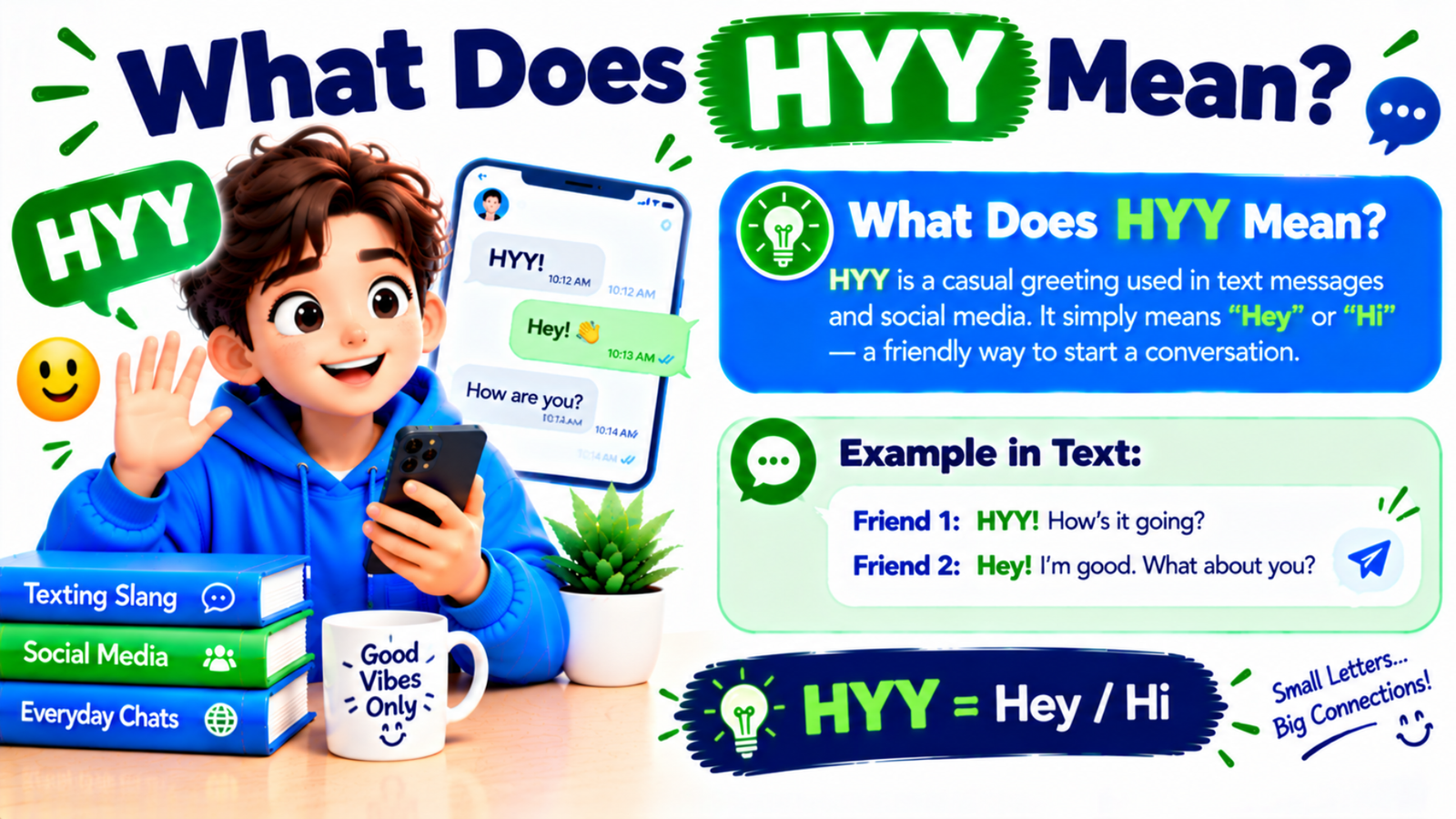
Have you ever received a message saying “Hyy” and wondered why someone added an extra letter instead of simply writing “Hi”? It might seem like a tiny detail, but in texting, even small changes can make a greeting feel warmer, friendlier, or more playful.
Understanding hyy meaning can help you interpret messages without overthinking them. Whether someone sends Hyy on Instagram, Snapchat, TikTok, or WhatsApp, the intended tone depends on the conversation. This guide explains hyy meaning in text, common variations, examples, and possible flirting signals so you can understand the message and respond naturally.
HYY Meaning in Text
The hyy meaning in texting is usually a casual, expressive way to say “Hi” or “Hey.” People often add an extra letter to make a greeting feel warmer, more enthusiastic, or less formal.
Unlike established abbreviations such as LOL or BRB, HYY doesn’t have one universally accepted full form. Its meaning usually comes from how people use it in everyday digital communication.
What Does HYY Communicate in a Message?
- Greeting: Opens a conversation casually.
- Friendliness: Makes a greeting feel warmer.
- Enthusiasm: Suggests extra energy compared with a plain “Hi.”
- Playfulness: Creates a relaxed, informal tone.
- Interest: May invite conversation, but doesn’t prove attraction.
- Personal style: Reflects how someone naturally types online.
Example in texting:
Friend 1: “Hyy! What are you doing?”
Friend 2: “Heyy! Nothing much, what’s up?”
In this example, Hyy simply starts a friendly conversation. There’s no reason to assume it has a hidden meaning.
Hyy meaning
The word “Hyy” is an informal greeting commonly used in text messages, social media comments, and direct messages. It resembles “Hey” or “Hi,” with the additional letter making the greeting look more expressive.
The exact tone depends on the person using it. Some people type Hyy automatically, while others use it when they want to sound particularly friendly.
Why Do People Type Hyy Instead of Hi?
- Convenience: It’s quick to type.
- Warmth: It can sound less formal.
- Personality: It adds an expressive touch.
- Familiarity: It suits conversations between friends.
- Engagement: It can encourage the other person to reply.
Common Greeting Variations
| Greeting | Typical tone | Common use |
|---|---|---|
| Hi | Neutral | Everyday conversations |
| Hey | Casual | Friends and acquaintances |
| Hyy | Friendly | Informal chats |
| Heyy | Warm or playful | Friends and romantic interests |
| Hyyyy | Highly expressive | Close friends or excited greetings |
| Hello | Polite or formal | Work and professional communication |
These descriptions reflect common texting conventions, not fixed rules. Different people may use the same greeting differently.
Example in chat:
Friend 1: “Hyy, long time no talk!”
Friend 2: “Hey! I know, how have you been?”
what does hyy mean
If someone sends you Hyy, they’re usually saying hello and opening the door to a conversation. The extra letter can make the greeting seem friendlier, but the message alone doesn’t reveal the sender’s full intentions.
When interpreting hyy meaning, consider who sent the message, what you discussed previously, and whether the person usually types this way.
How Can You Understand the Sender’s Intention?
- Read the message: Look at the complete sentence.
- Consider the relationship: Friends may greet differently from strangers.
- Notice the context: A greeting before a question is usually straightforward.
- Check their usual style: Some people always stretch letters.
- Avoid assumptions: Extra letters don’t automatically indicate flirting.
Example in texting:
Person A: “Hyy, can I ask you something?”
Person B: “Sure! What’s up?”
Here, Hyy introduces a question. The important part is what follows the greeting.
What Does HYY Mean?
HYY generally means “Hi” or “Hey” in casual digital conversations. It’s better understood as a stylized greeting than as an abbreviation with a formal full form.
People sometimes interpret it as an enthusiastic hello, especially when it appears with extra letters, emojis, or friendly punctuation.
Is HYY a Word or an Abbreviation?
- Informal greeting: Its most common interpretation is “Hi” or “Hey.”
- Not a standard acronym: The letters don’t consistently represent separate words.
- Digital expression: Repeated letters can communicate enthusiasm.
- Context-dependent: A private group might use HYY differently.
- Easy to answer: A simple “Hey!” usually works.
Example in chat:
Friend 1: “HYY 😊”
Friend 2: “Hey! How’s your day going?”
The exchange demonstrates how HYY functions as an ordinary greeting.
what does hyy mean in text
The hyy meaning in text is usually a friendly greeting used to begin a conversation. It can feel more expressive than “Hi,” particularly when someone wants to sound relaxed or approachable.
However, the extra Y doesn’t have a fixed emotional meaning. A person might use Hyy with a friend, a classmate, a relative, or someone they’re interested in.
How Is HYY Used in Everyday Texting?
- Starting conversations: “Hyy, are you free?”
- Checking in: “Hyy, how have you been?”
- Replying to stories: “Hyy, loved your post!”
- Reconnecting: “Hyy, it’s been ages!”
- Greeting a friend: “Hyy bestie!”
- Opening a direct message: “Hyy, can I tell you something?”
Example in texting:
Friend 1: “Hyy, are you coming tomorrow?”
Friend 2: “Hey! Yes, I’ll be there.”
In this situation, Hyy is simply a greeting before a practical question.
HYY – Quick Meaning
If you want the shortest explanation, HYY generally means “Hi” or “Hey.” It’s a casual greeting that people use to make digital conversations feel friendly and informal.
The hyy meaning in text doesn’t usually require a complicated interpretation. The surrounding words provide the most useful clues about the sender’s intention.
HYY at a Glance
| Detail | Explanation |
|---|---|
| Main meaning | Hi or Hey |
| Type | Informal greeting |
| Tone | Friendly or casual |
| Common platforms | WhatsApp, Instagram, Snapchat, TikTok |
| Typical audience | Friends and online acquaintances |
| Formality | Informal |
| Possible romantic meaning | Depends on context |
| Standard full form | No universally accepted full form |
Example in chat:
Friend 1: “Hyy!”
Friend 2: “Heyy! What’s up?”
Quick takeaway: If someone sends Hyy without additional context, the safest interpretation is that they’re saying hello.
Origin & Background
HYY belongs to a broader style of online writing in which people stretch words to express emotion. Although the exact origin of HYY isn’t firmly established, expressive spellings such as “Heyy” and “Hiiii” have become familiar in informal digital communication.
Traditional written language relies on punctuation and descriptive words to communicate tone. Texting often replaces some of those cues with repeated letters, emojis, and informal spellings.
Why Do People Add Extra Letters?
- Expressiveness: Extra letters can make a greeting look more enthusiastic.
- Informality: Casual spellings reduce the feeling of formality.
- Personality: People develop distinctive texting habits.
- Social familiarity: Friends often communicate using relaxed language.
- Digital culture: Online conversations encourage creative spelling.
How Has Digital Greeting Style Changed?
The growth of instant messaging and social platforms has made informal greetings common in everyday conversations. People can now communicate quickly through short messages, reactions, stickers, and emojis.
| Greeting style | Example | Possible effect |
|---|---|---|
| Standard spelling | Hi | Neutral |
| Casual spelling | Hey | Relaxed |
| Extended spelling | Heyyy | More expressive |
| Greeting with emoji | Hyy 😊 | Friendly |
| Greeting with punctuation | Hyy!! | Energetic |
These are general writing patterns rather than documented stages in a verified history of HYY specifically.
Example in texting:
Friend 1: “Hiiii, guess what!”
Friend 2: “What happened? Tell me!”
The extended greeting helps create an excited opening.
Real-Life Conversations
Real conversations show why the hyy meaning can change with context. The greeting itself usually means hello, while the rest of the message tells you whether the sender wants to chat, ask a question, or reconnect.
Below are realistic examples of how HYY might appear in different online settings.
Instagram DM
Example in chat:
Person A: “Hyy! Thanks for liking my post 😊”
Person B: “You’re welcome! Loved the picture.”
Here, Hyy is a friendly response to social media interaction.
WhatsApp Conversation
Example in chat:
Friend 1: “Hyy, are you home?”
Friend 2: “Hey! Yes, why?”
The greeting introduces a practical question.
TikTok Comment
Example in chat:
Person A: “Hyy, I love your videos!”
Person B: “Thank you so much! ❤️”
Here, the greeting adds warmth to a compliment.
Late-Night Text
Example in chat:
Person A: “Hyy, still awake?”
Person B: “Yeah, what’s up?”
The timing may suggest the sender wants to talk, but it doesn’t establish a romantic intention.
What Can These Examples Teach You?
- Look beyond the greeting: The following words usually clarify the purpose.
- Consider the platform: Public comments differ from private messages.
- Notice the tone: Emojis can add emotional context.
- Avoid overthinking: Hyy usually means hello.
- Reply naturally: You don’t need a special response.
Emotional & Psychological Meaning
Written conversations lack many signals available in face-to-face communication, including vocal tone, facial expressions, and body language. People sometimes compensate by stretching words, adding emojis, or choosing expressive punctuation.
In that sense, Hyy can help a greeting feel more personal. However, its emotional effect depends on the recipient’s expectations and the sender’s usual communication style.
Why Can Hyy Feel Warmer Than Hi?
- Visual emphasis: Extra letters make the greeting more noticeable.
- Friendly appearance: Informal spelling can feel relaxed.
- Social connection: A warm greeting can encourage conversation.
- Personal expression: People use spelling to reflect their personality.
- Tone flexibility: The same greeting can sound playful or neutral.
It’s important not to treat these observations as psychological proof of someone’s feelings. A person’s word choice offers clues, not certainty.
Example in texting:
Person A: “Hyy 😊 How was your exam?”
Person B: “Hey! It went really well, thanks for asking!”
The greeting and follow-up question together create a friendly impression.
Usage in Different Contexts
The hyy meaning in text stays close to “Hi” or “Hey” in most informal settings, but the greeting may feel different depending on the relationship and platform.
Understanding the setting helps you decide whether Hyy is appropriate and how to respond without sounding too formal or overly familiar.
Social Media
On Instagram, Snapchat, and TikTok, Hyy may appear in direct messages, comments, or replies to stories. It provides a quick, informal way to start a conversation.
Friends & Relationships
Friends may use Hyy as a familiar greeting. Someone who is romantically interested might also use it, but the greeting alone isn’t evidence of attraction.
Work & Professional Settings
Hyy is generally better suited to informal chats than formal business communication. “Hi” or “Hello” is a safer choice when messaging a client, manager, or unfamiliar professional contact.
Casual vs. Serious
Hyy works naturally when starting a relaxed conversation. If you’re delivering serious news, apologizing, or discussing a sensitive issue, choose a greeting and message that match the situation.
Which Greeting Fits Each Situation?
| Situation | Suggested greeting | Reason |
|---|---|---|
| Close friend | Hyy! | Relaxed and familiar |
| New online acquaintance | Hi! | Friendly but neutral |
| Romantic interest | Heyy 😊 | Warm without assuming feelings |
| Client | Hi, [Name] | Professional |
| Teacher | Hello, [Name] | Respectful |
| Serious discussion | Hi, can we talk? | Clear and direct |
Example in chat:
Person A: “Hi, could we discuss the project deadline?”
Person B: “Of course. What do we need to change?”
A straightforward greeting works better when clarity matters.
When NOT to Use It
Although HYY is a harmless greeting in ordinary conversation, it isn’t suitable for every situation. The goal is to match your language to the person you’re contacting and the reason for your message.
When Is HYY Too Informal?
- Client emails: Use a professional greeting.
- Formal applications: Choose standard written English.
- Serious apologies: Focus on sincerity and clarity.
- Sensitive conversations: Avoid making the opening seem playful.
- Unfamiliar contacts: Start with a neutral greeting.
For example, “Hyy, I am applying for the position” may look overly casual in a formal email. “Hello, I am writing to apply for the position” is more appropriate.
Example in texting:
Person A: “Hello, I wanted to ask about tomorrow’s interview.”
Person B: “Of course. What would you like to know?”
The formal greeting makes the purpose clear.
Common Misunderstandings
HYY is easy to misinterpret because people often assume that every unusual spelling must have a hidden definition. In reality, it’s usually an informal variation of a familiar greeting.
Is HYY Always an Acronym?
No. HYY generally functions as a greeting rather than an abbreviation whose letters represent separate words.
Does HYY Always Mean Flirting?
No. Friends and acquaintances may use HYY without any romantic intention. The surrounding conversation provides more information than the greeting itself.
Does the Number of Y’s Matter?
The number of repeated letters can change how expressive a greeting appears, but there is no universal scale. One person’s “Hyyyy” might show excitement, while another might type it casually.
Why Might Someone Reply With “Yes?”
They may be waiting for you to explain why you’re messaging. A greeting doesn’t always communicate the purpose of the conversation.
What Mistakes Should You Avoid?
- Assuming attraction: A greeting alone doesn’t prove romantic interest.
- Inventing a full form: HYY has no universally accepted acronym expansion.
- Ignoring context: Read the complete message.
- Overanalyzing spelling: People have different typing habits.
- Confusing tone with intention: Friendly language doesn’t reveal every feeling.
Example in chat:
Person A: “Hyy 😊”
Person B: “Hey! What’s up?”
Person A: “Nothing much, just wanted to say hi.”
The conversation demonstrates that Hyy can be nothing more than a greeting.
Comparison Table
Comparing HYY with similar greetings can help you understand the difference between neutral, friendly, and highly expressive writing styles.
How Does HYY Compare With Other Greetings?
| Term | Common meaning | Typical tone | Best use |
|---|---|---|---|
| Hi | Hello | Neutral | Most situations |
| Hey | Hello | Casual | Friends and colleagues |
| Hyy | Hi or Hey | Friendly | Informal conversations |
| Heyy | Hey | Warm or playful | Friends and acquaintances |
| Hyyyy | Hey | Highly expressive | Close relationships |
| Hello | Greeting | Polite | Professional settings |
| Yo | Greeting | Very informal | Friends |
| Hru | How are you? | Casual | Asking about someone’s well-being |
Key insight: The spelling can influence how a greeting feels, but it doesn’t determine the sender’s emotions.
Example in texting:
Friend 1: “Hyyyy!”
Friend 2: “Heyyy! You’re in a good mood today 😂”
The extended spelling makes the exchange feel energetic, although the exact intention remains personal.
Variations & Types
HYY appears in several informal spelling variations. These forms are not standardized, so people may use them differently depending on their personality, age, friendships, and online habits.
Common HYY Variations
- Hy: A shortened greeting that may mean “Hi.”
- Hyy: A casual, friendly greeting.
- Hyyy: Often looks more enthusiastic.
- Heyy: A common alternative spelling of “Hey.”
- Hyyyyy: An exaggerated, highly expressive greeting.
- Hyy 😊: Adds a friendly visual cue.
- Hyy!: Can appear energetic or excited.
- Hyy…: May suggest hesitation, depending on context.
Does Punctuation Change the Meaning?
Punctuation can influence the tone of a greeting. An exclamation mark may make it appear energetic, while an ellipsis can suggest hesitation or an unfinished thought.
These effects are not guaranteed. The sender’s usual style matters.
Example in chat:
Person A: “Hyy…”
Person B: “Hey, is everything okay?”
The ellipsis may make the greeting appear hesitant, but the sender could simply be using their usual typing style.
How to Respond When Someone Uses It
If someone sends Hyy, you usually don’t need to decode anything complicated. A simple greeting is enough to continue the conversation, and you can add a question if you want to keep talking.
Your response should reflect how well you know the sender and whether the conversation is casual or professional.
Casual Replies
- “Hey! What’s up?”
- “Hyy, how are you?”
- “Heyy 😊”
- “Hi! How’s your day going?”
- “Hey! Long time no talk.”
Funny Replies
- “Hyy right back at you 😂”
- “Someone’s feeling energetic today!”
- “Heyyy! What’s the news?”
- “That extra Y means business 😂”
- “Hyy! Tell me everything.”
Mature Replies
- “Hello! How can I help?”
- “Hey, what did you want to discuss?”
- “Hi! Is everything okay?”
- “Hello, good to hear from you.”
- “Hey, what’s on your mind?”
Respectful Replies
- “Hello, how are you?”
- “Hi! I hope you’re doing well.”
- “Hello, thanks for messaging.”
- “Hi, how may I help you?”
- “Hey! Nice to hear from you.”
Example in texting:
Person A: “Hyy!”
Person B: “Hey! How’s everything going?”
A natural response keeps the conversation moving without assuming what the sender wants.
Regional & Cultural Usage
Informal greetings like HYY can appear in online conversations across different countries. However, usage varies between individuals and communities, and there isn’t enough reliable evidence to assign one fixed meaning to HYY in every region.
Western Culture
In English-language online conversations, stretched greetings such as “Heyy” and “Hiiii” are familiar informal writing styles. HYY may be understood similarly, depending on the recipient’s experience.
Asian Culture
In English-speaking online communities across Asia, informal greetings may appear alongside local languages, abbreviations, and emojis. The exact interpretation depends on the individual and community.
Middle Eastern Culture
People who communicate in English through social media may use HYY as a casual greeting. However, usage isn’t uniform across Middle Eastern countries, languages, or age groups.
Generational Differences
Younger and older users may have different texting habits, but age alone doesn’t determine how someone interprets HYY. Some people enjoy expressive spellings, while others prefer conventional greetings.
What Should You Remember About Regional Differences?
- Avoid stereotypes: Don’t assume everyone in a region types alike.
- Consider language: Multilingual users may mix languages and greetings.
- Notice personal habits: Individuals develop their own styles.
- Read the conversation: Context helps explain the greeting.
- Ask when uncertain: A simple question can resolve confusion.
Example in chat:
Person A: “Hyy, how are you?”
Person B: “I’m good, thanks! How about you?”
The greeting works as an ordinary conversation starter regardless of location.
Is It Safe for Kids?
HYY is generally a harmless informal greeting. It doesn’t inherently refer to adult content, dangerous behavior, or anything inappropriate.
However, the meaning of any online conversation depends on the messages around it. Parents and children can benefit from discussing online communication, privacy, and respectful interactions.
What Should Parents and Young Users Know?
- Understand the basics: HYY usually means “Hi” or “Hey.”
- Consider context: The rest of a conversation matters.
- Protect personal information: Avoid sharing private details with strangers.
- Communicate respectfully: A friendly greeting should lead to appropriate conversation.
- Ask questions: Seek help when an online interaction feels uncomfortable.
There is no reason to treat HYY itself as a warning sign. Focus instead on the person’s behavior, the conversation’s content, and appropriate online safety practices.
Example in texting:
Person A: “Hyy, want to chat?”
Person B: “Hi! Sure, what’s up?”
The greeting itself is ordinary. As with any online interaction, users should still follow sensible privacy and safety practices.
Why Do People Use HYY Instead of Hey?
People use HYY because informal spelling can make a greeting feel more expressive, relaxed, or personal. It can also be a simple typing habit.
Common Reasons for Using HYY
- Expressiveness: It makes a greeting look less neutral.
- Friendliness: It can create a relaxed opening.
- Habit: Some people naturally stretch letters.
- Social style: Informal spelling fits casual messaging.
- Conversation starters: It opens the door to further discussion.
Example in chat:
Friend 1: “Hyy, what are you doing?”
Friend 2: “Nothing much! You?”
The greeting starts a casual conversation without needing a special interpretation.
Does HYY Mean Someone Likes You?
Receiving HYY may feel exciting when it comes from someone you like, but the greeting alone doesn’t reveal romantic interest. Some people use the same greeting with all their friends and acquaintances.
What Clues Can Help You Interpret the Message?
- Conversation quality: Notice whether they ask questions about you.
- Consistency: Consider whether they regularly initiate conversations.
- Personal interest: Look at the full conversation rather than one greeting.
- Tone: Emojis and wording may add context.
- Direct communication: Ask if you need clarification.
None of these clues guarantees romantic interest. The clearest way to understand someone’s feelings is through honest communication over time.
Example in texting:
Person A: “Hyy 😊”
Person B: “Hey! How’s your day?”
Person A: “Pretty good. I wanted to talk to you.”
The additional message gives more context than the initial greeting.
When Should You Use HYY in a Conversation?
HYY is most suitable for relaxed digital conversations with friends, acquaintances, or people who are comfortable with informal language. It is less appropriate when you need a formal or professional tone.
Choosing the Right Greeting
- Friends: HYY is usually fine.
- Casual social media messages: Use it to open a conversation.
- New acquaintances: Choose HYY or a neutral “Hi.”
- Professional emails: Prefer “Hi” or “Hello.”
- Sensitive topics: Use a clear, thoughtful opening.
Example in chat:
Person A: “Hyy, are you free this evening?”
Person B: “Hey! Yes, what’s the plan?”
The informal greeting suits a casual invitation.
FAQs About HYY Meaning
1. What Does HYY Mean in Texting?
HYY meaning is usually “Hi” or “Hey,” written in a casual, expressive style. People use it to start friendly conversations.
2. Is HYY the Same as Hey?
Yes, hyy meaning is generally similar to “Hey” or “Hi.” The extra letter can make the greeting look more expressive.
3. What Does HYY Mean From a Girl?
HYY meaning from a girl is usually a casual greeting. It doesn’t automatically mean she is flirting or romantically interested.
4. What Does HYY Mean From a Guy?
HYY meaning from a guy is usually “Hi” or “Hey.” His other messages provide better clues about his intentions.
5. Does HYY Mean Flirting?
HYY meaning doesn’t inherently indicate flirting. It may accompany a flirty conversation, but many people use it with friends.
6. What Is the Difference Between HYY and HYYY?
HYY meaning generally remains a casual greeting, while HYYY may look more enthusiastic. Neither spelling has a universally fixed emotional meaning.
7. How Should I Reply to HYY?
To respond to hyy meaning in a message, simply say “Hey!” or “Hyy!” You can add a question to continue chatting.
Conclusion
Understanding hyy meaning is simple once you recognize that it is usually a casual variation of “Hi” or “Hey.” People use it in messages, social media comments, and direct messages to create a friendly or expressive opening.
The hyy meaning in text depends on context, personal typing habits, and the relationship between the people communicating. Although HYY can appear in a flirty conversation, it doesn’t automatically mean someone likes you. Similarly, adding extra Y’s may make a greeting look more enthusiastic, but it doesn’t provide a reliable measure of someone’s feelings.
The next time you receive Hyy, respond naturally and pay attention to what the person says afterward. A simple “Hey, how are you?” is usually enough to keep the conversation going without overthinking a small greeting.

LearnerGrammar.com helps English learners improve grammar, vocabulary, writing, and communication skills with simple lessons and tips.