
Have you ever received a text saying OM and suddenly wondered what those two letters mean? Short messages can feel surprisingly confusing when there is not enough context. The OM meaning in text can change depending on the sentence, tone, and conversation.
If you are searching for what does OM mean in text, this guide will make the answer much easier. We will cover OM meaning slang, different meanings, real chat examples, social media usage, common mistakes, and how to tell which meaning someone intended. Keep reading, and you will know what OM means without having to guess.
What Does OM Mean in Text?
The OM meaning in text most commonly refers to “Oh My” when someone is reacting to something surprising, exciting, shocking, funny, or unexpected. It works as a short emotional response in casual conversations.
However, OM meaning slang is not limited to one universal definition. Depending on the sentence, OM may also refer to phrases such as “Old Man” or appear as part of a phrase such as “On My.”
Current texting references commonly describe OM as “Oh My,” while other sources also identify context-dependent meanings.
What Does OM Usually Express?
When OM means “Oh My,” it can communicate several reactions:
- Surprise at unexpected information
- Shock after hearing dramatic news
- Excitement about something impressive
- Disbelief when something seems unbelievable
- Amusement after seeing something funny
- Emphasis before an emotional statement
| OM usage | Possible meaning | Typical context |
| OM! | Oh My | Surprise |
| OM, seriously? | Oh My | Shock or disbelief |
| OM, that’s amazing! | Oh My | Excitement |
| My OM called | Old Man | Family context |
| OM way home | On My | Informal phrase |
Example in texting:
Friend 1: I just won two concert tickets!
Friend 2: OM, that’s amazing!
Here, OM clearly works as an emotional reaction.
OM meaning text
The phrase OM meaning text usually points to the casual abbreviation “Oh My.” It is short, quick, and useful when someone wants to react without typing a longer expression.
For example, someone might write:
“OM, you actually did it!”
The intended feeling is similar to saying:
“Oh my, you actually did it!”
The exact emotion depends on the rest of the message. A laughing emoji may make OM playful, while a serious sentence may make it sound shocked.
How Does OM Work in a Text Message?
- Oh My is the most common casual interpretation.
- Emotion usually provides the strongest clue.
- Punctuation can make the reaction stronger.
- Emojis can clarify whether the tone is playful.
- Following words often reveal the intended meaning.
Example in chat:
Friend 1: Guess what happened at school.
Friend 2: OM, what happened?
Here, OM expresses curiosity and surprise.
OM text meaning
The OM text meaning depends heavily on context because two-letter abbreviations can represent different phrases.
In a reaction such as “OM, that was crazy,” the most natural interpretation is “Oh My.” In another message, such as “My OM is coming home,” the abbreviation may have a completely different meaning.
That is why it is risky to treat OM as having one fixed definition.
Why Context Matters
- Sentence structure can reveal the intended phrase.
- Conversation topic can narrow possible meanings.
- Capitalization may sometimes provide a clue.
- Relationship context can affect interpretation.
- Nearby words often provide the strongest evidence.
Example in texting:
Friend 1: My OM is picking me up today.
Friend 2: Nice! Tell him I said hi.
Here, OM is being used differently from an emotional “Oh My” reaction.
OM meaning slang
The OM meaning slang is commonly explained as “Oh My,” especially when used as a quick reaction in casual online conversations. It can express surprise, excitement, disbelief, or mild shock.
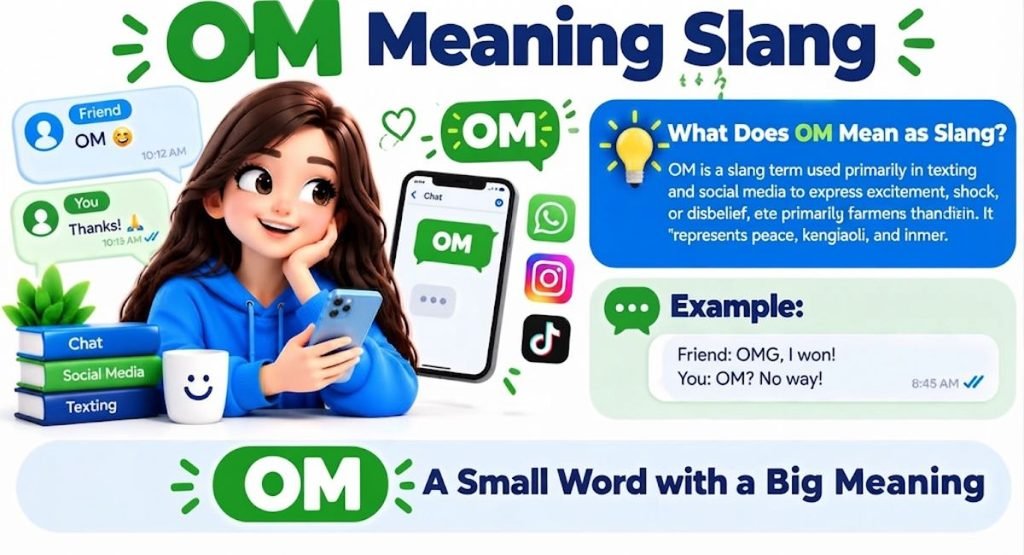
Still, slang dictionaries and modern articles do not always list exactly the same meanings. Some sources mention “Old Man,” “On My,” or other context-specific uses.
Common Slang Interpretations
- Oh My — emotional reaction
- Old Man — informal family reference
- On My — phrase component in casual texting
- Oh My God — possible shortened reaction
- Other meanings — personal or specialized contexts
Example in chat:
Friend 1: OM, that video was wild 😂
Friend 2: I know! I watched it three times.
The emotional context strongly supports “Oh My.”
Simple Definition of OM in Easy Words
In simple English, OM is a short expression that can mean “Oh My” when someone reacts to surprising or emotional information. It is usually informal and works best in casual conversations.
If someone sends “OM!” by itself, they may be reacting strongly to something you just said. But if OM appears inside a longer phrase, the meaning can change.
OM in One Simple Sentence
- OM = Oh My in many casual reactions.
- It can show surprise.
- It can show excitement.
- It can show shock.
- It can add emotional emphasis.
- Its meaning still depends on context.
Example in texting:
Friend 1: I got the job!
Friend 2: OM, congratulations!
Origin & History of OM in Text
The exact history of OM as texting slang is difficult to establish from a single authoritative source. The competitor describes it as developing through early SMS and internet chat culture, where shortening expressions helped people type quickly.
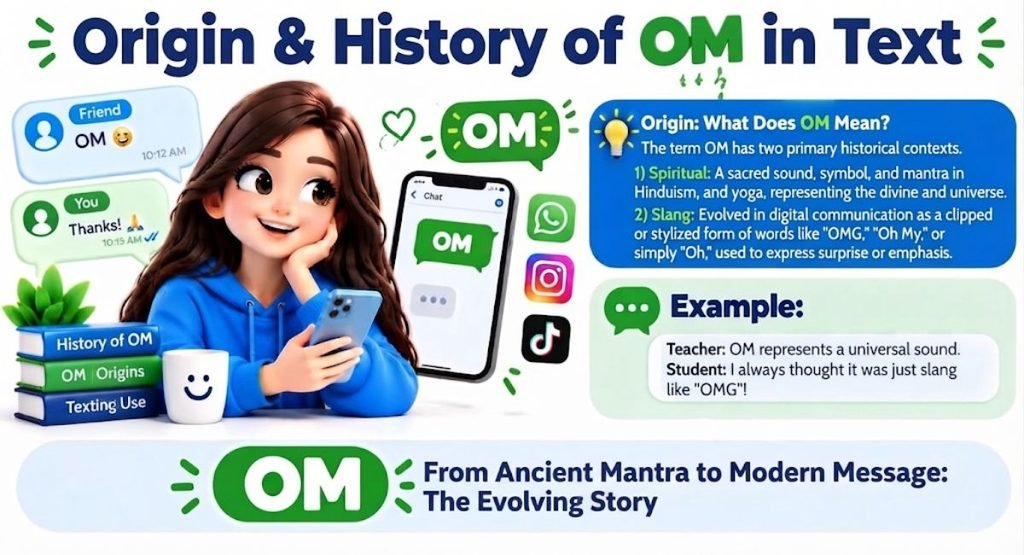
It is safer to describe this as part of the broader history of digital shorthand rather than claiming that one specific platform created OM.
1. Early SMS Culture
Early mobile messaging encouraged shorter communication because typing was slower and older SMS systems could impose character limits.
Common expressions were shortened in different ways, and emotional phrases became especially easy to compress.
- Shorter phrases saved typing effort.
- Abbreviations became common online.
- SMS limits encouraged concise messages.
- Informal language spread between friends.
- Repeated phrases were easier to shorten.
Example in texting:
Friend 1: You saw the score?
Friend 2: OM! No way!
2. Internet Chat Rooms
Online chat rooms and instant messaging made rapid communication even more important. People developed personal shorthand, acronyms, and abbreviated reactions.
The competitor specifically connects OM with early chat rooms and messaging services.
- Fast replies became normal.
- Short expressions saved effort.
- Internet slang spread between communities.
- Informal tone became common.
- Context became important for interpretation.
Example in chat:
User 1: The ending was completely unexpected.
User 2: OM, I did not see that coming!
3. Modern Social Media (2010–2026)
Modern platforms such as Instagram, Snapchat, TikTok, WhatsApp, and messaging apps have made short reactions normal parts of online communication. Current sources continue to describe OM as a casual reaction, especially meaning “Oh My.”
However, usage varies between communities.
- Instagram supports short comment reactions.
- Snapchat encourages fast messaging.
- TikTok uses short comment language.
- WhatsApp supports casual conversations.
- Emojis often replace longer reactions.
Example in chat:
Friend 1: This new AI can actually cook.
Friend 2: OM, technology is moving fast.
Common Meanings of OM in Text
The most useful way to understand OM is to separate its possible meanings instead of assuming every message means the same thing.
In current texting references, “Oh My” is the clearest common casual meaning. Other meanings appear in particular contexts rather than being universal.
Which Meaning Fits Your Message?
- Oh My — reaction to surprising information
- Old Man — possible family reference
- On My — usually part of a longer phrase
- Oh My God — possible casual shortening
- Specialized OM — technical or organizational context
| Meaning | Example | Context |
| Oh My | “OM, that’s crazy!” | Reaction |
| Old Man | “My OM called.” | Family |
| On My | “OM way home.” | Casual phrase |
| Oh My God | “OM, seriously?” | Emotional reaction |
| Order of Merit | Formal reference | Awards/title context |
Example in texting:
Friend 1: I just saw the final score.
Friend 2: OM, that was unexpected!
How OM Is Used in Real Life Chats
People use OM in real conversations when they want a quick emotional response. The meaning becomes clearer when you look at what happened immediately before the message.
Current references describe OM as a casual reaction to surprise, shock, excitement, or amazement.
Example Situations:
- Seeing shocking news
- Reacting to a surprise
- Hearing exciting news
- Watching something funny
- Responding to unexpected results
- Reacting to dramatic stories
Example in chat:
Friend 1: I accidentally sent the message to my boss.
Friend 2: OM 😭 what did you say?
Here, OM expresses shock rather than a literal phrase.
Real-Life Examples with Simple Explanations
Real conversations make the OM meaning in text much easier to understand because they show how context changes the tone.
Example 1: Surprise Reaction
Chat:
Friend 1: I won first place in the competition!
Friend 2: OM, congratulations!
Explanation: OM means “Oh My” and shows surprise and excitement.
Example 2: Funny Situation
Chat:
Friend 1: I slipped on the wet floor but somehow stayed standing.
Friend 2: OM 😂 that was close!
Explanation: The abbreviation adds a playful reaction to the funny situation.
Example 3: Family Context
Chat:
Friend 1: My OM is visiting this weekend.
Friend 2: Nice! Are you excited?
Explanation: Here, OM may mean “Old Man,” depending on the sender’s personal slang.
Example 4: Casual Slang Use
Chat:
Friend 1: I’m on my way home.
Friend 2: OM way too.
Explanation: In this example, OM is being used as part of “On My,” although this usage is less standardized.
Example 5: Shock Reaction (2026 Style)
Chat:
Friend 1: The phone I wanted just dropped $300 in price.
Friend 2: OM, seriously?
Explanation: OM communicates immediate surprise about the unexpected price change.
Personality Traits of People Who Use OM
Using OM does not prove that someone has a particular personality. It is better to describe the communication style rather than make assumptions about the person.
Someone who uses OM may simply prefer quick, informal reactions in digital conversations.
Communication Style Table
| Communication style | What OM may suggest |
| Fast texting | Short emotional response |
| Casual conversation | Informal language |
| Expressive messaging | Strong reaction |
| Social messaging | Familiar slang |
| Playful conversation | Light emotional emphasis |
Example in texting:
Friend 1: I finally finished the project!
Friend 2: OM, you survived 😂
The message shows a casual communication style, not a fixed personality trait.
Context of Usage (When and Where OM Is Used)
OM is most appropriate in informal digital communication. Current references place this type of abbreviation in casual chats, social media, and other informal online conversations.
1. Informal Chats
Friends and family may use OM when reacting quickly to unexpected information.
- WhatsApp conversations
- Messenger chats
- Snapchat messages
- Group chats
- Private DMs
Example in chat:
Friend 1: Guess who I saw today?
Friend 2: OM, who?
2. Social Media Comments
OM can also appear in comments when users want to react quickly to photos, videos, or surprising posts.
- Instagram comments
- TikTok replies
- YouTube comments
- Social posts
- Reaction threads
Example in texting:
User 1: Posted a surprise wedding video.
User 2: OM, this is beautiful!
3. Gaming Chats
Fast-moving gaming conversations can encourage short reactions because players do not have time to type long sentences.
- Quick reactions are useful.
- Surprise can happen instantly.
- Short slang saves typing.
- Team chats favor speed.
- Context usually provides meaning.
Example in chat:
Player 1: I just defeated the final boss!
Player 2: OM, no way!
4. Not Used In Formal Writing
OM is generally unsuitable when your goal is professional or academic clarity.
Avoid it in:
- Business emails
- School assignments
- Formal reports
- Job applications
- Professional documents
Example in texting:
Casual: “OM, that result was crazy!”
Formal: “I was surprised by the result.”
Modern Usage of OM in 2026
In 2026, short digital reactions remain common, but people also use emojis, GIFs, reactions, stickers, and voice messages. Recent articles continue to describe OM as an informal expression of surprise or emotion.
This means OM still appears online, but its frequency can vary widely between communities.
Modern Trends:
- Emojis often replace short reactions.
- GIFs can communicate emotion instantly.
- Voice notes reduce typing.
- Short slang remains common.
- Platform culture influences language.
Example (2026 Chat Style):
Friend 1: This app just created a whole video from one sentence.
Friend 2: OM 😭 that’s actually wild.
What Does OM Mean on Snapchat and Social Media?
When you see OM on Snapchat, Instagram, TikTok, or another social platform, the surrounding message should guide your interpretation.
There is no reliable rule that makes OM have one platform-specific meaning. Current sources generally describe the casual reaction “Oh My,” while other meanings depend on context.
How Platform Context Helps
- Snapchat often uses quick reactions.
- Instagram supports short comments.
- TikTok encourages expressive replies.
- WhatsApp supports personal shorthand.
- Gaming chats prioritize speed.
Example in chat:
Friend 1: Look at this Snapchat story 😂
Friend 2: OM, what happened?!
Why Can OM Have Different Meanings?
Two-letter abbreviations leave very little information for the reader. That is why one person may understand OM as “Oh My,” while another may interpret it differently.
The key is not the abbreviation alone. The words around it provide the clues.
What Should You Check?
- Read the full sentence
- Check previous messages
- Look for emotional language
- Consider the relationship
- Ask for clarification if needed
Example in texting:
Friend 1: My OM is coming over tonight.
Friend 2: Your dad?
Friend 1: Yeah!
Here, the second message confirms the intended meaning.
Common Mistakes and Misconceptions
Many misunderstandings happen because people assume OM has one permanent definition.
The competitor also highlights confusion between OM and OMG and explains that context affects meaning.
Mistake 1: Thinking OM Always Means “Oh My God”
OM can mean “Oh My,” but it does not automatically mean “Oh My God.”
A sentence such as “OM, that’s beautiful” may simply be expressing surprise or admiration.
Mistake 2: Confusing OM with OMG
OM and OMG can both express surprise, but they are not identical.
- OM can mean “Oh My.”
- OMG means “Oh My God.”
- OM has other context-dependent meanings.
- OMG is more widely recognized.
- Context helps identify the intended expression.
Mistake 3: Using OM in Formal Writing
OM is informal and can confuse readers who are unfamiliar with the abbreviation.
Use complete words when clarity matters.
Mistake 4: Misreading “OM way”
Some people may interpret “OM way” as random letters. In the competitor’s example, it is intended as “On My Way.”
However, this particular use is less standardized, so the surrounding conversation should confirm it.
Example in chat:
Friend 1: OM way home.
Friend 2: Okay, see you soon.
Quick Comparison: OM vs OMG
OM and OMG can look similar because both may appear in emotional reactions. However, their meanings and familiarity are not exactly the same.
| Feature | OM | OMG |
| Common meaning | Oh My | Oh My God |
| Main purpose | Emotional reaction | Strong emotional reaction |
| Formality | Informal | Informal |
| Recognition | Context-dependent | Very widely recognized |
| Other meanings | Possible | Less likely in casual slang |
Example in texting:
Friend 1: I just won the lottery!
Friend 2: OM, are you serious?
Friend 1: I just won the lottery!
Friend 2: OMG, are you serious?
Both express surprise, but OMG is generally more explicit.
Short Dialogues for Better Understanding
Short conversations show how the same abbreviation can carry different meanings depending on context.
Dialogue 1
Friend 1: I passed my final exam!
Friend 2: OM, congratulations!
Meaning: OM expresses excitement and surprise.
Dialogue 2
Friend 1: The movie ending was completely unexpected.
Friend 2: OM, I need to watch it!
Meaning: OM shows excitement and curiosity.
Dialogue 3
Friend 1: My OM is coming to pick me up.
Friend 2: Oh, your dad?
Meaning: In this context, OM may mean “Old Man.”
Why People Prefer Using OM Meaning in Text
People may use OM because it provides a quick emotional reaction without requiring a complete sentence. It fits the fast, informal style common in messaging.
Current sources describe OM as a short way to express surprise, shock, excitement, or amazement.
What Makes OM Convenient?
- Shorter than a complete reaction
- Faster to type
- Expressive in casual conversations
- Flexible across situations
- Easy to combine with emojis
- Natural in informal chats
Example in texting:
Friend 1: I got front-row tickets!
Friend 2: OM 😭 that’s amazing!
Is OM Still Popular Today?
Yes, OM can still be found in casual online communication, but it should not be described as universally popular or equally common across every age group and platform.
Recent 2026 sources continue to describe OM as a texting reaction, while also noting that emojis and other digital reactions are common alternatives.
What Is Changing in Digital Communication?
- Emojis communicate reactions instantly.
- GIFs add visual emotion.
- Stickers replace some text reactions.
- Voice notes reduce typing.
- Slang continues evolving.
Example in chat:
Friend 1: Did you see that ending?
Friend 2: OM 😭 I was not ready!
How Do You Know What OM Means in a Message?
The safest way to understand OM is to examine the words surrounding it instead of relying on the abbreviation alone.
This approach works especially well when OM could have more than one interpretation.
A Simple Context Test
- Check what happened immediately before OM.
- Replace OM with “Oh My.”
- Test whether the sentence still makes sense.
- Consider family or personal slang.
- Ask the sender when uncertain.
Example in chat:
Friend 1: OM, you actually got the tickets!
Friend 2: Yeah! I got them this morning.
“Ah, now the surprise makes sense.”
When Should You Use OM in a Conversation?
OM works best when you are having an informal conversation with someone who understands casual texting language.
OM meaning in text is useful for quick reactions, but clearer wording is better when there is a chance of confusion.
Good Situations for OM
- Friends sharing exciting news
- Family casual group chats
- Social media comments
- Gaming conversations
- Private DMs
- Casual reactions
Example in texting:
Friend 1: I finally booked the vacation!
Friend 2: OM, where are you going?
Is OM Appropriate in Professional Messages?
Generally, no. If you are communicating with a client, manager, teacher, employer, or professional audience, writing the full phrase is clearer.
Formal communication should prioritize understanding over texting speed.
Choose Clearer Language When:
- Writing emails
- Submitting assignments
- Speaking with clients
- Applying for jobs
- Writing reports
- Communicating officially
Example in chat:
Informal: “OM, that result surprised me!”
Professional: “I was very surprised by that result.”
How Should You Reply to OM Meaning in Text?
Your response depends on what the sender is reacting to. If OM means “Oh My,” you can respond naturally to the information that caused the reaction.
If the abbreviation has another meaning, context should guide your reply.
Easy Reply Options
- Explain what happened.
- Continue the story.
- Match the sender’s excitement.
- Ask what they mean.
- Clarify ambiguous wording.
Example in chat:
Friend 1: OM, what happened?!
Friend 2: I accidentally sent the screenshot to the wrong person.
A natural reply would continue the story rather than explain the abbreviation.
FAQs About OM Meaning in Text
What does OM mean in text?
OM meaning in text commonly refers to “Oh My,” showing surprise or excitement.
Its exact meaning can change when surrounding context suggests another interpretation.
What does OM mean in texting slang?
OM meaning in text slang commonly means “Oh My” as a quick emotional reaction.
Some conversations may use OM differently, so context remains important.
Is OM the same as OMG?
OM meaning in text is not exactly the same as OMG.
OM often means “Oh My,” while OMG means “Oh My God.”
Can OM mean Old Man?
Yes, OM meaning in text can sometimes refer to “Old Man” in family conversations.
This interpretation depends heavily on the sender’s personal communication style and context.
What does OM mean on Snapchat?
The OM meaning in text on Snapchat usually depends on the surrounding message.
It may be an emotional reaction, but personal slang can create other meanings.
What does OM mean in a chat?
The OM meaning in text is commonly “Oh My” when reacting to surprising information.
Read the complete message before deciding whether another meaning fits better.
Is OM still used in 2026?
Yes, OM meaning in text still appears in casual digital conversations.
However, emojis, GIFs, reactions, and voice messages also provide quick alternatives.
Final Thoughts
The OM meaning in text is usually connected with “Oh My,” especially when someone wants to express surprise, excitement, shock, or disbelief. But short abbreviations are rarely perfect on their own. The surrounding sentence, conversation topic, and relationship between the people can change the intended meaning.
If you are unsure about OM meaning in text, first check whether “Oh My” makes sense in the sentence. If it does not, consider context-dependent meanings such as “Old Man” or another personal abbreviation. The safest approach is simple: read the full conversation before guessing.
Understanding OM meaning in text can make casual online conversations much easier. When clarity matters, though, use complete words instead of relying on ambiguous slang.

LearnerGrammar.com helps English learners improve grammar, vocabulary, writing, and communication skills with simple lessons and tips.





1 thought on “OM Meaning in Text: Easy Meanings Explained 2026 ”