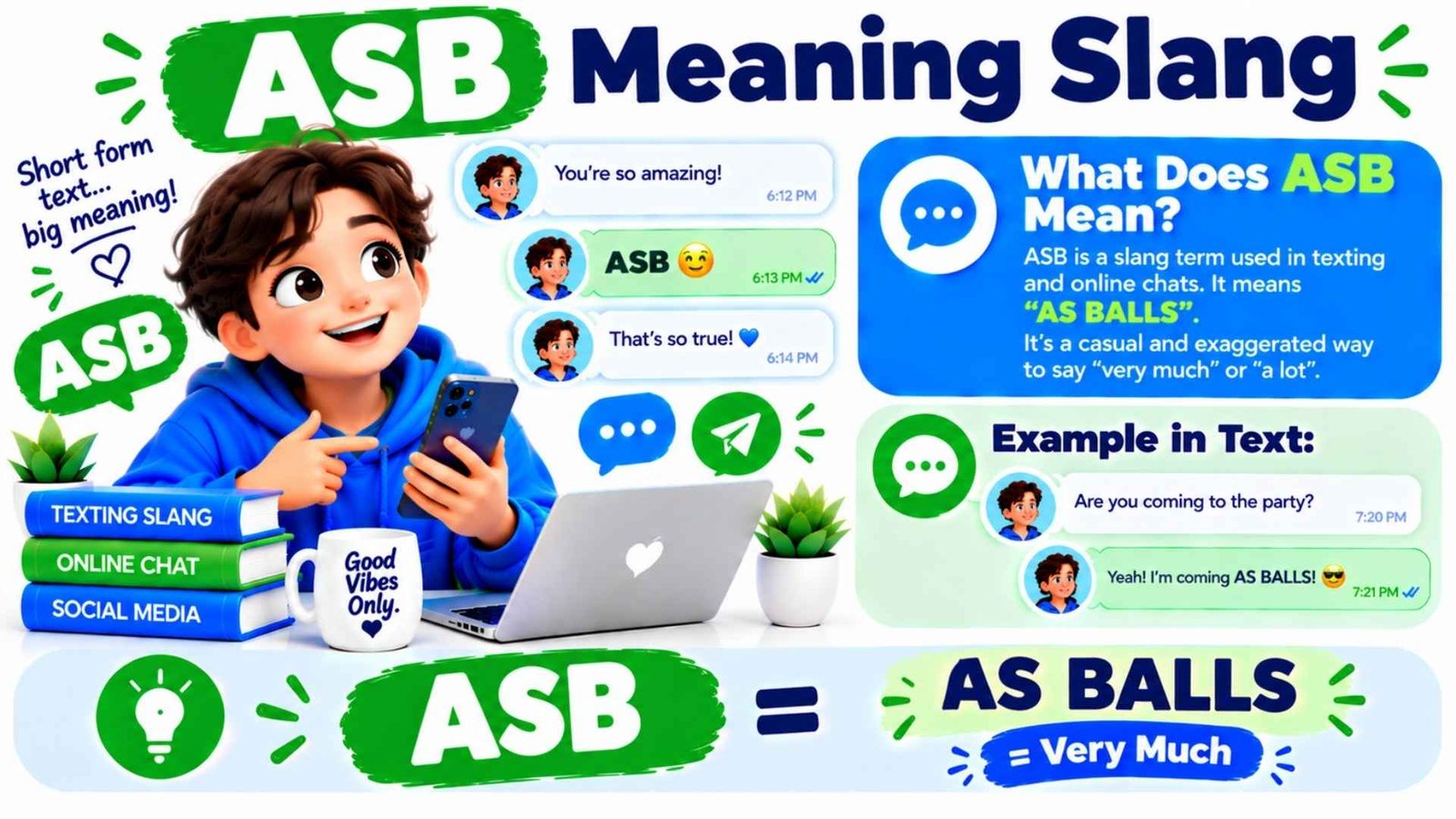
Have you ever received a message with “ASB” and paused because you had no idea what the sender meant? Short internet abbreviations can be confusing, especially when one combination of letters has several meanings. Understanding asb meaning slang can help you follow casual conversations and avoid awkward misunderstandings.
If you’re asking what does asb mean, the slang meaning covered in this guide is “As Balls,” an informal expression used to mean “very” or “extremely.” You’ll learn how ASB is used in texts, where it appears, how it compares with similar slang, and when to avoid it. Let’s make it simple.
What Does ASB Mean in Text?

When someone sends an unfamiliar abbreviation, it is easy to misunderstand the tone or intention behind the message. Asb meaning slang usually refers to “As Balls,” a casual expression that makes a description sound stronger.
In texting, ASB is used as an intensifier. An intensifier adds emphasis to a word or phrase. In this case, the expression can communicate that something is very tiring, extremely funny, unusually difficult, or strongly felt.
What Does ASB Stand For in a Text Message?
In the slang usage described in the reference article, ASB stands for “As Balls.” It is informal and can be considered crude because of the phrase it represents. People may use it to add emphasis when speaking with friends or posting casually online.
- Meaning: ASB can mean “As Balls” in slang.
- Purpose: It makes a description more intense.
- Tone: It is casual and may sound vulgar.
- Usage: It can appear in messages and social media posts.
- Context: The surrounding conversation helps identify the intended meaning.
| Text message | Intended meaning |
|---|---|
| “I’m tired ASB.” | I’m extremely tired. |
| “That exam was hard ASB.” | That exam was very difficult. |
| “It’s cold ASB outside.” | It’s extremely cold outside. |
| “That movie was funny ASB.” | That movie was very funny. |
Example in texting:
Friend 1: “I’m tired ASB after that long trip.”
Friend 2: “You should get some rest.”
Here, ASB emphasizes how tired the person feels. It does not change the basic meaning of the sentence; it simply makes the description stronger.
ASB Meaning slang
Internet slang often uses short forms to communicate feelings quickly. Asb meaning slang is one informal usage of the abbreviation, but the meaning may not be familiar to everyone who sees it.
How Is ASB Used as Slang?
ASB may be added to a descriptive sentence to make it more expressive. In this usage, it works similarly to words such as “really,” “very,” or “extremely,” although the tone is more casual and potentially crude.
- Emphasis: Adds extra strength to a description.
- Emotion: Can express excitement, frustration, or surprise.
- Informality: Fits relaxed conversations rather than formal writing.
- Expression: Makes a message sound more dramatic.
- Audience: Works only when the reader understands the slang.
ASB is not a standard English word, and it does not have one guaranteed meaning in every conversation. Its slang meaning should be interpreted in context.
Example in chat:
Friend 1: “That concert was amazing ASB.”
Friend 2: “Sounds like you had a great time!”
The sender uses ASB to stress how enjoyable the concert was. A person unfamiliar with the expression might need to ask what it means.
ASB meaning in text
When ASB appears in a message between friends, the slang expansion may be the intended meaning. However, what does asb mean can depend on whether the message is personal, educational, or related to another subject.
How Can You Understand ASB in a Message?
The easiest way to interpret ASB is to read the entire sentence rather than focusing only on the abbreviation. Look at the words around it, the relationship between the people messaging, and the topic of the conversation.
- Read the full message before deciding what ASB means.
- Check whether the conversation is casual or formal.
- Notice whether ASB follows a descriptive word.
- Consider the sender’s usual texting style.
- Ask for clarification if the meaning remains unclear.
| Message | Possible interpretation |
|---|---|
| “I’m hungry ASB.” | Informal intensifier |
| “The ASB meeting is tomorrow.” | Possibly a school-related abbreviation |
| “The report mentions ASB.” | Meaning depends on the report’s subject |
| “That was stressful ASB.” | Informal intensifier |
Example in texting:
Friend 1: “This assignment is difficult ASB.”
Friend 2: “I know. There’s so much to finish.”
The description “difficult” provides a clue that ASB is being used as an intensifier. In a school announcement, however, the same letters could refer to a student organization.
ASB meaning
ASB can have different expansions in different settings. The slang meaning in this article is “As Balls,” but the abbreviation may also appear in educational or community contexts.
What Are the Different Meanings of ASB?
The reference article lists several possible meanings beyond casual slang. These include Anti-Social Behaviour, Associated Student Body, and Academic Skills Builder. The exact expansion depends on the context in which the abbreviation appears.
- As Balls: Informal slang used as an intensifier.
- Anti-Social Behaviour: A term used in UK contexts.
- Associated Student Body: A term that may refer to a school organization.
- Academic Skills Builder: An educational phrase listed in the reference.
- Context: Helps distinguish between these meanings.
| ASB expansion | Possible context |
|---|---|
| As Balls | Casual texting or online slang |
| Anti-Social Behaviour | UK-related community or official discussions |
| Associated Student Body | School activities or student organizations |
| Academic Skills Builder | Educational settings |
Example in chat:
Friend 1: “The ASB meeting starts after lunch.”
Friend 2: “Is that the student body meeting?”
The reference to a meeting at school makes an educational meaning more likely than the slang expansion. When the context is not clear, asking the sender is better than guessing.
what does ASB mean
The question what does asb mean does not have one answer that applies to every situation. In casual texting, it can mean “As Balls,” while in other settings it may stand for a school or community term.
How Do You Identify the Correct Meaning?
A short abbreviation can be used by different groups for different reasons. Instead of assuming that ASB always means slang, use the surrounding sentence and the subject being discussed to work out the likely meaning.
- Identify the topic of the conversation.
- Review the sentence containing ASB.
- Consider whether the sender is a friend, teacher, or colleague.
- Look for other words that explain the abbreviation.
- Confirm the meaning if the message is important.
Example in texting:
Friend 1: “I saw ASB written in the school notice.”
Friend 2: “It might mean Associated Student Body. Check the notice.”
The same abbreviation can be used differently by separate communities. The context is the most useful clue.
Simple Meaning of ASB (In Easy Words)
Slang becomes easier to understand when you replace it with familiar words. Asb meaning slang can be simplified to “very” or “extremely” when it is used as an intensifier.
How Can You Explain ASB Simply?
Imagine a friend saying, “I’m very hungry.” If they use the slang expression “I’m hungry ASB,” the intended meaning is that they are extremely hungry. The expression makes the sentence sound more casual and emphatic.
- Very: A simple, everyday alternative.
- Extremely: A stronger standard English alternative.
- Really: A natural option for casual conversation.
- Emphasis: Shows that the feeling is strong.
- Informal tone: Makes the sentence sound more like slang.
| Slang sentence | Simple version |
|---|---|
| “I’m bored ASB.” | “I’m extremely bored.” |
| “That was funny ASB.” | “That was really funny.” |
| “I’m stressed ASB.” | “I’m very stressed.” |
| “It’s hot ASB.” | “It’s extremely hot.” |
Example in chat:
Friend 1: “I’m bored ASB at home.”
Friend 2: “Maybe watch a movie or call a friend.”
The expression adds intensity, but the sentence can still be understood by replacing ASB with “extremely.”
Where Is ASB Used?
ASB may appear in informal online communication, especially when people use slang with friends. The reference article mentions text messages, social media, and group chats as possible places where this abbreviation may appear.
Where Might You See ASB Online?
Different platforms allow people to communicate through messages, comments, captions, and replies. Slang can appear in these spaces, but that does not mean every user or community uses the same abbreviations.
- Text messages: May appear in personal conversations.
- Instagram: Could be used in comments or direct messages.
- Snapchat: May appear in casual messages between friends.
- TikTok: Could appear in informal comments.
- Twitter/X: May be used in casual replies.
- Group chats: Can reflect the slang shared by a friend group.
| Platform | Example | Communication style |
|---|---|---|
| Text messages | “I’m tired ASB.” | Personal |
| “This song is good ASB.” | Casual comment | |
| Snapchat | “That was funny ASB.” | Informal message |
| TikTok | “This video is funny ASB.” | Casual reply |
| Group chats | “It’s cold ASB.” | Friendly conversation |
Example in texting:
Friend 1: “Are you coming out tonight?”
Friend 2: “Yes, I’m excited ASB!”
ASB may be used to express excitement in a casual exchange. In a formal announcement or work message, standard wording is generally clearer.
1. Text Messages
Personal messages are a natural setting for informal language. Friends may use abbreviations to express their feelings without writing a long explanation.
- Quick replies: Short forms can make messages brief.
- Shared slang: Friends may understand expressions familiar to their group.
- Emphasis: ASB can strengthen a description.
- Casual tone: It can make a message feel relaxed.
- Personal context: The relationship helps shape how slang is understood.
Example in texting:
Friend 1: “I’m sleepy ASB.”
Friend 2: “You were up late again, weren’t you?”
2. Social Media Platforms
Social media includes many types of informal communication, from captions to comments. ASB may appear in these settings when users choose slang to express a strong reaction.
- Captions: May include slang to express a mood.
- Comments: Users may respond casually to posts.
- Direct messages: Friends may use familiar abbreviations.
- Replies: Short slang can make a reaction feel conversational.
- Audience: Public posts may reach people unfamiliar with the term.
Example in chat:
Friend 1: “Did you see that video?”
Friend 2: “Yes, it was funny ASB.”
3. Group Chats
Group chats often develop their own style of communication. Members may use abbreviations that feel familiar to the group, although someone new to the chat might not understand every term.
- Shared expressions: Members may reuse familiar slang.
- Quick reactions: Short forms can express feelings quickly.
- Inside jokes: Some phrases may have a group-specific meaning.
- Clarity: Explain unfamiliar abbreviations to new members.
- Respect: Consider everyone’s comfort with crude language.
Example in texting:
Friend 1: “That match was stressful ASB.”
Friend 2: “We were all shouting at the screen!”
Why Do People Use ASB?
People use slang for different reasons, including expressing emotions, keeping messages short, and matching the style of a social group. ASB can function as an intensifier when people want to make a statement sound stronger.
Why Might Someone Choose ASB Instead of “Very”?
Slang can make a conversation sound more relaxed, especially when the people communicating already understand the expression. ASB may also add a dramatic or playful tone, depending on how the sentence is written and the relationship between the speakers.
- Expression: Adds emphasis to a feeling or opinion.
- Connection: Can reflect a shared social style.
- Brevity: Keeps casual messages compact.
- Humor: May make an exaggerated statement sound playful.
- Tone: Can make a conversation feel less formal.
| Reason | How it may affect communication |
|---|---|
| Expression | Strengthens the message |
| Social connection | Reflects shared language |
| Brevity | Reduces extra wording |
| Humor | Adds dramatic emphasis |
| Casual style | Makes a message less formal |
Example in chat:
Friend 1: “I’m excited ASB for the weekend.”
Friend 2: “Same! I’ve been waiting all week.”
1. To Sound More Expressive
Some people use slang to make their feelings sound more intense. Instead of saying “I’m very happy,” a person might use an informal expression to make the excitement stand out.
- Emphasize strong feelings.
- Express excitement or frustration.
- Add a dramatic tone.
- Strengthen a personal reaction.
- Communicate emotion in a casual way.
Example in texting:
Friend 1: “That was amazing ASB!”
Friend 2: “You sound like you really enjoyed it.”
2. To Fit In
People sometimes adopt language they hear in their social circles. When a group frequently uses certain expressions, other members may start using them as well.
- Observe how friends communicate.
- Recognize expressions shared within a group.
- Adapt language to a casual setting.
- Build familiarity through shared wording.
- Respect people who prefer standard language.
Example in chat:
Friend 1: “Everyone in the group says ASB.”
Friend 2: “I’ve noticed. I usually just say ‘really.’”
3. To Be Short and Quick
Abbreviations can make digital communication feel brief and immediate. ASB is short to type, although the phrase it represents is not always suitable for every conversation.
- Save typing time in casual messages.
- Keep short replies compact.
- Express emphasis with fewer characters.
- Match the pace of fast conversations.
- Choose clearer wording when necessary.
Example in texting:
Friend 1: “How was the trip?”
Friend 2: “Long ASB, but it was fun.”
4. To Sound Casual and Cool
Slang can help people create a relaxed tone in informal conversations. However, slang does not automatically make a message sound natural, and using an expression that does not fit the speaker can feel forced.
- Keep friendly messages relaxed.
- Use expressions that feel natural to you.
- Avoid copying slang without understanding it.
- Consider the reader’s preferences.
- Switch to standard language when appropriate.
Example in chat:
Friend 1: “This weather is cold ASB.”
Friend 2: “It really is. I need a jacket.”
Real-Life Examples of ASB in Text (With Explanation)
Examples help show how an abbreviation works in different sentences. The following messages are illustrative and demonstrate the slang usage described in the reference article.
How Does ASB Change the Meaning of a Sentence?
ASB does not usually change the subject of a sentence. Instead, it increases the intensity of a description, such as tired, funny, hot, or stressful.
- Tired: Communicates extreme tiredness.
- Funny: Emphasizes how amusing something feels.
- Hot: Strengthens a description of temperature.
- Stressed: Expresses a high level of stress.
- Excited: Adds emphasis to excitement.
- Difficult: Highlights how challenging something seems.
| Example | Meaning |
|---|---|
| “I’m tired ASB.” | I’m extremely tired. |
| “That movie was funny ASB.” | That movie was very funny. |
| “It’s hot ASB outside.” | It’s extremely hot outside. |
| “I’m stressed ASB right now.” | I’m very stressed right now. |
| “I’m excited ASB.” | I’m extremely excited. |
Example 1:
Text: “I’m tired ASB.”
Meaning: “I’m extremely tired.”
This message could be sent after a long day at work, school, or while travelling. ASB emphasizes the speaker’s tiredness.
Example in texting:
Friend 1: “Are you still coming over?”
Friend 2: “I’m tired ASB. Can we meet tomorrow?”
Example 2:
Text: “That movie was funny ASB.”
Meaning: “That movie was very funny.”
Here, ASB adds emphasis to the speaker’s opinion about the movie. It suggests the person found it especially amusing.
Example in chat:
Friend 1: “Did you like the comedy?”
Friend 2: “Yes, it was funny ASB.”
Example 3:
Text: “It’s hot ASB outside.”
Meaning: “It’s extremely hot outside.”
The sender is emphasizing the temperature. The message may be part of a conversation about weather, outdoor plans, or feeling uncomfortable.
Example in texting:
Friend 1: “Want to go for a walk?”
Friend 2: “It’s hot ASB outside. Let’s go later.”
Example 4:
Text: “I’m stressed ASB right now.”
Meaning: “I’m very stressed right now.”
In this sentence, ASB makes the feeling sound stronger. The sender may be dealing with work, school, personal responsibilities, or another difficult situation.
Example in chat:
Friend 1: “You seem quiet. Everything okay?”
Friend 2: “I’m stressed ASB about my exams.”
In these examples, ASB appears after a descriptive word. That is a pattern shown in the reference article, not a strict grammar rule that every user must follow.
ASB vs Similar Slang Terms
ASB is not the only informal expression used to add emphasis. Terms such as AF, FR, lowkey, and highkey can appear in similar online spaces, but each has its own meaning and function.
What Is the Difference Between ASB and Other Slang?
ASB and AF may both intensify descriptions, while FR is commonly used to express agreement or sincerity. Lowkey and highkey can qualify how strongly or openly someone expresses a feeling.
- ASB: Informal intensifier meaning “very” or “extremely.”
- AF: Strong intensifier based on an explicit phrase.
- FR: Short for “for real.”
- Lowkey: Can mean subtly, slightly, or privately.
- Highkey: Can indicate an openly or strongly expressed feeling.
| Slang term | Common meaning | Main function | Tone |
|---|---|---|---|
| ASB | As Balls | Intensifies a description | Casual, potentially crude |
| AF | As F*** | Intensifies a description | Strong, vulgar |
| FR | For real | Shows agreement or sincerity | Casual |
| Lowkey | Slightly or secretly | Qualifies a statement | Casual |
| Highkey | Openly or strongly | Emphasizes a feeling | Casual |
ASB vs AF
Both expressions can mean “very” or “extremely” in casual messages. AF is more explicitly profane, while ASB also comes from a crude phrase and should not be assumed to be polite.
- Meaning: Both can intensify descriptions.
- Tone: Both are informal.
- Explicitness: AF contains a direct profanity.
- Audience: Neither is ideal for formal communication.
- Alternatives: “Very” and “extremely” are more neutral.
Example in texting:
Friend 1: “That match was intense AF.”
Friend 2: “FR, the last few minutes were stressful.”
The terms have overlapping uses, but they cannot replace each other in every sentence. Choose a term based on its meaning and the people reading it.
When Should You Use ASB?
Knowing what an abbreviation means is not the same as knowing when it is appropriate. ASB is informal and may sound crude, so the relationship, situation, and audience all matter.
When Is ASB Appropriate?
ASB may fit relaxed conversations with close friends who understand the expression and are comfortable with it. It is generally better to avoid the term in formal communication, professional settings, or serious discussions.
- Use it only with people comfortable with slang.
- Consider the tone of the conversation.
- Avoid it in professional emails.
- Skip it in formal school communication.
- Choose standard words when speaking to unfamiliar people.
- Respect the preferences of your audience.
| Situation | Suggested wording |
|---|---|
| Casual chat with close friends | ASB may fit if everyone is comfortable |
| Work email | “Very” or “extremely” |
| School assignment | Standard English |
| Professional social media | Clear, neutral wording |
| Serious conversation | Direct and respectful language |
Example in chat:
Friend 1: “I’m nervous ASB about my presentation.”
Friend 2: “You’ve prepared well. You’ll do great.”
The phrase may feel normal in one friendship but inappropriate in another. When uncertain, neutral language is the safer option.
Common Misunderstandings About ASB
ASB can cause confusion because the same letters may represent different phrases. Understanding the context helps prevent mistakes, especially when a message is about school, community matters, or an official subject.
What Are the Most Common ASB Misunderstandings?
One common mistake is assuming that ASB always refers to slang. Another is believing that everyone understands the abbreviation or that it is suitable for every age and setting.
- Multiple meanings: ASB has other possible expansions.
- Tone: The slang phrase may sound crude.
- Audience: Not everyone recognizes internet slang.
- Context: The subject can change the meaning.
- Popularity: Usage may vary between communities.
1. Does ASB Have Other Meanings?
Yes. The reference article lists Anti-Social Behaviour, Associated Student Body, and Academic Skills Builder as other possible meanings. These expansions may appear in contexts unrelated to casual texting.
- Anti-Social Behaviour: Appears in UK-related contexts.
- Associated Student Body: May refer to a school organization.
- Academic Skills Builder: An educational phrase listed in the reference.
- As Balls: An informal slang expansion.
- Context: Helps identify which meaning is intended.
Example in texting:
Friend 1: “The school ASB meeting is tomorrow.”
Friend 2: “That sounds like a student organization meeting.”
2. Is ASB Offensive?
ASB can be considered offensive or inappropriate by some readers because “As Balls” is a crude expression. Other people may use it casually among friends without intending to offend anyone.
- Consider the audience’s comfort with profanity.
- Avoid it in formal settings.
- Use neutral wording when unsure.
- Understand that people interpret slang differently.
- Respect requests to avoid crude language.
Example in chat:
Friend 1: “That was awkward ASB.”
Friend 2: “I get what you mean, but I don’t use that phrase.”
3. Is ASB Popular Everywhere?
The supplied reference associates ASB with American internet slang, but it does not provide verified statistics about its use across regions or age groups. Familiarity may differ between individuals, communities, and online spaces.
- Recognize that slang varies between groups.
- Avoid assuming everyone understands ASB.
- Consider regional language differences.
- Notice whether the sender uses other slang.
- Clarify the meaning when needed.
Example in texting:
Friend 1: “I keep seeing ASB online.”
Friend 2: “It can mean ‘As Balls’ in slang, depending on context.”
Pro Tips for Using ASB Correctly
Using slang naturally requires more than memorizing a definition. It helps to understand the expression’s tone, the audience, and whether the abbreviation makes the message clearer or more confusing.
How Can You Use ASB Without Confusing People?
ASB may be understood in one friend group but unfamiliar to another. A few simple habits can help you communicate clearly without relying too heavily on slang.
- Know whether the reader understands the expression.
- Avoid repeating ASB in every sentence.
- Check the subject and tone before using it.
- Remember that text does not show facial expressions.
- Keep the phrase for relaxed conversations.
- Replace it with standard wording when appropriate.
| Tip | What to do |
|---|---|
| Know your audience | Use slang with people familiar with it |
| Avoid overuse | Keep messages natural |
| Check context | Confirm that the slang fits the topic |
| Understand tone | Consider how the message may be received |
| Keep it casual | Avoid formal and professional settings |
1. Only Use It With People Who Use Slang
Using slang with people who already communicate casually can reduce the chance of confusion. However, even close friends may have different preferences about crude expressions.
- Notice how your friends communicate.
- Use shared expressions naturally.
- Avoid assuming everyone likes slang.
- Respect different communication styles.
- Switch to neutral wording when needed.
Example in chat:
Friend 1: “I’m hungry ASB.”
Friend 2: “Let’s grab something to eat.”
2. Don’t Overuse It
Repeating an abbreviation too often can make messages feel forced. Slang is usually more effective when it fits the sentence instead of appearing in every response.
- Vary your wording.
- Use ASB only when emphasis helps.
- Avoid adding it to every description.
- Keep sentences easy to read.
- Choose simple alternatives when appropriate.
Example in texting:
Friend 1: “I’m tired ASB, and I’m hungry ASB.”
Friend 2: “Sounds like you need food and rest.”
3. Watch the Context
The same abbreviation may be interpreted differently in different conversations. Always consider whether the topic is casual, educational, professional, or serious.
- Read the full conversation.
- Check what the message is about.
- Identify whether the sender is using slang.
- Avoid assumptions in important discussions.
- Ask for clarification when needed.
Example in chat:
Friend 1: “ASB is listed in the school notice.”
Friend 2: “That may be a school-related abbreviation.”
4. Understand Tone
Text messages do not include facial expressions, voice, or body language. As a result, a phrase meant to be funny or dramatic may be interpreted as rude by someone else.
- Consider how your words may sound.
- Avoid crude slang in sensitive discussions.
- Use emojis only when they genuinely clarify tone.
- Choose direct wording for serious matters.
- Respect how the recipient responds.
Example in texting:
Friend 1: “That was difficult ASB.”
Friend 2: “I understand. It sounded like a tough day.”
5. Keep It Casual
ASB is best understood as informal slang in the usage discussed here. Standard English is usually clearer for formal writing, professional communication, and messages to people you do not know well.
- Keep it for relaxed conversations.
- Avoid it in official documents.
- Use neutral wording at work.
- Consider the reader’s expectations.
- Prioritize clarity over slang.
Example in chat:
Friend 1: “This assignment is hard ASB.”
Friend 2: “I agree. Let’s work through it together.”
How ASB Became Popular
The reference article connects ASB with online communication, memes, group chats, and youth internet communities. However, it does not establish a precise origin or provide data showing when or how widely the term spread.
What Helped ASB Spread Online?
Internet expressions can move between communities as people see and repeat them. Social platforms make it easy for users to encounter unfamiliar slang, but the presence of a term online does not prove that it is widely used.
- Social media: Posts and comments can expose users to slang.
- Meme culture: Repeated phrases may become familiar.
- Group chats: Friends can share expressions within their circles.
- Online communities: Shared interests may encourage common language.
- Changing slang: Expressions can become less common over time.
| Possible influence | Role in slang use |
|---|---|
| Social media | Shares expressions across online spaces |
| Memes | Repeats phrases in humorous contexts |
| Group chats | Builds familiarity within friend groups |
| Youth communities | Develops shared informal language |
| Internet culture | Allows language to change quickly |
Example in texting:
Friend 1: “I saw ASB in a comment. Is it slang?”
Friend 2: “It can be. In that context, it may mean ‘As Balls.’”
The reference does not confirm the first use of ASB or identify a particular trend that created it. It is more accurate to describe the online spaces where the expression may appear than to claim a verified origin.
Is ASB Appropriate for All Ages?
ASB may not suit every age group because its slang expansion includes a crude phrase. Some people may understand it as casual internet language, while others may find it unnecessary or inappropriate.
Should You Use ASB Around Younger Audiences?
When communicating with younger people, it is helpful to consider both the meaning and the tone of an expression. Clear alternatives such as “very,” “really,” or “extremely” can communicate the same idea without using crude slang.
- Younger users: May encounter the abbreviation without knowing its expansion.
- Parents: Can explain the phrase and its tone.
- Students: Should follow school language expectations.
- Adults: May prefer more standard wording.
- Everyone: Can choose language suitable for the audience.
| Audience | Consideration |
|---|---|
| Close friends | Depends on shared comfort |
| Younger teens | Explain its meaning and tone |
| Family chats | Follow family preferences |
| School communication | Use clear, appropriate wording |
| Professional contacts | Avoid crude slang |
Example in chat:
Friend 1: “Should I use ASB in the class group?”
Friend 2: “It’s clearer to say ‘very’ or ‘extremely.’”
The important point is not whether every person should use or avoid slang. It is to understand the phrase and make a thoughtful choice based on the audience.
What Should You Say Instead of ASB?
Sometimes you may want to express a strong feeling without using slang. In those cases, simple words can make your message clear while avoiding the potentially crude tone of ASB.
Which Words Can Replace ASB?
When ASB is used to mean “very” or “extremely,” several common alternatives may fit the sentence. The best choice depends on the emotion you want to communicate and the level of emphasis required.
- Very: A simple, neutral intensifier.
- Really: A natural option for everyday conversation.
- Extremely: A stronger and more formal choice.
- So: A casual way to add emphasis.
- Incredibly: A descriptive alternative for strong reactions.
| With ASB | Neutral alternative |
|---|---|
| “I’m tired ASB.” | “I’m extremely tired.” |
| “That was funny ASB.” | “That was really funny.” |
| “It’s hot ASB.” | “It’s incredibly hot.” |
| “I’m stressed ASB.” | “I’m very stressed.” |
Example in texting:
Friend 1: “I’m tired ASB after work.”
Friend 2: “I’m extremely tired too. Let’s rest.”
Using a standard alternative does not make a message less expressive. It can make the meaning easier for a wider audience to understand.
FAQ: What Does ASB Mean in Text?
What Does ASB Mean in Texting?
ASB can mean “As Balls,” an informal intensifier. It usually means “very” or “extremely” in casual messages.
Is ASB the Same as AF?
Both can intensify descriptions, but AF is more explicitly profane. ASB is also crude and should be used cautiously.
Is ASB Inappropriate?
ASB may sound vulgar because it stands for “As Balls.” Use it carefully, especially in formal settings.
Does ASB Have Other Meanings?
Yes. ASB can also refer to Anti-Social Behaviour or Associated Student Body. The context helps identify its intended meaning.
Should I Use ASB in a Formal Message?
ASB is informal slang and may not suit professional communication. Use “very,” “really,” or “extremely” instead.
Final Thoughts: What Does ASB Mean in Text?
Asb meaning slang usually refers to “As Balls,” an informal expression that means “very” or “extremely.” People may use it to emphasize feelings, reactions, or descriptions in casual messages and online conversations. However, the phrase can sound crude, and not everyone is familiar with it.
If you have been wondering what does asb mean, remember that context matters. ASB may also stand for terms such as Anti-Social Behaviour or Associated Student Body in other settings. Look at the full message before deciding which meaning fits.
Use ASB only when it feels appropriate for the people you are communicating with. In formal or unfamiliar settings, words such as “really,” “very,” and “extremely” are clearer alternatives. The best approach is to understand the slang, consider your audience, and choose wording that communicates your meaning respectfully.

LearnerGrammar.com helps English learners improve grammar, vocabulary, writing, and communication skills with simple lessons and tips.






2 thoughts on “ASB Meaning Slang: Easy Guide and Best Examples (2026)”