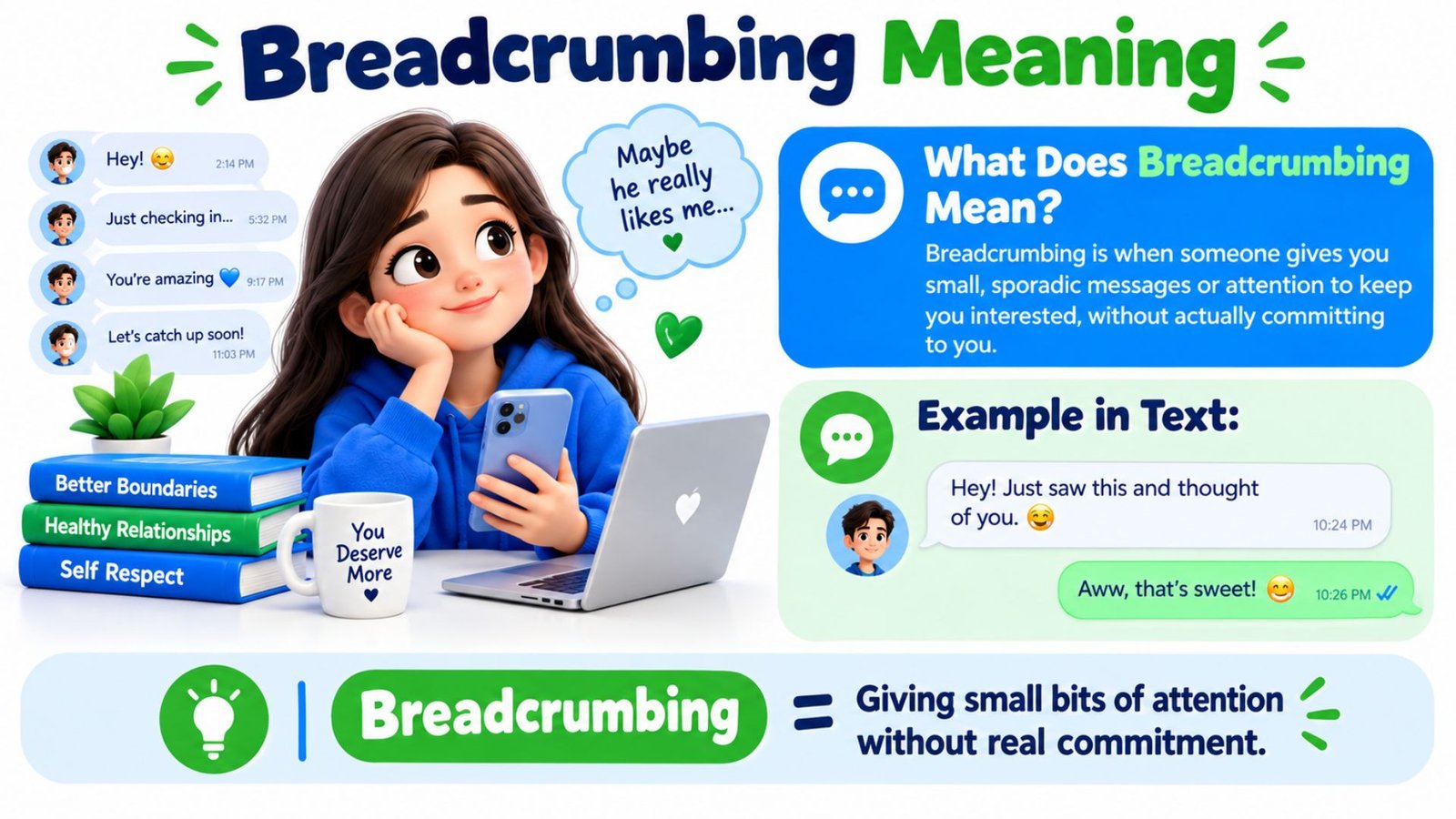
You may get a sweet message today, silence tomorrow, and another flirty reply weeks later. That confusing pattern can leave you wondering what the relationship actually means.
Breadcrumbing Meaning explains this frustrating behavior clearly, including what does breadcrumbing meaning look like in dating, friendships, social media, and work. You’ll learn the common signs, possible reasons behind the behavior, and how breadcrumbing differs from ghosting or benching. Most importantly, this guide focuses on observable patterns rather than guessing someone’s private intentions. Keep reading if you want clearer language for confusing communication and practical ways to protect your time, boundaries, and emotional energy.
What Is Breadcrumbing?
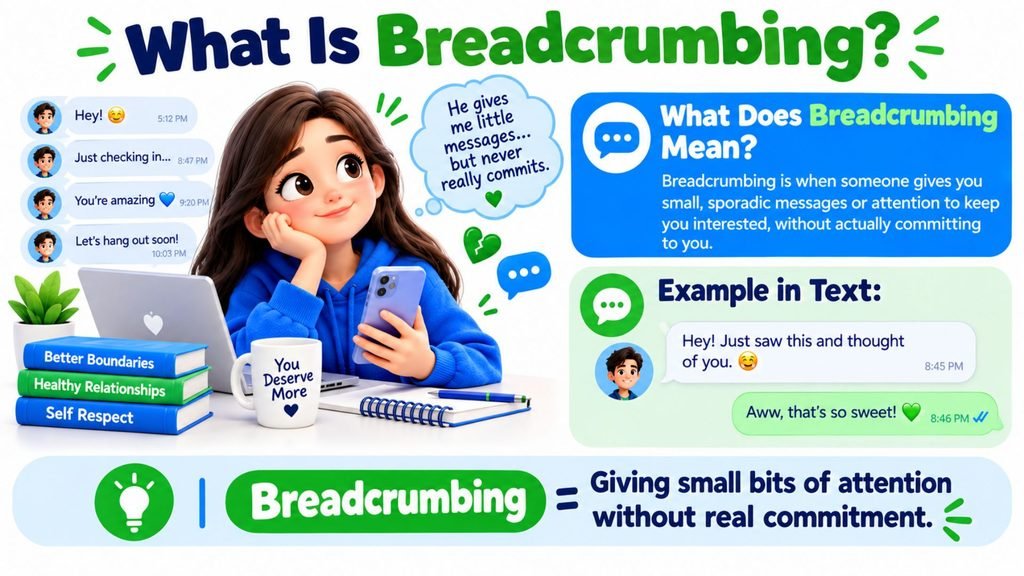
Breadcrumbing Meaning describes a pattern where someone gives small, inconsistent signals of interest while avoiding meaningful progress. What does breadcrumbing meaning look like? Think occasional texts, likes, compliments, or vague plans that create hope without consistent effort.
How Can You Recognize Breadcrumbing Quickly?
- Attention: They appear just often enough to maintain interest.
- Consistency: Their communication changes without clear explanation.
- Plans: They mention meeting but rarely follow through.
- Affection: Flirting appears without meaningful relationship progress.
- Effort: You usually invest more energy than they do.
- Clarity: Their intentions remain difficult to understand.
- Pattern: Interest increases when you begin pulling away.
Example in texting:
Friend 1: “You always disappear, then come back like nothing happened.”
Friend 2: “Haha, I know. We should definitely hang out sometime!”
what does breadcrumbing mean
Understanding what does breadcrumbing meaning involve looking beyond one isolated message. A delayed reply does not automatically prove breadcrumbing. The important issue is a repeated pattern of intermittent attention, vague interest, limited follow-through, and little relationship development.
What Does Breadcrumbing Look Like in Real Life?
- Messages: Random check-ins replace steady communication.
- Compliments: Flattery appears without meaningful action.
- Plans: Future ideas remain vague or unfinished.
- Social media: Likes substitute for genuine conversation.
- Timing: Contact often happens when convenient for them.
- Progress: Weeks pass without noticeable development.
- Reciprocity: Your effort exceeds their contribution.
Example in chat:
Friend 1: “Are we actually going to meet this week?”
Friend 2: “Of course! I’ve just been super busy lately.”
Simple Definition
The simplest Breadcrumbing Meaning is giving someone enough attention to keep them interested without offering consistent relationship effort. The behavior is most commonly discussed in dating, but similar patterns can appear in friendships, family relationships, and workplaces.
Breadcrumbing in One Simple Sentence
- Meaning: Small signals maintain someone’s interest.
- Pattern: Attention appears inconsistently.
- Result: The recipient stays hopeful.
- Problem: Progress remains limited.
- Context: Dating is the most common example.
- Platforms: Texts, apps, and social media can facilitate it.
Example in texting:
Friend 1: “They keep texting me, but never make plans.”
Friend 2: “That sounds like a pattern worth paying attention to.”
The Origin of the Term Breadcrumbing
The term Breadcrumbing Meaning comes from the familiar image of leaving breadcrumbs along a path, associated with the fairy tale Hansel and Gretel. Modern relationship language uses that image to describe leaving small signals that keep another person following.
Why Is It Called Breadcrumbing?
- Image: Small crumbs represent small signals of interest.
- Story: The phrase connects with Hansel and Gretel.
- Modern use: Dating culture popularized the expression.
- Meaning: Signals create a trail of continued hope.
- Technology: Digital communication makes tiny interactions easy.
- Usage: The term now extends beyond dating.
- Context: Online relationships often make the pattern easier to notice.
Example in chat:
Friend 1: “Why do people call it breadcrumbing?”
Friend 2: “Because the person keeps leaving little signs that make you follow.”
How Breadcrumbing Works
Breadcrumbing meaning usually develops through an inconsistent cycle: attention appears, hope increases, communication fades, and another small signal restarts the connection. Psychologists often discuss intermittent reinforcement when explaining why unpredictable attention can keep people invested.
What Is the Breadcrumbing Cycle?
| Stage | What Happens | Common Effect |
|---|---|---|
| 1 | Attention appears | Interest increases |
| 2 | Communication becomes warm | Hope grows |
| 3 | Contact decreases | Confusion begins |
| 4 | Another message arrives | Hope returns |
| 5 | Progress remains limited | The cycle repeats |
- Contact: A message suddenly appears.
- Hope: The recipient feels the connection may continue.
- Withdrawal: Communication becomes distant again.
- Checking: The recipient may watch for another message.
- Reassurance: A small interaction restores optimism.
- Repetition: The same pattern happens again.
Example in texting:
Friend 1: “They ignored me for two weeks.”
Friend 2: “And now they suddenly sent a heart emoji?”
Common Signs of Breadcrumbing
The clearest Breadcrumbing Meaning becomes easier to understand when you examine repeated behavior instead of individual messages. No single sign proves breadcrumbing, but several patterns appearing together can indicate an unclear or low-effort connection.
What Are the Biggest Breadcrumbing Red Flags?
- Inconsistency: Communication frequently starts and stops.
- Avoidance: Direct relationship questions receive vague answers.
- Flirting: Romantic signals appear without follow-through.
- Waiting: You spend significant time expecting contact.
- Imbalance: Your effort regularly exceeds theirs.
- Surface-level: Conversations avoid emotional depth.
- Uncertainty: You rarely know where things stand.
Example in chat:
Friend 1: “They act interested, but nothing ever changes.”
Friend 2: “Look at the overall pattern rather than one good conversation.”
1. Inconsistent Communication
Inconsistent communication is one of the most recognizable signs of Breadcrumbing Meaning. Someone may message frequently for a short period, disappear, then return casually without addressing the gap or changing the underlying pattern.
How Does Inconsistent Communication Appear?
- Replies: Responses arrive unpredictably.
- Frequency: Daily messages suddenly become weekly.
- Attention: Warmth changes without explanation.
- Timing: Messages may arrive at unusual times.
- Continuity: Conversations repeatedly lose momentum.
- Effort: Long gaps require you to restart contact.
Example in texting:
Friend 1: “We talked every day last week.”
Friend 2: “Now they haven’t replied since Monday.”
2. They Never Commit to Plans
A person can genuinely be busy without breadcrumbing. The stronger warning sign is repeated interest in meeting without specific plans, confirmation, or follow-through. Actions become more informative than promises.
Why Do Vague Plans Matter?
- Promises: They repeatedly mention future meetings.
- Details: No specific date gets chosen.
- Follow-through: Plans disappear before happening.
- Excuses: Similar reasons appear repeatedly.
- Initiative: You usually have to arrange everything.
- Progress: The relationship stays exactly where it started.
Example in chat:
Friend 1: “Want to grab coffee Saturday?”
Friend 2: “Definitely! Let’s figure it out later.”
3. Frequent Social Media Interaction
Social media can make breadcrumbing especially subtle because liking a story or sending a reaction requires very little effort. Online interaction alone does not prove romantic interest or commitment.
How Can Social Media Create Breadcrumbs?
- Likes: They repeatedly engage with your posts.
- Reactions: Emojis replace meaningful conversation.
- Stories: They regularly react without starting deeper discussions.
- Memes: Funny content becomes their main interaction.
- Comments: Public attention replaces private communication.
- DMs: Messages appear without meaningful progression.
Example in texting:
Friend 1: “They liked three of my stories today.”
Friend 2: “Do they actually talk to you outside social media?”
4. Mixed Signals
Mixed signals happen when someone’s words suggest interest while their actions suggest distance. The conflict can make Breadcrumbing Meaning difficult to recognize because each positive interaction feels like evidence that things might improve.
What Are Common Mixed Signals?
- Words: They say they miss you.
- Actions: They avoid making plans.
- Flirting: Romantic messages appear unexpectedly.
- Distance: They become unavailable afterward.
- Promises: Future possibilities are mentioned repeatedly.
- Behavior: Their effort remains inconsistent.
Example in chat:
Friend 1: “They said they really like me.”
Friend 2: “Do their actions show that consistently?”
5. Conversations Stay Surface-Level
A conversation can be frequent while remaining emotionally shallow. Breadcrumbing meaning often involves enough interaction to maintain connection but not enough vulnerability, curiosity, or shared planning to create genuine closeness.
What Does Surface-Level Communication Look Like?
- Topics: Conversations stay casual.
- Questions: They rarely ask meaningful questions.
- Vulnerability: Personal subjects are avoided.
- Depth: Discussions quickly return to flirting.
- Curiosity: They show limited interest in your life.
- Connection: Emotional intimacy does not develop.
Example in texting:
Friend 1: “We text a lot, but they barely know anything about me.”
Friend 2: “That difference between frequency and depth matters.”
6. They Contact You When Convenient
Breadcrumbing meaning can involve contact that appears mainly when the other person wants attention, entertainment, reassurance, or companionship. However, motives cannot always be known from behavior alone, so focus on the observable imbalance.
When Does Convenience Become a Pattern?
- Timing: Messages appear when they are bored.
- Availability: They expect quick replies.
- Reciprocity: They rarely accommodate your schedule.
- Attention: They disappear after receiving reassurance.
- Consistency: Contact depends on their needs.
- Balance: Your needs receive less attention.
Example in chat:
Friend 1: “They only text me late at night.”
Friend 2: “Notice whether daytime communication or real plans ever happen.”
7. Long Gaps Followed by Sudden Messages
Long gaps can happen naturally because people have jobs, family responsibilities, or personal challenges. The warning sign is a repeated cycle where silence is followed by sudden affection, flirting, or attention that restarts expectations.
Why Can Sudden Messages Feel So Powerful?
| Pattern | Possible Experience |
|---|---|
| Long silence | Uncertainty |
| Sudden message | Relief |
| Warm conversation | Renewed hope |
| Another disappearance | Disappointment |
| Repeated cycle | Emotional exhaustion |
- Silence: Contact suddenly stops.
- Return: They reappear without explanation.
- Warmth: Their message feels unusually affectionate.
- Hope: You reconsider the connection.
- Withdrawal: Communication fades again.
- Cycle: The same pattern repeats.
Example in texting:
Friend 1: “Hey stranger! I’ve been thinking about you ❤️”
Friend 2: “You disappeared for three weeks.”
Examples of Breadcrumbing
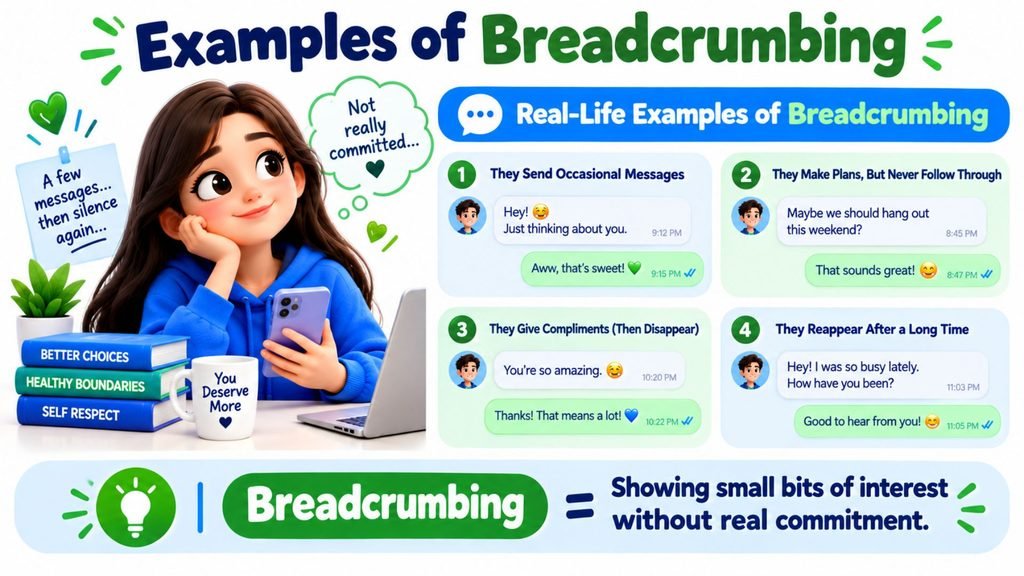
Real examples make Breadcrumbing Meaning easier to recognize because the behavior often looks harmless in isolation. The important factor is the repeated combination of attention, uncertainty, and limited follow-through.
How Does Breadcrumbing Appear in Different Relationships?
- Dating: Flirting never becomes consistent dating.
- Social media: Engagement replaces genuine conversation.
- Ex-partners: Old feelings are repeatedly reactivated.
- Workplace: Promised opportunities never materialize.
- Friendships: Contact appears only when convenient.
- Family: Affection becomes inconsistent or conditional.
Example in chat:
Friend 1: “Is breadcrumbing only a dating thing?”
Friend 2: “No. Similar patterns can happen in social and professional relationships.”
Example 1: Online Dating
Online dating creates many opportunities for intermittent contact because messages, likes, and matches can happen without an actual meeting. Breadcrumbing Meaning becomes clearer when online attention repeatedly fails to become real-world progress.
What Does Online Dating Breadcrumbing Look Like?
- Flirting: Romantic messages arrive regularly.
- Plans: Dates remain hypothetical.
- Replies: Messages stop unexpectedly.
- Returns: Contact resumes after silence.
- Promises: “Soon” replaces specific plans.
- Effort: One person carries the connection.
Example in chat:
Friend 1: “We’ve been talking for two months.”
Friend 2: “Have you actually met?”
Example 2: Social Media
Social media breadcrumbing meaning can involve likes, comments, reactions, or occasional direct messages that create a feeling of connection without meaningful communication. A single interaction is not enough to label the behavior.
What Can Social Media Breadcrumbing Look Like?
- Stories: They react repeatedly.
- Likes: They suddenly engage after silence.
- DMs: Messages remain casual.
- Comments: Public interaction replaces private effort.
- Flirting: Interest appears without progression.
- Consistency: Their effort remains unpredictable.
Example in chat:
Friend 1: “They react to every story but never ask how I’m doing.”
Friend 2: “That can feel confusing when the interaction never develops.”
Example 3: Ex-Partner Contact
An ex-partner may occasionally send nostalgic messages, react to posts, or mention old memories without clearly communicating whether they want to rebuild the relationship. Context matters, especially when both people have unresolved feelings.
What Might Ex-Partner Breadcrumbing Look Like?
- Nostalgia: They repeatedly mention old memories.
- Messages: They contact you after long gaps.
- Flirting: Romantic language suddenly returns.
- Plans: Reconciliation remains vague.
- Jealousy: They react when you move forward.
- Clarity: Their actual intentions remain unstated.
Example in texting:
Friend 1: “My ex texted me saying they miss our old days.”
Friend 2: “Did they actually explain what they want now?”
Example 4: Workplace Breadcrumbing
Breadcrumbing meaning can also describe professional situations where someone repeatedly hints at opportunities without providing clear information or follow-through. Cleveland Clinic specifically gives workplace promises of possible promotion as an example of this broader behavior.
How Can Workplace Breadcrumbing Meaning Appear?
- Promises: Advancement is repeatedly mentioned.
- Praise: Positive feedback replaces concrete action.
- Opportunities: Future possibilities remain vague.
- Timing: Decisions keep getting postponed.
- Clarity: Expectations are never clearly documented.
- Progress: Months pass without movement.
Example in chat:
Friend 1: “My manager keeps saying I’m being considered for promotion.”
Friend 2: “Have they given you clear criteria or a timeline?”
Why Do People Breadcrumb Others?
There is no single explanation for breadcrumbing meaning. Research and clinical commentary discuss possibilities such as validation, difficulty with commitment, keeping options open, loneliness, boredom, or controlling attention, but a person’s motive cannot be reliably determined from the pattern alone.
What Are Common Reasons Behind Breadcrumbing?
| Possible Reason | What It May Look Like |
|---|---|
| Validation | Seeking reassurance or attention |
| Fear | Avoiding deeper commitment |
| Options | Keeping connections available |
| Loneliness | Seeking occasional companionship |
| Boredom | Contacting someone for stimulation |
| Poor communication | Avoiding direct conversations |
- Validation: Attention may make someone feel wanted.
- Commitment: They may struggle with relationship decisions.
- Options: They may avoid closing other possibilities.
- Loneliness: Contact can temporarily reduce isolation.
- Boredom: Interaction may provide entertainment.
- Avoidance: Direct conversations may feel uncomfortable.
Example in chat:
Friend 1: “Why would someone keep texting if they don’t want a relationship?”
Friend 2: “There can be several reasons, and only they can explain their actual motive.”
Seeking Validation
Some explanations connect breadcrumbing meaning with the desire for attention or reassurance. Psychologists have discussed how intermittent attention can provide validation, although that does not mean every person who breadcrumbs consciously intends to manipulate someone.
How Can Validation Affect Communication?
- Attention: Positive replies provide reassurance.
- Compliments: Flattery may encourage continued contact.
- Control: Attention can create a sense of influence.
- Reassurance: Interest confirms desirability.
- Feedback: Responses reinforce the behavior.
- Pattern: Contact continues without deeper investment.
Example in texting:
Friend 1: “They message whenever I stop responding.”
Friend 2: “That timing may be part of the pattern.”
Fear of Commitment
Fear of commitment is sometimes discussed as a possible explanation for breadcrumbing meaning. Someone may enjoy connection while avoiding the expectations, vulnerability, or responsibility associated with a more defined relationship.
What Might Commitment Avoidance Look Like?
- Interest: They clearly enjoy connection.
- Distance: Serious conversations create withdrawal.
- Plans: Future commitments remain vague.
- Labels: Relationship definitions are avoided.
- Closeness: Emotional intimacy feels uncomfortable.
- Consistency: Their behavior fluctuates.
Example in chat:
Friend 1: “They want to talk but hate defining anything.”
Friend 2: “That combination can create a very confusing connection.”
Keeping Options Open
Some relationship experts describe keeping alternatives available as a possible reason for breadcrumbing. This behavior can involve maintaining contact without choosing a clear direction.
How Does Option-Keeping Appear?
- Contact: They maintain several connections.
- Availability: They avoid closing doors.
- Flirting: Interest remains active.
- Plans: Commitment stays uncertain.
- Timing: Attention increases when alternatives disappear.
- Clarity: You receive few definite answers.
Example in texting:
Friend 1: “They keep saying they’re not ready.”
Friend 2: “But they also don’t seem willing to let the connection end.”
Loneliness
Loneliness may lead some people to seek occasional connection without being ready to build a relationship. That possibility explains behavior but does not automatically excuse its emotional effect on another person.
How Can Loneliness Influence Contact?
- Company: Messages provide temporary companionship.
- Attention: Interaction reduces feelings of isolation.
- Timing: Contact increases during lonely periods.
- Consistency: Communication may disappear afterward.
- Expectations: The recipient may want more.
- Clarity: Honest communication remains important.
Example in chat:
Friend 1: “They only seem interested when they’re alone.”
Friend 2: “That pattern can still affect your expectations.”
Narcissistic Tendencies
Some sources discuss narcissistic traits as one possible factor, particularly where attention and control are central. However, breadcrumbing alone cannot establish that someone has narcissistic personality disorder or any mental health diagnosis.
What Should You Focus On Instead?
- Behavior: Look at observable actions.
- Consistency: Track repeated patterns.
- Boundaries: Notice how your limits are treated.
- Reciprocity: Compare effort levels.
- Clarity: Ask direct questions.
- Impact: Consider how the relationship affects you.
Example in texting:
Friend 1: “Does breadcrumbing mean they’re narcissistic?”
Friend 2: “No. The behavior alone cannot diagnose someone.”
Boredom
Boredom is another possible explanation for occasional attention. Someone may initiate contact because they want stimulation without actually intending to develop the relationship.
What Does Boredom-Based Contact Look Like?
- Timing: Messages arrive during idle periods.
- Energy: Conversation feels playful but shallow.
- Consistency: Contact disappears once interest fades.
- Purpose: Interaction provides temporary entertainment.
- Plans: Real commitments remain absent.
- Pattern: The cycle repeats unpredictably.
Example in chat:
Friend 1: “They text me whenever they’re bored.”
Friend 2: “Do they make time when you actually need them?”
The Psychology Behind Breadcrumbing Meaning
The psychology of breadcrumbing is often discussed through intermittent reinforcement, where unpredictable rewards can encourage repeated attention. The pattern can create hope followed by disappointment, making the recipient continue checking for another positive signal.
Why Can Inconsistent Attention Feel So Powerful?
- Uncertainty: You cannot predict the next message.
- Hope: Each interaction suggests possible progress.
- Relief: Contact ends temporary uncertainty.
- Reinforcement: Occasional rewards encourage continued attention.
- Checking: You may monitor your phone more often.
- Attachment: Emotional investment can gradually increase.
Example in texting:
Friend 1: “Why do I think about them more after they disappear?”
Friend 2: “Unpredictable attention can make the next interaction feel especially important.”
Emotional Effects of Being Breadcrumbed
Being breadcrumbed meaning can produce confusion, anxiety, self-doubt, loneliness, sadness, and frustration. Research and clinical sources describe these emotional effects, although experiences vary between individuals and relationships.
What Can Breadcrumbing Make Someone Feel?
| Emotional Effect | Why It May Happen |
|---|---|
| Confusion | Communication lacks clarity |
| Anxiety | The next contact feels unpredictable |
| Self-doubt | You may question your own behavior |
| Loneliness | Connection lacks consistency |
| Frustration | Promises repeatedly fail |
| Hope | Occasional attention keeps possibilities alive |
- Confusion: You struggle to understand the relationship.
- Anxiety: Silence makes you anticipate another message.
- Self-esteem: Rejection may feel personal.
- Dependency: You may wait for their attention.
- Time: Emotional energy can become consumed.
- Frustration: Repeated uncertainty becomes exhausting.
Example in chat:
Friend 1: “I feel fine when they’re gone, then anxious when they return.”
Friend 2: “That emotional cycle can be a useful pattern to notice.”
Confusion
Confusion often comes from conflicting information. Someone may communicate affection while behaving inconsistently, leaving the recipient unsure whether the connection is casual, romantic, or simply fading.
Why Does Breadcrumbing Create Confusion?
- Signals: Words and actions conflict.
- Timing: Communication has no predictable rhythm.
- Intentions: Relationship goals remain unclear.
- Progress: Nothing develops consistently.
- Questions: Direct answers may be avoided.
- Hope: Occasional warmth keeps uncertainty alive.
Example in texting:
Friend 1: “Yesterday they said they missed me.”
Friend 2: “And today they barely respond?”
Anxiety
Unpredictable communication can create worry about when the next message will arrive or whether the relationship still matters. Recognizing the pattern can help separate another person’s behavior from your personal worth.
What Can Increase Anxiety?
- Waiting: Constantly checking for replies.
- Uncertainty: Relationship status remains unclear.
- Overthinking: Small messages receive excessive attention.
- Comparison: You question your importance.
- Monitoring: Social media activity becomes significant.
- Anticipation: Every notification feels meaningful.
Example in chat:
Friend 1: “I keep checking whether they’re online.”
Friend 2: “That sounds like the uncertainty is taking too much attention.”
Lower Self-Esteem
Repeated inconsistency can cause people to question themselves, especially when they receive enough attention to remain hopeful but not enough to feel secure. Their behavior is not proof of your value.
How Can Self-Doubt Develop?
- Comparison: You wonder why they choose others.
- Blame: You assume you caused the distance.
- Rejection: Silence feels personally directed.
- Overanalysis: Every interaction becomes evidence.
- Approval: Their attention becomes overly important.
- Confidence: Uncertainty may weaken self-trust.
Example in texting:
Friend 1: “Maybe I’m just not interesting enough.”
Friend 2: “Their inconsistent behavior does not determine your worth.”
Emotional Dependency
Breadcrumbing meaning can create a cycle where occasional attention becomes disproportionately important. The recipient may begin organizing their expectations, availability, or mood around whether the other person contacts them.
What Can Emotional Dependency Look Like?
- Waiting: Your day revolves around their replies.
- Checking: You repeatedly monitor messages.
- Hope: Small signals feel unusually significant.
- Availability: You remain ready whenever they return.
- Tolerance: You accept behavior you dislike.
- Focus: Other relationships receive less attention.
Example in chat:
Friend 1: “I keep everything open because they might text.”
Friend 2: “That means their occasional attention is controlling your availability.”
Wasted Time
The emotional cost of breadcrumbing meaning can include time spent waiting, analyzing messages, arranging plans, and hoping for progress. Recognizing that cost can help you decide what level of effort feels healthy.
Where Can Time Be Lost?
- Waiting: Hours may disappear while expecting replies.
- Checking: Social profiles become a repeated habit.
- Planning: Future meetings remain hypothetical.
- Analyzing: Old conversations receive repeated attention.
- Explaining: You repeatedly seek clarity.
- Recovering: Disappointment requires emotional energy.
Example in texting:
Friend 1: “I’ve spent months wondering what this is.”
Friend 2: “A direct conversation may give you more useful information.”
Breadcrumbing vs. Genuine Interest
Genuine interest generally involves clearer reciprocity, consistent communication, realistic plans, and actions that support what someone says. Breadcrumbing involves intermittent signals where meaningful progress repeatedly fails to develop.
What Is the Difference Between Interest and Breadcrumbing?
| Genuine Interest | Breadcrumbing Pattern |
|---|---|
| Consistent effort | Sporadic effort |
| Clear plans | Vague plans |
| Mutual questions | Mostly surface-level contact |
| Follow-through | Repeated cancellations |
| Emotional growth | Little progress |
| Reciprocal effort | Uneven effort |
- Consistency: Genuine interest tends to be more reliable.
- Planning: Interested people usually make concrete arrangements.
- Effort: Both people contribute.
- Clarity: Relationship expectations can be discussed.
- Progress: Connection develops over time.
- Reciprocity: Interest moves in both directions.
Example in chat:
Friend 1: “They text consistently and make actual plans.”
Friend 2: “That pattern is different from occasional attention without progress.”
Breadcrumbing vs. Ghosting
Breadcrumbing and ghosting are related dating terms, but they describe different communication patterns. Ghosting generally means communication stops, while breadcrumbing meaning involves continued but inconsistent signals of interest.

How Are Breadcrumbing and Ghosting Different?
| Breadcrumbing | Ghosting |
|---|---|
| Occasional contact continues | Contact usually stops |
| Hope may remain | Connection becomes absent |
| Signals are intermittent | Signals disappear |
| Uncertainty continues | Silence provides a clearer pattern |
| Messages may return | Messages generally stop |
- Breadcrumbing: Small interactions continue.
- Ghosting: Communication disappears.
- Hope: Breadcrumbing can maintain expectations.
- Silence: Ghosting creates prolonged nonresponse.
- Pattern: Both can feel emotionally difficult.
- Context: Both commonly appear in digital dating.
Example in texting:
Friend 1: “They disappear but then text again.”
Friend 2: “That sounds more like breadcrumbing than complete ghosting.”
Breadcrumbing
Breadcrumbing meaning keeps a connection partially active through sporadic attention. The person may send messages, likes, compliments, or vague invitations without developing a consistent relationship.
What Defines Breadcrumbing?
- Contact: Communication continues occasionally.
- Interest: Signals appear periodically.
- Plans: Commitment remains uncertain.
- Progress: The relationship rarely develops.
- Hope: The recipient may keep waiting.
- Pattern: Attention repeatedly appears and disappears.
Example in chat:
Friend 1: “They vanished again.”
Friend 2: “Did they usually return after a few weeks?”
Ghosting
Ghosting generally involves cutting off communication without explanation. Unlike breadcrumbing, the defining feature is the absence of ongoing interaction rather than intermittent attention.
What Defines Ghosting?
- Silence: Messages receive no response.
- Contact: Communication effectively ends.
- Explanation: Closure may not be provided.
- Return: The person may not reappear.
- Pattern: Interaction stops rather than fluctuates.
- Impact: The recipient may feel rejected or confused.
Example in texting:
Friend 1: “They haven’t replied for two months.”
Friend 2: “If communication completely stopped, ghosting may describe the pattern.”
Breadcrumbing vs. Benching
Breadcrumbing and benching both involve keeping someone in an uncertain position, but the terms emphasize different patterns. Benching generally describes keeping someone as an option while pursuing other possibilities, whereas breadcrumbing emphasizes intermittent signals that maintain interest.
What Is the Difference Between Benching and Breadcrumbing Meaning?
- Breadcrumbing: Small signals maintain interest.
- Benching: Someone remains an available option.
- Communication: Both can involve inconsistency.
- Dating: Both terms commonly appear online.
- Intent: Motives cannot be assumed automatically.
- Progress: Both may lack clear development.
Example in chat:
Friend 1: “They keep me around but rarely make plans.”
Friend 2: “That could overlap with both terms depending on the broader pattern.”
Benching
Benching describes keeping someone available without fully pursuing the relationship. The person may continue occasional communication while exploring other romantic possibilities.
What Does Benching Usually Involve?
- Options: Multiple possibilities remain open.
- Contact: Communication stays occasional.
- Availability: You remain in their orbit.
- Dating: Other people may receive more attention.
- Plans: Progress remains uncertain.
- Commitment: A clear choice is delayed.
Example in texting:
Friend 1: “They say they like me but keep dating other people.”
Friend 2: “That can resemble the idea of being benched.”
Breadcrumbing
Breadcrumbing focuses more on the small signals themselves. A person may maintain hope through occasional affection, flirting, social media interactions, or vague future plans.
What Makes Breadcrumbing Meaning Distinct?
- Signals: Small signs appear repeatedly.
- Attention: Contact can feel encouraging.
- Gaps: Long periods may separate messages.
- Hope: Interest stays alive.
- Follow-through: Concrete action remains limited.
- Cycle: Attention repeatedly returns.
Example in chat:
Friend 1: “They keep sending flirty messages.”
Friend 2: “But do those messages ever lead to real plans?”
Modern Technology and Breadcrumbing Meaning
Modern technology makes breadcrumbing easier because digital platforms allow people to send low-effort signals without committing significant time. Dating apps, messaging platforms, and social media can all support this kind of intermittent interaction.
How Has Technology Changed Breadcrumbing Meaning?
- Access: People can contact each other instantly.
- Visibility: Social activity remains constantly visible.
- Low effort: Reactions require minimal investment.
- Options: Dating apps provide many connections.
- Notifications: Small interactions can trigger strong attention.
- Distance: Online contact can continue without meeting.
Example in texting:
Friend 1: “They never ask me out but always react to my stories.”
Friend 2: “Digital attention can feel meaningful without becoming real progress.”
Social Media Platforms
Social platforms create many opportunities for small interactions, including likes, comments, story reactions, and direct messages. These actions can communicate interest, but their meaning depends on the broader relationship context.
Which Social Signals Can Become Breadcrumbs?
- Likes: Repeated engagement without conversation.
- Stories: Frequent reactions without deeper contact.
- Comments: Public attention without private effort.
- Memes: Content sharing without meaningful discussion.
- Emojis: Flirty reactions without clarity.
- DMs: Occasional messages without progression.
Example in chat:
Friend 1: “They liked my post after ignoring my message.”
Friend 2: “One like does not explain the relationship by itself.”
Dating Apps
Dating apps can make breadcrumbing easier because matches can communicate without ever meeting. The pattern becomes clearer when repeated online interest never develops into concrete, mutually agreed plans.
How Can Dating Apps Encourage Breadcrumbing?
- Matches: Connections remain easily available.
- Messages: Conversations can restart after silence.
- Swiping: New options appear constantly.
- Flirting: Attraction can remain digital.
- Plans: Meetings may never happen.
- Attention: Matches can provide reassurance.
Example in texting:
Friend 1: “We matched months ago and still haven’t met.”
Friend 2: “Has either person suggested a specific plan?”
Messaging Apps
Messaging apps make intermittent communication extremely easy. A person can send a quick “hey,” emoji, meme, or compliment and disappear again without addressing the relationship.
What Makes Messaging Apps Important?
- Speed: Contact takes seconds.
- Convenience: Messages can be sent anytime.
- Notifications: Replies remain highly visible.
- History: Old conversations stay accessible.
- Low effort: Short messages require little investment.
- Availability: People can reconnect instantly.
Example in chat:
Friend 1: “They sent ‘miss you’ after three weeks.”
Friend 2: “What happened after you replied?”
How to Tell If You’re Being Breadcrumbed
There is no single test that can prove breadcrumbing. Instead, look for repeated patterns involving consistency, reciprocity, follow-through, clarity, and progress. Those observable behaviors are more useful than trying to guess another person’s hidden motives.
What Questions Should You Ask Yourself?
- Follow-through: Do they actually keep plans?
- Effort: Are you doing most of the work?
- Communication: Is the relationship mostly one-sided?
- Clarity: Do they answer direct questions?
- Progress: Has anything meaningfully changed?
- Consistency: Does the same cycle keep repeating?
- Reciprocity: Are your needs considered?
Example in texting:
Friend 1: “I’m not sure whether I’m being breadcrumbed.”
Friend 2: “Compare their repeated actions with the level of interest they communicate.”
Do They Consistently Follow Through?
Follow-through is often more informative than affectionate language. Someone can be busy occasionally, but repeated failure to turn interest into action creates a meaningful pattern.
What Should You Look For?
- Promises: Are they completed?
- Plans: Do meetings actually happen?
- Timing: Do they communicate changes early?
- Reliability: Can you depend on agreed arrangements?
- Effort: Do they initiate sometimes?
- Consistency: Does behavior improve over time?
Example in chat:
Friend 1: “They’ve promised to meet four times.”
Friend 2: “How many of those plans actually happened?”
Are You Doing Most of the Work?
A healthy connection usually involves some level of mutual effort. If you repeatedly initiate conversations, suggest plans, repair misunderstandings, and maintain contact, the imbalance deserves attention.
How Can You Measure Effort?
- Initiation: Who usually starts conversations?
- Planning: Who suggests meeting?
- Follow-up: Who keeps conversations alive?
- Availability: Who adjusts their schedule?
- Support: Who shows up when needed?
- Reciprocity: Does effort move both ways?
Example in texting:
Friend 1: “I realized I start almost every conversation.”
Friend 2: “That imbalance is useful information.”
Is Communication One-Sided?
One-sided communication can involve more than message frequency. It may mean one person asks questions, shares feelings, initiates plans, and tries to maintain the relationship while the other contributes very little.
What Does One-Sided Communication Look Like?
- Questions: You ask most of them.
- Initiation: You start most conversations.
- Depth: You share more personal information.
- Planning: You organize meetings.
- Repair: You resolve disagreements.
- Support: You provide more emotional effort.
Example in chat:
Friend 1: “I know everything about their life.”
Friend 2: “Do they show the same curiosity about yours?”
Are Their Intentions Clear?
Clear intentions do not require immediate commitment. They require honest communication about what someone currently wants and whether their actions reasonably match those statements.
How Can You Seek Clarity?
- Ask: Use a direct question.
- Listen: Pay attention to the answer.
- Compare: Match words with actions.
- Observe: Watch what happens afterward.
- Respect: Accept their stated boundaries.
- Decide: Choose what works for you.
Example in texting:
Friend 1: “Are you interested in actually dating?”
Friend 2: “I’m not sure.”
Has Progress Been Made?
Time alone does not create a relationship. If weeks or months pass and the connection remains at exactly the same level, the lack of progress can tell you something important.
What Counts as Relationship Progress?
- Consistency: Communication becomes more stable.
- Plans: Meetings happen more regularly.
- Trust: Personal openness increases.
- Clarity: Expectations become easier to discuss.
- Reciprocity: Effort becomes more balanced.
- Connection: Emotional closeness gradually develops.
Example in chat:
Friend 1: “We’ve talked for six months.”
Friend 2: “Has the relationship actually moved forward?”
How to Respond to Breadcrumbing
Responding to breadcrumbing does not require proving someone’s motives. A practical approach is to recognize the pattern, communicate your needs, establish boundaries, and decide whether the connection provides enough consistency for you.
What Should You Do If Someone Breadcrumbs You?
- Recognize: Identify repeated behavior.
- Clarify: Ask what they want.
- Boundary: Decide what treatment you accept.
- Stop: Reduce unnecessary chasing.
- Focus: Protect your time and attention.
- Choose: Leave when the pattern no longer works.
Example in chat:
Friend 1: “I’m tired of guessing what this is.”
Friend 2: “Then ask directly and judge the response by their actions too.”
1. Recognize the Pattern
Recognizing the pattern means stepping back from individual messages and examining the full timeline. One delayed response is normal; repeated cycles of attention and withdrawal provide more useful information.
What Pattern Should You Track?
- Frequency: How often does contact disappear?
- Timing: When do they usually return?
- Promises: Which commitments remain unfinished?
- Effort: Who maintains the connection?
- Clarity: Are questions answered honestly?
- Progress: Does anything change?
Example in texting:
Friend 1: “They’re amazing every few weeks.”
Friend 2: “Look at what happens during the weeks between those moments.”
2. Set Clear Boundaries
Boundaries help you define what kind of communication and effort you are willing to accept. They do not force another person to behave differently; they clarify your own response.
What Can a Healthy Boundary Sound Like?
- Communication: “I need more consistency.”
- Plans: “I prefer specific arrangements.”
- Availability: “I cannot stay on standby.”
- Respect: “I need direct communication.”
- Effort: “I want mutual initiative.”
- Action: Follow your stated boundary.
Example in chat:
Friend 1: “I enjoy talking, but inconsistent contact doesn’t work for me.”
Friend 2: “I understand.”
3. Ask Direct Questions
Direct questions can replace weeks of guessing with clearer information. Keep the question simple, respectful, and focused on what you need to know rather than accusing the other person.
Which Questions Can Help?
- Intentions: “What are you looking for?”
- Dating: “Do you want to meet?”
- Consistency: “Can we communicate more regularly?”
- Expectations: “How do you see this connection?”
- Plans: “Would you like to choose a specific day?”
- Clarity: “Are you interested in continuing?”
Example in texting:
Friend 1: “I like talking to you. Are you interested in actually dating?”
Friend 2: “I’m not looking for that right now.”
4. Stop Chasing
Stopping the chase means allowing the other person’s natural level of effort to become visible. You do not need to repeatedly send messages simply to keep an uncertain connection alive.
What Does Stopping the Chase Mean?
- Pause: Stop initiating every interaction.
- Observe: See whether they reach out.
- Redirect: Spend time elsewhere.
- Respond: Reply according to your own availability.
- Avoid: Do not manufacture reasons to contact them.
- Reflect: Notice how the change feels.
Example in chat:
Friend 1: “I stopped initiating and they never contacted me.”
Friend 2: “That response gives you useful information about reciprocity.”
5. Focus on Self-Worth
Someone else’s inconsistent attention should not become your measure of attractiveness, value, or importance. Focus on relationships where respect, communication, and mutual effort are easier to recognize.
How Can You Protect Self-Worth?
- Separate: Their behavior from your value.
- Reconnect: Spend time with supportive people.
- Reflect: Notice your own needs.
- Limit: Reduce unhealthy monitoring.
- Respect: Take your boundaries seriously.
- Choose: Prioritize reciprocal relationships.
Example in texting:
Friend 1: “I keep wondering what I did wrong.”
Friend 2: “Their communication pattern is not a measurement of your worth.”
6. Move On If Necessary
Moving on can be appropriate when repeated conversations produce no meaningful change. You do not need certainty about another person’s motives before deciding that a pattern does not meet your needs.
When Might Moving On Make Sense?
- Patterns: The same behavior continues.
- Boundaries: Your limits are ignored.
- Clarity: Questions remain unanswered.
- Effort: Reciprocity stays low.
- Impact: The connection repeatedly harms your peace.
- Progress: Nothing meaningful changes.
Example in chat:
Friend 1: “I gave them another chance and nothing changed.”
Friend 2: “You can decide that the pattern no longer works for you.”
Can Breadcrumbing Be Unintentional?
Yes, breadcrumbing-like behavior can sometimes happen without deliberate manipulation. Someone may communicate poorly, feel uncertain, struggle with commitment, or simply misread the level of interest they are giving.
How Can Unintentional Breadcrumbing Happen?
- Uncertainty: They genuinely do not know what they want.
- Busyness: Their communication becomes inconsistent.
- Avoidance: Difficult conversations are postponed.
- Poor awareness: They underestimate their impact.
- Indecision: They cannot choose a relationship direction.
- Communication: Their expectations were never discussed.
Example in texting:
Friend 1: “Maybe they don’t realize they’re confusing me.”
Friend 2: “That’s possible, which is why direct communication can help.”
How to Avoid Being Breadcrumbed
Avoiding breadcrumbing does not mean assuming every slow reply is a red flag. It means paying attention to consistent patterns, communicating your expectations, and valuing actions alongside words.
What Can Help You Avoid Breadcrumbing?
- Know: Understand what relationship you want.
- Observe: Watch behavior over time.
- Question: Ask when communication becomes unclear.
- Boundaries: Protect your emotional availability.
- Reciprocity: Look for mutual effort.
- Decide: Leave patterns that repeatedly do not work.
Example in chat:
Friend 1: “How can I stop getting stuck in these situations?”
Friend 2: “Set expectations early and watch whether actions match them.”
Know What You Want
Knowing what you want makes inconsistent relationships easier to evaluate. You do not need a perfect relationship plan, but understanding your basic expectations gives you a clearer reference point.
What Should You Know About Yourself?
- Goals: Decide whether you want casual or serious dating.
- Needs: Identify communication expectations.
- Boundaries: Know what you will not accept.
- Values: Consider what matters in relationships.
- Timing: Respect your own pace.
- Standards: Expect reasonable reciprocity.
Example in texting:
Friend 1: “I want something serious, but they want casual.”
Friend 2: “That difference matters more than occasional chemistry.”
Watch Actions Closely
Words can communicate attraction, but repeated actions show how someone actually participates in the relationship. This does not mean ignoring circumstances; it means looking at the overall pattern.
Which Actions Matter Most?
- Follow-through: Do promises become actions?
- Initiation: Do they contact you independently?
- Planning: Do they make concrete arrangements?
- Respect: Do they consider your needs?
- Consistency: Does behavior remain stable?
- Progress: Does the relationship develop?
Example in chat:
Friend 1: “They say they care.”
Friend 2: “What do they consistently do that demonstrates it?”
Don’t Ignore Red Flags
Red flags become more meaningful when they repeat. You do not need to label someone negatively; you can simply recognize that certain patterns do not meet your expectations.
Which Patterns Deserve Attention?
- Silence: Repeated unexplained disappearances.
- Promises: Constant future plans without action.
- Flirting: Attraction without progression.
- Imbalance: One-sided effort.
- Confusion: Repeated uncertainty.
- Boundaries: Your needs are repeatedly dismissed.
Example in texting:
Friend 1: “Maybe I’m overreacting.”
Friend 2: “You can notice the pattern without judging the person.”
Maintain Healthy Boundaries
Healthy boundaries make relationships easier to navigate because they establish what you can give and what you expect in return. They also prevent uncertainty from consuming your time.
How Can You Maintain Boundaries?
- Communicate: Explain your expectations clearly.
- Limit: Avoid unlimited availability.
- Observe: Watch how boundaries are received.
- Follow: Keep promises to yourself.
- Protect: Preserve personal time.
- Adjust: Step back when needed.
Example in chat:
Friend 1: “I don’t want to keep waiting for vague plans.”
Friend 2: “Then it’s reasonable to ask for something more concrete.”
Value Mutual Effort
Mutual effort does not mean every conversation must be perfectly equal. It means both people contribute meaningfully over time and neither person must constantly carry the connection.
What Does Mutual Effort Look Like?
- Initiation: Both people start conversations.
- Planning: Both suggest activities.
- Support: Both show consideration.
- Communication: Both address concerns.
- Reliability: Both make reasonable efforts.
- Growth: Both participate in progress.
Example in texting:
Friend 1: “I stopped doing all the planning.”
Friend 2: “Now you can see whether they naturally contribute.”
What Does Breadcrumbing Really Mean in Texting?
In texting, Breadcrumbing Meaning usually refers to occasional messages that keep a person interested without consistent relationship development. Examples include “hey stranger,” late-night check-ins, flirty replies, vague invitations, and sudden messages after long silence.
Which Texts Can Be Breadcrumbs?
- “Miss you”: Affection without a concrete plan.
- “We should hang”: Interest without scheduling.
- “Hey stranger”: Contact after unexplained silence.
- “Thinking about you”: Emotional warmth without progression.
- “Soon”: Future plans without details.
- “You up?”: Late-night attention without broader effort.
Example in texting:
Friend 1: “Hey stranger 😏”
Friend 2: “Hey. Are you actually trying to meet this time?”
Why Do People Use Breadcrumbing Online?
Online communication makes small signals easy to send and easy to repeat. A person can like a story, send a meme, or write a short message without investing the time required for a deeper relationship.
Which Online Behaviors Should You Watch?
- Likes: Repeated low-effort engagement.
- Replies: Occasional flirty messages.
- Memes: Contact without meaningful conversation.
- Stories: Frequent reactions without plans.
- DMs: Short conversations that disappear.
- Notifications: Attention arrives unpredictably.
Example in chat:
Friend 1: “They react to every story but ignore actual questions.”
Friend 2: “That difference between interaction and communication matters.”
When Should You Stop Responding to Breadcrumbs?
There is no universal deadline for ending communication. A useful point to reconsider the connection is when repeated inconsistency continues after you clearly communicate your needs and expectations.
What Can Help You Decide?
- Pattern: The behavior repeatedly returns.
- Boundaries: Your requests are ignored.
- Effort: Reciprocity remains low.
- Clarity: Answers stay vague.
- Impact: You feel repeatedly drained.
- Progress: Nothing meaningful develops.
Example in texting:
Friend 1: “I already explained that I need consistency.”
Friend 2: “If nothing changes, you can decide whether continuing serves you.”
Frequently Asked Questions
What is the Breadcrumbing Meaning?
Breadcrumbing Meaning describes small, inconsistent signals of interest without meaningful relationship progress. It commonly appears in modern dating and digital communication.
What does breadcrumbing mean in dating?
Breadcrumbing Meaning in dating involves intermittent attention that keeps someone interested without consistent commitment. It may include texts, flirting, likes, or vague plans.
Is breadcrumbing the same as ghosting?
Breadcrumbing Meaning differs from ghosting because communication continues intermittently. Ghosting generally involves communication stopping altogether.
Is breadcrumbing always intentional?
Breadcrumbing Meaning does not automatically prove intentional manipulation. Poor communication, uncertainty, or avoidance may also produce similar patterns.
Why does breadcrumbing feel confusing?
Breadcrumbing Meaning can feel confusing because positive attention appears alongside withdrawal. That unpredictable pattern can create hope and disappointment.
Can breadcrumbing happen outside dating?
Breadcrumbing Meaning can apply beyond romance, including friendships, family relationships, social media, and workplace situations.
How should I respond to breadcrumbing?
Understanding Breadcrumbing Meaning can help you recognize the pattern, communicate clearly, set boundaries, and decide what level of effort works for you.
Conclusion
Understanding Breadcrumbing Meaning can make confusing communication much easier to recognize. The pattern usually involves small, inconsistent signals of interest that keep a connection alive without producing reliable progress. Breadcrumbing Meaning is not established by one late reply or missed plan; it becomes clearer when inconsistency, vague communication, limited effort, and repeated uncertainty form a pattern.
Understanding Breadcrumbing Meaning also helps separate observable behavior from assumptions about another person’s motives. Someone may breadcrumb intentionally, unintentionally, or simply communicate poorly. What matters for your decision is whether the relationship provides the clarity, consistency, and mutual effort you need.
If what does breadcrumbing meaning has been confusing you, look at actions over time, ask direct questions, and protect your boundaries. A useful final question is simple: Does this connection give you enough clarity and reciprocity to continue investing in it?

LearnerGrammar.com helps English learners improve grammar, vocabulary, writing, and communication skills with simple lessons and tips.