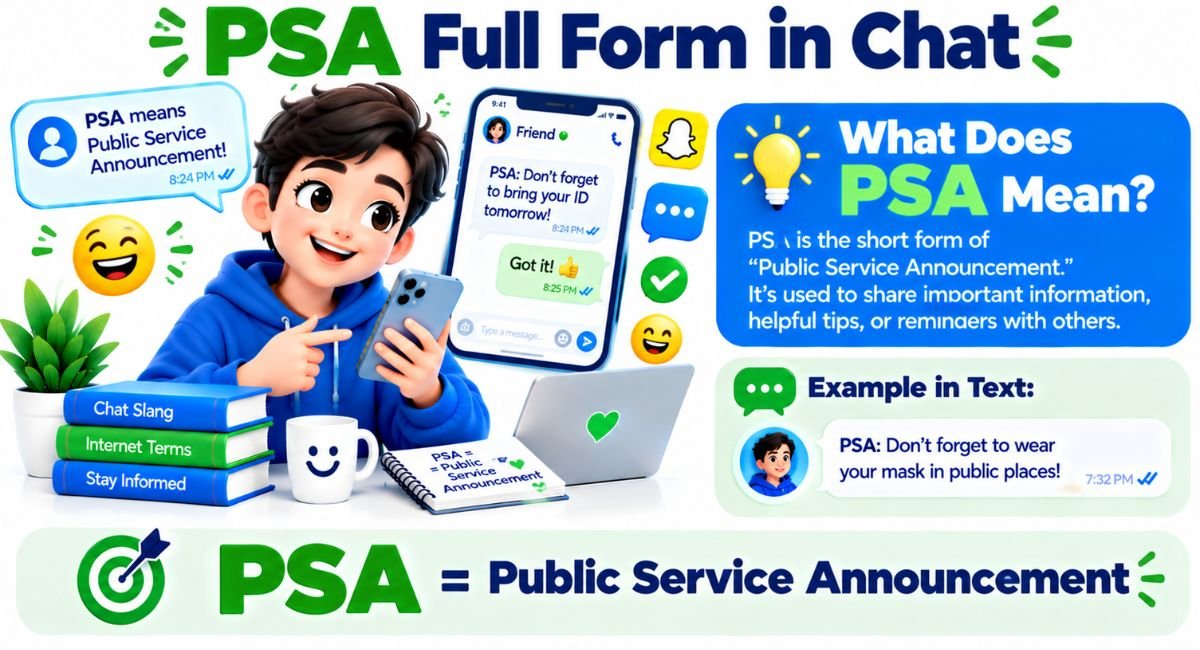
You see “PSA” in a group chat, and suddenly you wonder: is this an important warning or just another joke? The psa full form in chat can be easy to understand once you know the context.
People use PSA Full in Chat and other texting abbreviations in texts, social media posts, group conversations, and captions. It can introduce useful information, a friendly reminder, or even a sarcastic comment. This guide explains what PSA means, how people use it, and how its tone can change online.
Quick Answer: What Does PSA Mean in Chat?
The psa full form in chat is usually “Public Service Announcement.”
In texting and social media, people use PSA before information they want others to notice. It can introduce a reminder, warning, announcement, opinion, or funny observation.
Example:
“PSA: The meeting starts at 9 AM tomorrow.”
Here, PSA tells readers that the information is important enough to pay attention to.
However, online users do not always use PSA seriously. Someone might also write:
“PSA: Never go shopping when you are hungry.”
In this example, the statement is more humorous than official.
PSA Meaning in Text
The PSA meaning in text is usually “public service announcement.” It works as a short way to introduce information that deserves attention.
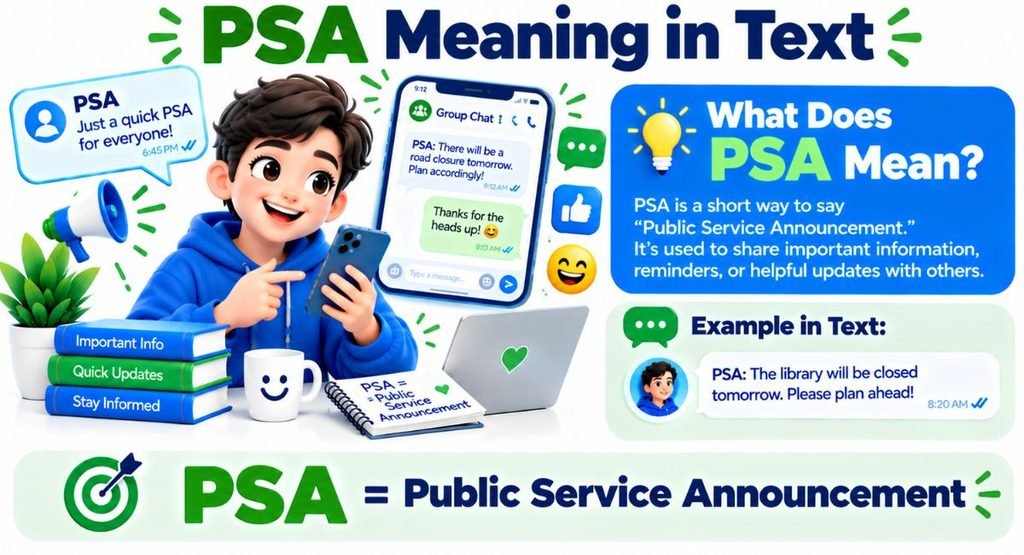
People may use PSA before:
- A reminder
- A warning
- Helpful information
- Personal advice
- An announcement
- A funny observation
- A community update
- A social media statement
For example:
“PSA: Bring your umbrella today.”
This message uses PSA as an attention-grabbing introduction.
Another example is:
“PSA: Please stop sending spoilers.”
Here, PSA introduces a direct request.
The exact tone depends on the sentence that comes after it.
PSA Meaning in Chat
In a conversation, PSA usually introduces something the sender wants everyone to notice.
For example:
“PSA: The deadline has been moved to Friday.”
The sender is sharing useful information with the group.
But PSA can also be playful:
“PSA: I need coffee before answering any questions.”
This is not a formal public announcement. It is a humorous way of making a personal statement.
That is why the psa meaning in chat depends partly on context and tone.
PSA Full Form in Chat

The psa full form in chat is Public Service Announcement.
Traditionally, a public service announcement is information shared with the public to educate, warn, or inform people about something important.
Online communication has made PSA more flexible.
Today, someone may use PSA for something as simple as:
“PSA: The restaurant closes at 10 tonight.”
They may also use it jokingly:
“PSA: Sleeping for five hours does not make me a morning person.”
The abbreviation remains the same, but its purpose changes with the conversation.
PSA Full Form on Instagram
On Instagram, PSA usually means Public Service Announcement.
People may place PSA at the beginning of captions, comments, Stories, or messages when they want followers to notice something.
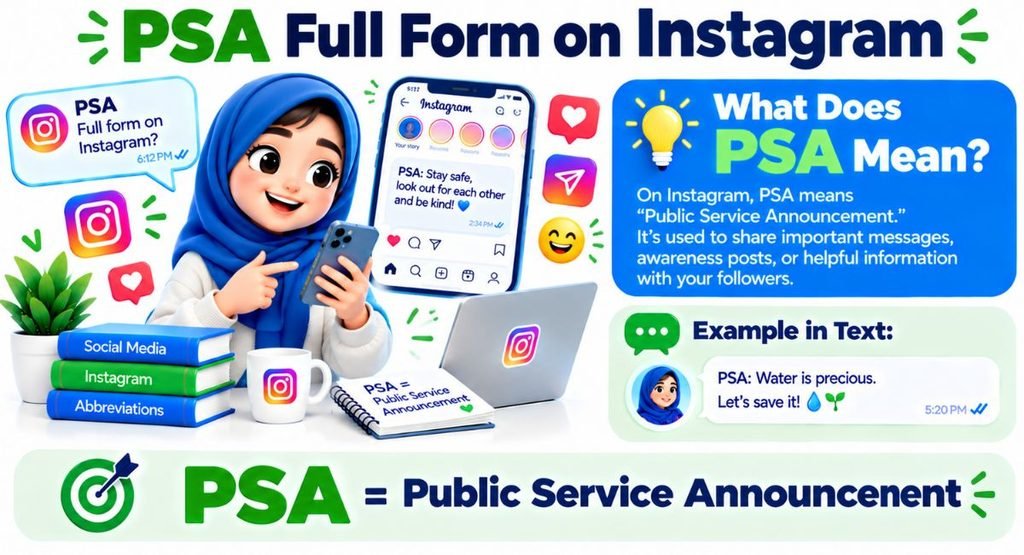
Examples include:
“PSA: Check your privacy settings.”
“PSA: This sale ends tonight.”
“PSA: Stop comparing your life to social media posts.”
Instagram users can also use PSA humorously when making relatable observations.
The platform does not change the basic meaning. The surrounding content determines whether the message feels serious, helpful, or funny.
Is PSA an Acronym?
Yes. PSA is an abbreviation formed from the initial letters of Public Service Announcement.
It is commonly written in uppercase as PSA.
Unlike some internet slang, PSA did not originate purely from texting culture. The full phrase has been used for public information and awareness messages for many years.
Online communication simply made the abbreviation more convenient and flexible.
What Does PSA Mean in Chat?
If someone sends:
“PSA: Please remember your appointment tomorrow.”
they are using PSA to introduce a reminder.
If they write:
“PSA: I have officially watched the entire season in one day.”
the same abbreviation introduces a personal or humorous statement.
So, when asking what does PSA mean in chat, the basic answer is “public service announcement.” The intended tone comes from the rest of the message.
PSA Slang Meaning
PSA is more accurately described as an abbreviation than traditional slang.
However, online users often use it in a casual way, similar to other internet slang.
Instead of making a formal announcement, someone may write:
“PSA: You can mute the group chat.”
Or:
“PSA: Nobody needs to know what I ordered for lunch.”
This casual use has made PSA common in online conversations.
It can sound serious, playful, sarcastic, or dramatic without changing its basic meaning.
Why Do People Say PSA Sarcastically in Texts?
People sometimes use PSA sarcastically because the abbreviation makes an ordinary statement sound like an official announcement.
Like other online slang, PSA can take on a different tone depending on the context.
For example:
“PSA: I am never trusting my cooking skills again.”
The sender is not making an actual public service announcement. They are exaggerating a personal experience for humor.
This style works because PSA creates a contrast between the serious-sounding introduction and the casual statement.
Common sarcastic uses include:
- Complaining about everyday problems
- Making dramatic personal announcements
- Sharing embarrassing experiences
- Giving humorous advice
- Pointing out relatable behavior
- Making ordinary news sound important
The sarcasm usually comes from the context rather than the abbreviation itself.
PSA Meaning on Snapchat
On Snapchat, PSA can still mean Public Service Announcement.
A person may use it in a Snap, Story, or chat when they want to highlight information.
For example:
“PSA: Save your pictures before clearing your phone.”
Or:
“PSA: Do not text your ex at midnight.”
The second example has a more humorous and personal tone.
Snapchat does not give PSA a separate official meaning. Users determine the tone through the content surrounding it.
PSA Meaning on TikTok
On TikTok, PSA is often used before an opinion, reminder, warning, or humorous statement.
For example:
“PSA: Stop believing everything you see online.”
A creator might also use:
“PSA: This is your sign to take a break.”
TikTok captions and videos can use PSA in both serious and playful ways.
The psa full form in chat remains the same, even when the abbreviation appears in a TikTok comment or caption.
PSA Meaning on Instagram
On Instagram, PSA can appear in captions, Stories, Reels, comments, and direct messages.
Common examples include:
“PSA: The event starts at 7 PM.”
“PSA: Please check the full caption.”
“PSA: Wear sunscreen when you’re outside.”
The meaning is usually easy to understand because PSA signals that the next statement deserves attention.
PSA Meaning on WhatsApp
WhatsApp users may use PSA in individual chats or group conversations.
For example:
“PSA: We are meeting at 6 instead of 7.”
In a family group:
“PSA: Dinner is ready.”
In a friend group:
“PSA: Nobody is allowed to spoil the movie.”
The meaning remains Public Service Announcement, but the tone depends on the relationship between the people chatting.
PSA Meaning in SMS
In SMS messages, PSA generally has the same meaning as in other forms of texting.
Someone may write:
“PSA: Your appointment is tomorrow.”
or:
“PSA: The office closes early today.”
Because SMS messages are often short, abbreviations such as PSA can make communication more concise.
However, if the recipient may not understand the abbreviation, writing “public service announcement” or simply using “Reminder” may be clearer.
Is PSA the Same on Every Platform?
The basic meaning of PSA usually stays the same across platforms.
| Platform | Common Meaning | Typical Use |
|---|---|---|
| Public Service Announcement | Captions, Stories, comments | |
| Snapchat | Public Service Announcement | Chats and Stories |
| TikTok | Public Service Announcement | Captions and comments |
| Public Service Announcement | Group messages | |
| SMS | Public Service Announcement | Short reminders |
| Public Service Announcement | Posts and community updates | |
| Discord | Public Service Announcement | Group announcements |
However, the tone can change.
A workplace message may use PSA seriously, while a friend may use the same abbreviation as a joke.
Tone & Context Variations
One reason the psa full form in chat can feel confusing is that the abbreviation does not tell you the complete tone.
You need to look at the surrounding words.
Funny Tone
A funny PSA turns an ordinary statement into an exaggerated announcement.
“PSA: Eating an entire pizza alone is completely possible.”
The purpose is entertainment rather than a formal announcement.
Sarcastic Tone
Sarcastic PSA messages often exaggerate a complaint or observation.
“PSA: Apparently, answering emails is part of having a job.”
The sender is using PSA to make the statement sound more dramatic.
Romantic Tone
PSA can also appear in lighthearted romantic conversations.
“PSA: Someone has been on my mind all day.”
The abbreviation creates a playful announcement style.
Angry Tone
A person can also use PSA when expressing frustration.
“PSA: Please stop changing the group schedule without asking.”
Here, the statement is direct and serious.
Playful Tone
A playful PSA may simply share something relatable.
“PSA: Coffee counts as breakfast when you are busy.”
The tone comes from the statement rather than the abbreviation.
15 Real Chat Examples of PSA
Seeing psa full form in chat examples makes the meaning much easier to understand. The same abbreviation can sound serious, funny, helpful, or casual depending on the message around it.
| Chat Example | What PSA Means |
|---|---|
| “PSA: The meeting starts at 9.” | Important reminder |
| “PSA: Bring your charger tomorrow.” | Helpful announcement |
| “PSA: I finally finished my homework.” | Funny personal update |
| “PSA: Stop sending spoilers!” | Strong reminder |
| “PSA: The store closes early today.” | Useful information |
| “PSA: Nobody wants to hear your alarm again.” | Playful complaint |
| “PSA: Drink some water today.” | Friendly reminder |
| “PSA: We are ordering pizza.” | Casual announcement |
| “PSA: Your favorite show is back.” | Exciting information |
| “PSA: I forgot my own password again.” | Humorous update |
| “PSA: The group project is due Friday.” | Important notice |
| “PSA: Please check the group chat.” | Attention-getting message |
| “PSA: I am officially done procrastinating.” | Humorous update |
| “PSA: The game starts in ten minutes.” | Quick announcement |
| “PSA: Please do not text me before coffee.” | Funny personal rule |
These examples show why the psa meaning in chat depends heavily on context.
Grammar & Language Role of PSA
Understanding the grammar behind psa full form in chat can help you use the abbreviation naturally.
PSA usually introduces information rather than acting as the main action in a sentence.
Part of Speech
PSA is normally used as an abbreviation or noun-like label at the beginning of a message.
For example:
“PSA: The deadline has changed.”
Here, PSA introduces the announcement that follows.
Sentence Role
In casual writing, PSA works like a short attention marker.
It tells the reader:
- Pay attention to this information.
- This message may be useful.
- I want several people to notice this.
- The following statement is an announcement.
- This could be a reminder or warning.
Because of this function, PSA can appear before a complete sentence, phrase, reminder, or joke.
Does It Replace a Full Sentence?
Not usually.
PSA does not replace the actual information being communicated. Instead, it introduces that information.
For example:
With PSA:
“PSA: The library closes at 6 PM.”
Without PSA:
“The library closes at 6 PM.”
Both communicate the same basic fact. PSA simply gives the message an announcement-style tone.
Formal vs Informal Usage
PSA can appear in both formal and informal communication, but the surrounding wording matters.
In a workplace message:
“PSA: Please submit your forms before Friday.”
In a friend group:
“PSA: I am never trusting my cooking skills again.”
The psa full form in chat remains the same, while the tone changes according to the situation.
How to Reply When Someone Says “PSA”
Your response should depend on what follows the abbreviation.
If the message contains important information, a direct response usually works best.
Funny Replies
When the PSA is clearly humorous, you can answer casually:
- “Message received 😂”
- “Public service accepted.”
- “Noted!”
- “This announcement was necessary.”
- “Thank you for this important information.”
- “We needed this PSA.”
- “Breaking news!”
Serious Replies
If someone shares important information, keep your response simple:
- “Thanks for letting us know.”
- “Got it.”
- “Good to know.”
- “Thanks for the reminder.”
- “I’ll keep that in mind.”
- “Understood.”
Flirty Replies
If the conversation is already playful, you can use a light response:
- “PSA received, but I need more details.”
- “That sounds like an announcement I should remember.”
- “Okay, you definitely got my attention.”
- “Message received loud and clear.”
Neutral Replies
For ordinary conversations, these are safe choices:
- “Okay, thanks.”
- “Noted.”
- “Got it.”
- “Thanks for sharing.”
- “I understand.”
The best response depends on the message rather than the abbreviation itself.
Is PSA Rude or Bad?
PSA is not inherently rude or offensive. It is simply an abbreviation used to introduce information, reminders, or announcements.
However, the tone can change depending on the wording.
Is PSA Rude?
Usually, no.
A message such as:
“PSA: Please remember your appointment tomorrow.”
is simply informative.
But:
“PSA: Some people really need to learn how to read.”
may sound sarcastic or insulting because of the statement that follows.
Is It Disrespectful?
The abbreviation itself is not disrespectful.
The surrounding message determines whether someone may interpret it as criticism, sarcasm, or a complaint.
Is It a Bad Word?
No. PSA is not a profanity or inherently offensive slang term.
It is commonly used as an abbreviation for public service announcement.
Can You Use PSA in School?
Yes, but context matters.
A student might use it casually in a group chat:
“PSA: The assignment is due tomorrow.”
For a formal school assignment, writing public service announcement may be clearer than using the abbreviation.
Can You Use PSA at Work?
Yes, although professional communication may benefit from more direct wording.
For example:
“Reminder: Please submit the report by 3 PM.”
can sound more professional than:
“PSA: Send your report by 3 PM.”
PSA is not automatically inappropriate at work, but the audience and communication style should guide your choice.
Who Uses This Term?
PSA is widely understandable in English-language online communication.
Like many chat abbreviations, PSA is most useful when the reader understands the context.
People may use it in:
- Group chats
- Social media captions
- Community posts
- Forums
- Text messages
- Workplace chats
- Online communities
- Casual conversations
Usage can vary between communities. Someone unfamiliar with internet abbreviations may not immediately understand it.
Regions
PSA is especially familiar in English-language online environments, including the United States and other regions where English internet abbreviations are common.
Most Common Platforms
You may encounter PSA on:
- TikTok
- Snapchat
- X
- Discord
- Group chats
- Text messages
The exact psa meaning in chat does not usually change between these platforms.
Origin & Internet Culture
PSA comes from the phrase public service announcement.
Traditionally, public service announcements are messages intended to educate, inform, or warn the public about an issue or useful information.
Online communication shortened the phrase to PSA because abbreviations are faster to type.
Over time, people began using PSA more playfully.
For example:
“PSA: Never trust yourself when you say ‘I’ll only watch one episode.’”
This is not a traditional public announcement. Instead, PSA creates a humorous announcement format.
That evolution explains why psa full form in chat can feel different from the traditional meaning.
When Should You Avoid Using PSA?
PSA is easy to understand in many casual situations, but it is not always the clearest option.
Consider avoiding it when:
- The audience may not know the abbreviation.
- You are writing a formal academic document.
- The message involves sensitive information.
- A direct statement would be clearer.
- You are communicating with customers.
- The announcement needs a highly professional tone.
- The meaning could be misunderstood without context.
For example, a customer service email might be clearer with:
“Important update: Our opening hours have changed.”
instead of:
“PSA: Our opening hours have changed.”
The first version immediately tells the reader what kind of information they are receiving.
Beyond Texting: Other Meanings of PSA
The most common everyday meaning of PSA is public service announcement.
However, PSA can represent different terms in specialized contexts.
One example is prostate-specific antigen, a medical term associated with a blood test.
Other industries may also use PSA as an abbreviation for organization names, technical terms, or professional concepts.
This is why context matters.
If someone says:
“The PSA campaign starts tomorrow.”
they are probably discussing a public service announcement.
If a medical professional discusses a PSA test, the meaning is different.
Therefore, never assume an abbreviation has only one meaning without checking the surrounding information.
PSA vs Similar Texting Terms
Several expressions can perform a similar function in online communication.
| Term | Common Function | Typical Tone |
|---|---|---|
| PSA | Introduces an announcement | Informative or playful |
| FYI | Shares information | Neutral |
| BTW | Adds an extra point | Casual |
| IMO | Gives an opinion | Casual |
| ICYMI | Highlights something missed | Informal |
| Reminder | Calls attention to something | Direct |
| Heads up | Warns or alerts someone | Casual |
| Announcement | Introduces important information | More formal |
PSA is especially useful when the writer wants the message to feel like a small public announcement.
For example:
“FYI, the meeting moved to Friday.”
sounds different from:
“PSA: The meeting moved to Friday.”
The information is similar, but PSA adds an announcement-style framing.
Real-World Usage Insight
A useful way to understand psa full form in chat is to look at the intention behind the message.
Ask three simple questions:
- Is the person sharing information?
- Are they trying to get attention?
- Is the message serious, playful, or sarcastic?
If the answer to the first two questions is yes, PSA may simply be introducing an announcement.
If the statement is exaggerated or humorous, PSA may be functioning as an internet-style joke.
For example:
“PSA: Never go grocery shopping when you are hungry.”
This is presented like an announcement, but it is also a relatable joke.
What Does PSA Really Mean in a Text Message?
In a text message, PSA usually means public service announcement.
People use it to introduce information, reminders, warnings, opinions, or humorous observations.
The meaning becomes clearer when you read the words after PSA.
For example:
“PSA: Bring an umbrella today.”
Here, PSA introduces a practical reminder.
In another message:
“PSA: I need coffee before anyone talks to me.”
The abbreviation introduces a playful personal statement.
So, the psa full form in chat stays consistent, while the intended tone can change.
Why Does PSA Appear So Often in Online Messages?
PSA is short, recognizable, and easy to place at the beginning of a message.
It immediately signals that the writer wants attention on the information that follows.
People may use it when sharing:
- Reminders
- Warnings
- Advice
- News
- Personal opinions
- Community updates
- Funny observations
- Social media announcements
Its flexibility makes it useful beyond traditional public announcements.
Can PSA Have Different Meanings Online?
Yes. PSA can represent different phrases depending on the subject.
In everyday texting and social media, it commonly means public service announcement.
In specialized contexts, PSA may refer to something completely different.
For this reason, the surrounding conversation is important. A medical discussion, workplace document, social media caption, and group chat can all use PSA differently.
When Is PSA Most Commonly Used?
PSA is especially common when someone wants to make a statement noticeable.
Common situations include:
- Group reminders
- Social media captions
- Community announcements
- Friendly warnings
- Funny observations
- Event updates
- Public information
- Personal declarations
It can appear at the beginning of a sentence or as a standalone label.
How Do You Reply When Someone Sends PSA?
Read the message after PSA before choosing your response.
If it is serious, try:
“Thanks for the update.”
If it is a reminder:
“Got it, thanks!”
If it is clearly a joke:
“😂 Message received.”
If you are unsure about the meaning, simply ask:
“What do you mean by PSA here?”
This is often better than guessing.
Is PSA the Same as “FYI”?
Not exactly.
Both can introduce information, but they have slightly different tones.
FYI means for your information and is often used to pass along information without making a strong announcement.
PSA means public service announcement and can make the following statement feel more noticeable or announcement-like.
Compare:
“FYI, the office closes at 5.”
with:
“PSA: The office closes at 5.”
Both are understandable, but the second has a stronger announcement feel.
FAQs About PSA Full Form in Chat
What is the PSA full form in chat?
The psa full form in chat is usually “public service announcement.” It introduces information, reminders, warnings, or playful announcements.
What does PSA mean in texting?
PSA usually means public service announcement in texting. The writer may use it before a useful reminder or casual statement.
What does PSA mean on social media?
On social media, PSA often introduces information the writer wants followers to notice. It can be serious, informative, humorous, or sarcastic.
Is PSA slang?
PSA is better described as an abbreviation than traditional slang. Online users often use it casually and creatively.
Is PSA rude?
PSA itself is not rude. The wording that follows it can make the overall message sound friendly, serious, sarcastic, or critical.
Can PSA have another meaning?
Yes. PSA can have specialized meanings in fields such as medicine and other professional areas. Context determines the intended meaning.
How should I respond to PSA?
Read the complete message first, then match the tone. A simple “Got it,” “Thanks,” or a playful reply may work depending on the situation.
Conclusion
Understanding psa full form in chat is easier once you look at the complete message instead of the abbreviation alone. In most texting and social media conversations, PSA means public service announcement.
People use it to introduce reminders, warnings, useful information, personal updates, and jokes. Its tone can range from serious to playful depending on the words that follow.
The psa meaning in chat can also change in specialized situations, so context always matters. If you see PSA in a message and are unsure what it means, read the surrounding conversation before responding.
Once you recognize the pattern, PSA becomes a simple and useful abbreviation to understand in everyday online communication.

LearnerGrammar.com helps English learners improve grammar, vocabulary, writing, and communication skills with simple lessons and tips.