You’re in a group chat, and someone drops “TBF, he did warn us.” Everyone reacts with a thumbs-up. You? You’re staring at the screen. Is that a joke, a shrug, or a polite disagreement? Plenty of us have typed what does TBF mean in texting into Google just to feel less lost.
Good news: it’s simpler than it looks. This guide explains the TBF mean idea in plain words, with the tone, real chat examples and easy replies. You’ll also learn how it works on Snapchat and when to skip it. Keep reading, and the next TBF text will feel easy.
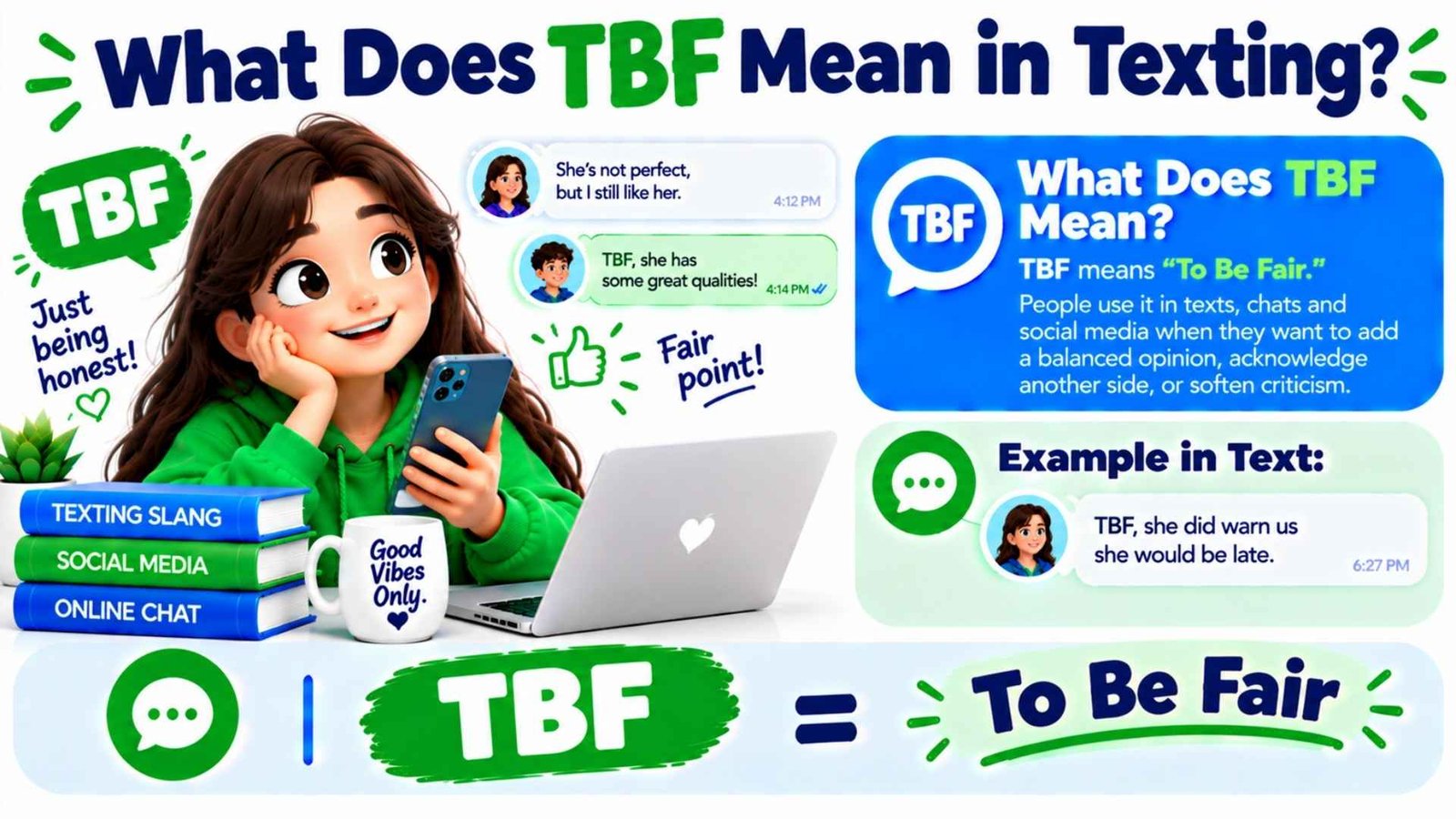
Quick Answer: TBF means “to be fair.” People type it to add balance, context or a gentler view before making a point. So, what does TBF mean in texting? It’s a casual shortcut for “let me be fair about this,” and it’s usually calm, honest and friendly.
Meaning Summary Box
- Meaning: To be fair
- Tone: Calm, balanced, sometimes a little defensive
- Where it’s used: Texts, DMs, snaps, comments and group chats
- Positive or negative: Mostly neutral to positive
What Does TBF Mean in Text Messages?
Ever read a text that starts with TBF and wondered if the sender was agreeing or arguing? The TBF meaning is much simpler, and usually kinder, than most people expect.
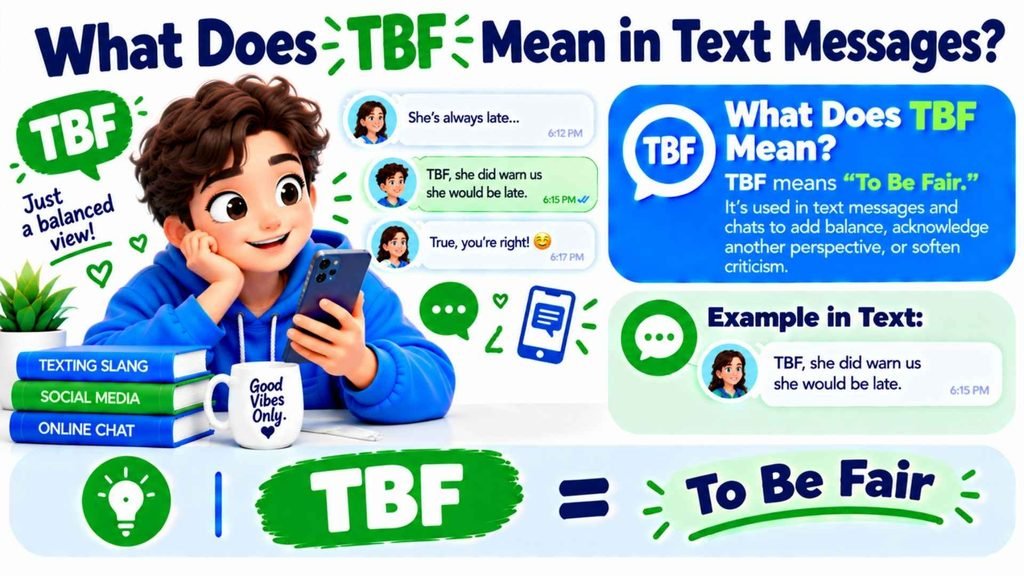
TBF stands for “to be fair.” People use it in texts, DMs and comments to add balance or context to an opinion. Think of it as a tiny pause before a fair point. It shows up on iMessage, WhatsApp, Instagram, Snapchat and TikTok. So when someone asks what does TBF mean in texting, the short answer is this: they’re adding the other side of the story.
- Balance: adds the other side before or after a strong opinion
- Context: explains why something happened without making excuses
- Softening: makes a blunt point sound gentler
- Defense: speaks up for someone who isn’t in the chat
- Self-explaining: gives a reason for your own behavior
Example in chat: Friend 1: “Ugh, Jay never answered my text.” Friend 2: “TBF, his phone died at the gym.”
Key Takeaway: TBF is a quick, friendly way to say, “Here’s a fair point you might be missing.”
what’s tbf mean in text
In a hurry and just want the answer? No problem. Here’s the TBF mean question boiled down to its simplest form, with no long setup and no confusing extra slang.
Meaning Summary Box
- Full form: To be fair
- Use: Adds balance, context or a softer view
- Tone: Calm and casual
- Quick example: “TBF, the traffic was awful.”
what does tbf mean on snapchat
Snapchat moves fast, and so do the replies. Between streaks, snaps and story replies, a short phrase like TBF fits right in, and it means just what you’d hope for.
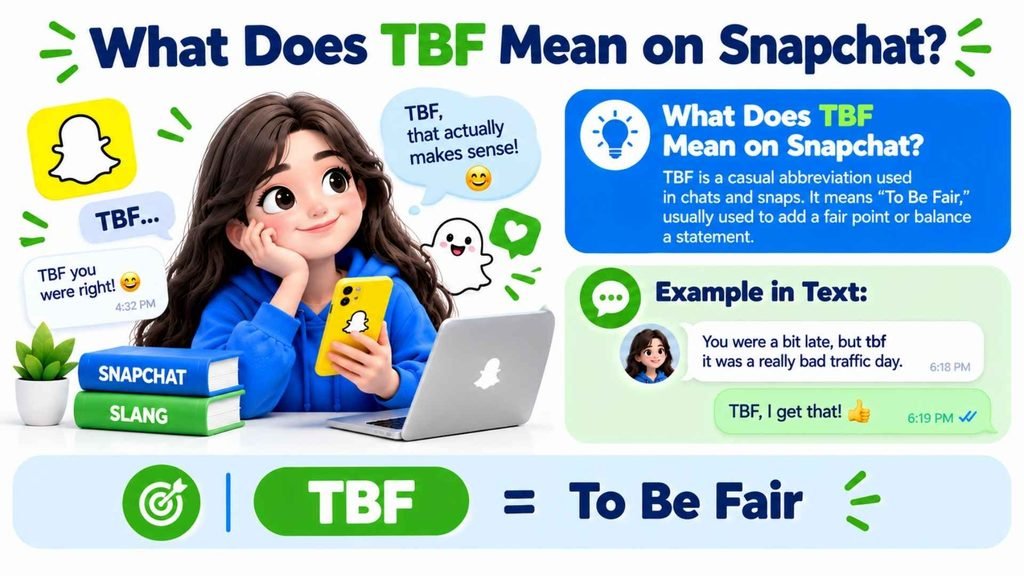
On Snapchat, TBF means “to be fair,” the same as everywhere else. There’s no secret Snapchat-only meaning. You’ll see it in private chats, group chats and story replies when someone wants to add balance or explain a reaction. It’s the same answer as what does TBF mean in texting anywhere else. If a friend sends it, read it as a friendly “hold on, let’s be fair here.”
Example in chat: Friend 1: “Mia left me on read again.” Friend 2: “TBF, she’s at work till midnight.”
TBF meaning
Typos happen, especially when you’re searching on your phone with one thumb. If you landed here after typing “TBF meanin,” you’re in the right place, and the answer is quick.
Meaning Summary Box
- TBF meanin = TBF meaning: To be fair
- Used for: Adding balance, context or fairness
- Tone: Friendly, honest, mostly neutral
- Safe to use with: Friends, family and online chats
TBF mean
Sometimes people search just two words and hope for a clear answer. Fair enough. This is the plain version of the TBF mean question, ready to quote on its own.
TBF means “to be fair.” It’s an informal text abbreviation that signals a balanced, honest or considerate point. People use it to explain someone’s actions, soften criticism, or give their own reasons. It almost never signals anger. That’s the quick answer to what does TBF mean in texting.
what does tbf mean in texting
You’d think a three-letter abbreviation would be easy. Yet it trips people up all the time, because the same letters can sound kind in one chat and defensive in another.
The direct answer to what does TBF mean in texting is “to be fair.” The phrase adds balance to an opinion, gives context for a choice, or shows that the writer is thinking about both sides. Below is a plain-English definition you can quote, followed by how it plays out in real conversations.
Simple Definition
TBF (to be fair) is a text abbreviation people use to give a fair judgment, explain context, or show they’re considering both sides. For example, “TBF, he’s new here” means “give him a break, he’s still learning.” It signals honesty, fairness and calm thinking, not an argument.
Key Takeaway: If you remember one thing, remember this: TBF means “to be fair,” and it almost always adds balance.
Why Is TBF So Popular in Texting and Social Media?
Text has no tone of voice, and that’s a real problem. A blunt message can land like a slap. TBF is one of the easiest little fixes people have found.
TBF is popular because chats are fast, casual and easy to misread. A short phrase that adds fairness keeps the mood calm. It also saves typing, since “to be fair” takes three taps instead of nine. That’s why what does TBF mean in texting is such a common search.
- Speed: three letters instead of three words
- Peace: it lowers the chance of a fight
- Nuance: it lets you hold two ideas at once
- Sound: it makes you seem fair-minded
Key Takeaway: TBF is popular because it adds kindness and nuance in very few characters.
Where Does TBF Come From? Origin and Background
Slang often feels like it appeared overnight, but most of it has roots. TBF is a good example, because it grew out of a phrase people have said for ages.
“To be fair” is a normal spoken English phrase, and TBF is simply its short form for typing. It grew in chat rooms, forums and texting, where short forms save time. It’s long been common in British English, and it’s now used in the USA too. No single person invented it, so there’s no exact date to point to. The answer to what does TBF mean in texting has roots in everyday speech.
How TBF Is Commonly Used in Text Messages
Most of us don’t plan to use TBF. It just slips out when something feels a little unfair. Let’s look at the four most common reasons people type it daily.
People use TBF in four main ways: to add balance, to soften a critique, to bring up another view, or to explain their own choice. Each one answers what does TBF mean in texting in a slightly different way, so read the whole message.
1. To Add Balance to an Opinion
People often use TBF when they’re about to say something critical but want to sound fair. For example, “TBF, he didn’t know the meeting was moved.” Here, the writer defends someone by adding a missing fact, which keeps the group chat from piling on.
2. To Soften Criticism
Instead of sounding rude, TBF helps wrap a negative opinion in kindness. Take this one: “TBF, the movie wasn’t bad, it just wasn’t what I expected.” You’re honest about your feelings, but you’re not trashing something your friend may have loved.
3. To Introduce a Contrasting View
TBF is a handy way to bring in a different angle without starting a debate. For example, “I get why you’re upset, but TBF, she did apologize.” It tells the reader you’ve heard their side and now you’re adding one more piece.
4. To Justify an Action or Reaction
Sometimes you’re the one who needs a little grace. “TBF, I was exhausted after work, so I didn’t reply” explains your own behavior without sounding like a big excuse. It’s honest, short, and usually well received.
Tone and Emotional Context of TBF
The same three letters can feel warm or a bit tense. What changes is the mood around them. Pay attention to the person, the topic and the punctuation they use.
TBF is most often calm and sincere, but its tone shifts with the situation. A friendly “TBF, that was funny” feels light. A sharp “TBF, you started it” feels defensive. Knowing what does TBF mean in texting is step one; tone is step two. Read the whole message and what came before it.
Common Tones Associated With TBF
Most TBF texts land in a handful of moods. You’ll see these often:
- Neutral: simply adding a fact
- Honest: being real without being harsh
- Calm: keeping things peaceful
- Understanding: showing empathy for the other side
- Slightly defensive: protecting yourself or someone else
Not Usually Used For
TBF isn’t built for heavy moments. People rarely use it for aggressive arguments, formal writing, or professional emails (unless your workplace is very casual). In those spaces, “in fairness” or a full sentence sounds clearer and safer.
Examples of TBF in Real-Life Text Conversations
Seeing real texts makes slang click faster than any definition. Here are four real examples to answer “what does TBF mean in texting,” so you can match the pattern later.
| Setting | Text | What It Means |
|---|---|---|
| Friend chat | “TBF, you did say you might be late.” | You warned us, so it’s not shocking. |
| Relationship text | “TBF, I thought you needed space.” | I had a reason for my choice. |
| Work chat | “TBF, the deadline wasn’t very clear.” | The unclear deadline caused the problem. |
| Social comment | “TBF, not everyone can afford that.” | There’s another side to think about. |
These samples show the same pattern each time. The writer adds context, and the reader gets a fuller picture.
Key Takeaway: In every example, TBF adds a missing fact or a kinder angle.
TBF Meaning in Relationships and Group Chats
Texting someone you care about adds pressure. One short word can feel really huge. That’s why TBF shows up so often between partners, friends and family when feelings are involved.
In a relationship, TBF usually softens a point so it doesn’t sound like blame. In a group chat, it often defends someone or cools down a heated topic. It doesn’t mean something different from a guy or a girl. The meaning stays “to be fair.” In couples’ chats, what does TBF mean in texting? Usually, “I’m trying to be fair to you.”
Example in texting: Friend 1: “You forgot our plans again.” Friend 2: “TBF, I did text you Tuesday. But I’m sorry!”
Is TBF Formal or Informal?
Imagine sending TBF to your boss. Suddenly, it feels a little off, right? That gut feeling is correct, because this abbreviation belongs to relaxed, everyday chats with friends you know.
TBF is informal. It fits text messages, social media posts, online forums and casual chats. It doesn’t fit academic writing, legal documents or professional emails, unless your workplace is very relaxed. When you need a formal tone, write out “to be fair” or use “in fairness” instead.
- Good for: texts, DMs, comments and group chats
- Avoid in: essays, contracts, cover letters and client emails
TBF vs TBH: What’s the Difference?
These two look almost identical, and people mix them up every day. One swapped letter changes the whole feel of a sentence, so it pays to know which is which.
TBF means “to be fair,” and it adds balance. TBH means “to be honest,” and it adds bluntness. TBF often defends or explains. TBH often shares a raw opinion. Once you know what does TBF mean in texting, the comparison is easy. Both are casual, but they set different moods.
| Abbreviation | Full Form | Meaning | Best Used For |
|---|---|---|---|
| TBF | To be fair | Shows balance or fairness | Explanations, context |
| TBH | To be honest | Shows blunt honesty | Personal opinions |
Example Comparison
TBH, I didn’t like the show. TBF, it wasn’t made for my age group. The first line shares a plain opinion. The second adds fairness by admitting the show had a different audience in mind. Together, they sound honest and thoughtful.
TBF vs IMO and FWIW: What’s the Difference?
Slang cousins are everywhere in texting, and they all sound a bit alike. Sorting them out takes about a minute and saves you from sending the wrong signal by mistake.
TBF adds fairness. IMO means “in my opinion” and marks a personal view. FWIW means “for what it’s worth” and offers a small, humble thought. All three soften a message, but only TBF is built to bring balance to a topic by pointing at the other side.
| Term | Full Form | Main Job |
|---|---|---|
| TBF | To be fair | Adds balance or context |
| IMO | In my opinion | Marks a personal view |
| FWIW | For what it’s worth | Offers a humble thought |
Common Misunderstandings About TBF
A tiny abbreviation can cause big confusion, especially when you can’t hear the sender’s voice. Most mix-ups come down to three wrong assumptions, and luckily they’re very easy to fix.
People tend to read TBF as an attack, as sarcasm, or as agreement. None of those is always right, and each one can start a pointless fight over nothing. Most come from not knowing what does TBF mean in texting. Knowing helps you skip a pointless argument.
1. TBF Is Not Always Defensive
It can sound defensive, but TBF is usually about context, not excuses. If a friend writes “TBF, I was busy,” they’re likely explaining, not fighting. Check the rest of the message before you assume they’re upset.
2. TBF Is Not Sarcastic by Default
Tone matters, but most TBF texts are sincere. Sarcasm usually comes with other clues, like eye-roll emojis, odd capitalization or a long pause. Without those hints, take the phrase at face value.
3. TBF Doesn’t Mean Agreement
You can use TBF and still disagree. “TBF, I see your point, but I’d still say no” is perfectly polite. The phrase shows you’ve considered the other side, not that you’ve changed your mind.
Is TBF Positive or Negative in a Text?
Here’s a question that comes up a lot: is someone being nice or being picky when they type TBF? Mostly, they’re being nice. But let’s check the details together now.
TBF is mostly positive or neutral. It signals fairness and understanding. It turns negative only when the next words are unkind. Think of “TBF, your feelings aren’t that important.” In that case, the words are rude, not the abbreviation. The phrase itself stays gentle. Asked another way, what does TBF mean in texting: kind or critical? Kind.
| Use | Tone | Example |
|---|---|---|
| Explaining | Positive | “TBF, he’s new.” |
| Softening | Positive | “TBF, it wasn’t bad.” |
| Defending | Neutral | “TBF, she apologized.” |
| Dismissing | Negative | “TBF, who cares?” |
When NOT to Use TBF in Text Messages
Even a friendly abbreviation can backfire at the wrong moment. A little care keeps you from sounding cold, careless or sarcastic when you only meant to be kind and fair.
Skip TBF when you want to sound professional, when the topic is very sensitive, or when your message could feel dismissive. Someone who’s grieving or hurt doesn’t want a “fair point.” They want to be heard. Example to avoid: “TBF, your feelings aren’t that important.” That reads as rude and invalidating.
- At work: with clients, managers or formal teams
- In serious talks: health, loss, money trouble or big fights
- When someone is upset: listen first, add fairness later
Key Takeaway: Use TBF to add kindness. If it could feel like a brush-off, say it another way.
Why Do People Use TBF Online?
Scroll through any comment section, and you’ll spot TBF within seconds. It’s a tiny tool that people reach for again and again, for pretty good reasons, and they’re all simple.
People use TBF online to sound reasonable, calm debates and add nuance. Online talk can turn harsh quickly, and TBF acts like a small shield. It tells readers, “I’m not starting a fight.” Even if you know what does TBF mean in texting, the habit makes sense once you see the crowd.
Alternatives to TBF in Text Messages
Using the same abbreviation fifty times gets stale. Luckily, you have plenty of other ways to say the same thing, and some even sound a little softer and warmer too.
If you want variety or a different tone, you can swap TBF for casual or softer phrases. Each option keeps the same fair-minded idea. Each one answers what does TBF mean in texting in new words. Pick what fits the person and the mood.
Casual Alternatives
These work great with friends and family: “honestly,” “in fairness,” “if we’re being fair,” and “realistically.” They keep the relaxed feel of TBF but add a bit of variety. For example, “In fairness, he did try” says the same thing as “TBF, he did try.”
Softer Phrases
For gentler moments, try “from another perspective,” “considering everything,” or “looking at both sides.” These sound more thoughtful and less like slang. They work well when the topic is sensitive or when you’re texting someone older who may not use abbreviations.
How to Reply to a TBF Text
Got a TBF text and not sure what to say back? You’re not alone, and the fix is easy. A good reply keeps the chat friendly and moves things forward.
Start by deciding if the TBF was sincere or defensive. Then reply to the point, not the abbreviation. Once you know what does TBF mean in texting, replying is easy. Acknowledge what they said, and share your view calmly. A simple “Good point” or “Fair enough” usually works. If you still disagree, say so kindly.
- If you agree: “Fair point, I hadn’t thought of that.”
- If you’re unsure: “Good call. Tell me more?”
- If you disagree: “I hear you, but I still see it differently.”
Example in chat: Friend 1: “TBF, she didn’t know it was your birthday.” Friend 2: “Fair enough. I should’ve told her.”
TBF in Social Media and Online Culture
Social media loves quick takes, and TBF is a quick way to make a take sound smarter. You’ll find it in tweets, replies, captions and comment threads every single day.
On X (Twitter), TikTok, Reddit and Instagram, TBF often adds nuance to a hot take. People use it to sound reasonable in debates and to avoid backlash for a one-sided opinion. It’s also a handy way to agree with part of a post while pointing out what’s missing.
Example tweet: “TBF, the app update isn’t terrible. It just needs time.”
Does TBF Mean Something Different on Instagram and TikTok?
You might wonder if TBF changes from app to app. Short answer: not really. But each platform has its own flavor, and that can change how the whole phrase feels.
TBF means “to be fair” on every platform. The difference is the style. Instagram DMs feel personal, TikTok comments feel quick and playful, and X replies feel debate-heavy. The answer to what does TBF mean in texting stays the same, while the tone adjusts to the crowd.
| Platform | Typical Feel | Example |
|---|---|---|
| iMessage / WhatsApp | Personal and friendly | “TBF, you did say 8.” |
| Casual, caption or DM | “TBF, the lighting was bad.” | |
| TikTok | Quick, playful comment | “TBF, that was funny.” |
| X (Twitter) | Opinion-focused | “TBF, both sides have a point.” |
Why Understanding TBF Matters
Small abbreviations carry big feelings. Misreading one can turn a friendly chat tense, so knowing what does TBF mean in texting makes you a much calmer, kinder, quicker reader online.
Knowing the meaning of TBF helps you read messages correctly, avoid misunderstandings and sound natural online. It also helps you write kinder texts. In digital talk, one short phrase can change the whole mood of a message, so a little know-how goes a long way.
Summary: TBF means “to be fair.” It’s an informal text abbreviation that adds balance, context or kindness to an opinion. It’s mostly positive or neutral, works on every platform, and fits chats better than formal writing. To answer what does TBF mean in texting in one line: it’s a friendly nudge to see the fair side.
Frequently Asked Questions
Every question below comes from what people really ask about TBF. Short answers, friendly tone, and no fluff, so you can find what you need in just a few seconds.
What Does TBF Mean in Texting?
TBF means “to be fair.” It adds balance, honesty or context to a conversation. So if you’re asking what does TBF mean in texting, think of it as a polite way to share the other side.
Is TBF Rude or Polite?
TBF is generally polite and neutral. Tone and context still matter, though. The phrase itself is gentle, but the words that follow it can still sound rude.
Can TBF Be Used Sarcastically?
Yes, but it’s not common. Sarcasm depends on tone, emojis and the situation, so what does TBF mean in texting stays the same: fairness. Most people who text TBF are sincere, and it’s a safe bet to read it that way.
Is TBF the Same as TBH?
No. TBF means “to be fair,” while TBH means “to be honest.” One adds balance, and the other adds bluntness. Now that you know what does TBF mean in texting, the difference is easy to spot.
Can I Use TBF in Professional Messages?
It’s best to avoid it in formal settings. If your workplace is relaxed, a quick TBF in a team chat is fine. For clients and managers, write out “to be fair.” That’s what does TBF mean in texting, spelled out.
Do Older People Use TBF?
Yes. It’s more popular with younger users, but people of all ages use it online. Plenty of parents and grandparents know what does TBF mean in texting and use it freely.
What’s a Longer Version of TBF?
The full version is “to be fair.” You can also say “in fairness” or “considering everything.” They all carry the same balanced meaning that TBF does in a text, which is what does TBF mean in texting in a longer form.
Conclusion
So, what does TBF mean in texting? It means “to be fair,” and it’s one of the kindest little shortcuts in your phone’s vocabulary. You’ve seen how it adds balance, softens criticism, and explains tricky moments without starting drama.
Now you can spot the tone, pick the right reply, and avoid the few places where TBF doesn’t belong. The TBF mean question isn’t confusing anymore. Next time what does TBF mean in texting pops into your head, you’ll know it’s a friendly flag for fairness. And if a friend asks what does TBF mean in texting, you can explain it. Try using it once today, in a text where a little extra understanding would help.

LearnerGrammar.com helps English learners improve grammar, vocabulary, writing, and communication skills with simple lessons and tips.